In short
MOSS-Image is a 5B text-to-image model under Apache-2.0 that reads layout boxes and renders text well, and ComfyUI has had core support since October 16. The cost is 13 to 15.5 GB of downloads for the quantized stack and about 52 seconds an image on a 12 GB card in the one direct test. It takes no reference images, so a recurring face needs a character LoRA, ideally on the Kromoss fine-tune with its 8-step LoRAs.
If your character posts the same face every day, MOSS-Image does not solve that problem, and it is easy to miss why. It is a 5B text-to-image model with Apache-2.0 weights that reads layout boxes and renders text well, and yesterday's creator briefing could only give it a paragraph. The fact that matters for a recurring face is that the released model takes no reference image, so identity has to come from a LoRA you train yourself. A stale line on its model card also still says ComfyUI support is "in progress", when core support was merged on October 16.
This review covers what the model is, the files and sizes you need, what the first testers measured, how the Kromoss fine-tune and the 8-step LoRAs change speed, and who should spend a weekend on it. We did not run the model ourselves; every number below is attributed to the page or person that measured it, and the places where nobody has measured anything are marked.
What MOSS-Image is
OpenMOSS introduced MOSS-Image on October 16 with two checkpoints: Base, meant for fine-tuning, and SFT, tuned further on curated data. The model card lists 5B parameters, a Flow-matching Euler sampler, and the Apache License 2.0 for the weights and bundled inference code. The project page adds that the pipeline code and third-party components keep their own licenses. Prompts can be natural language, tag sequences or a JSON layout, and the card lists English and Chinese.
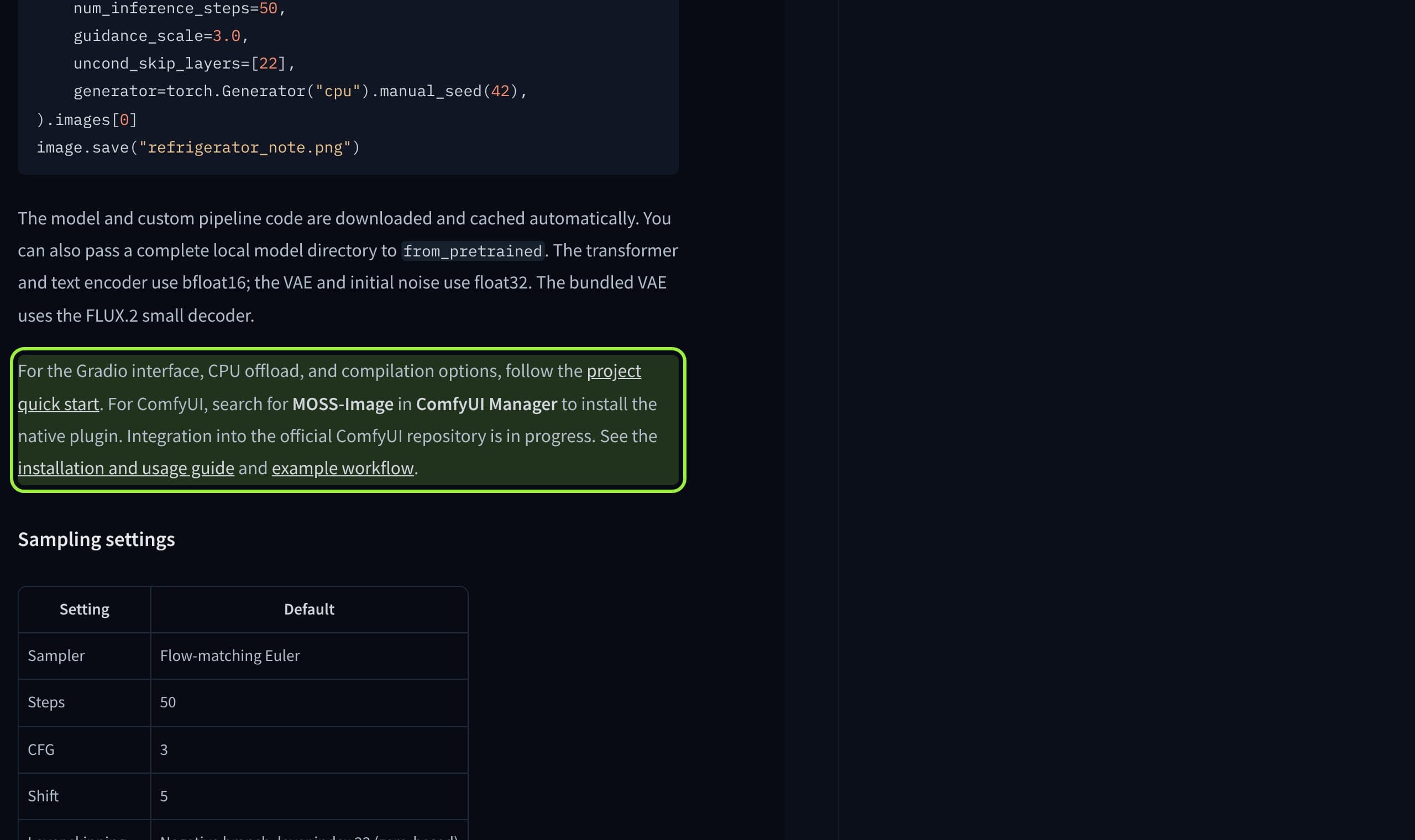
The ComfyUI pull request describes the network as a 5B single-stream DiT in the FLUX.2 latent space, written by kijai and merged into ComfyUI's master branch on October 16. The text encoder is a stock Qwen3.5-9B, which matters because it is the largest file in the stack, a pattern our download size study measured across models.
MOSS-Image cheat sheet
- Parameters
- 5B diffusion transformer (model card)
- Checkpoints
- Base for fine-tuning, SFT for generation
- License
- Apache-2.0 for the weights and bundled inference code; pipeline code and third-party parts keep their own
- Text encoder
- Qwen3.5-9B, English and Chinese listed
- VAE
- FLUX.2 VAE (the card names the small decoder)
- Vendor settings
- Euler, 50 steps, CFG 3, shift 5, skip layer 22 on the negative branch, 1024 by 1024, sizes in multiples of 16
- Reference images
- Not supported in the release; image conditioning and editing are listed as future work in the technical report, as relayed by a reviewer
- ComfyUI
- Core support merged October 16 (PR 17095); a Manager plugin also exists
What you download, and what it costs in disk
The ComfyUI-ready files live in the Comfy-Org repack, which is an Apache-2.0 repack of the OpenMOSS weights. Sizes below come from the ComfyUI Wiki write-up, which lists them per file. Adding the smallest options gives a 13 GB stack (5.4 GB INT8 diffusion model, 7.3 GB W4A8 text encoder, 0.34 GB VAE), the INT8 text encoder gives 15.5 GB, and a reviewer who read the repository listing on October 20 put the all-BF16 stack at about 29.7 GB. Those are download sizes, not VRAM.
Source: ComfyUI Wiki, MOSS-Image
The text encoder is bigger than the image model in every precision. If you are short on disk, the encoder is the file to quantize first, and the Comfy-Org repack already ships two quantized versions.
The layout node converts boxes from Create Bounding Boxes into the model's JSON. The wiki page does not name separate loader nodes, so check your template.
Speed and VRAM: what was measured
Almost nothing about hardware comes from the vendor. The model card gives no VRAM figure. The best direct measurement is a Japanese hands-on article on an RTX 4070 with 12 GB, ComfyUI master and the INT8 weights: about 52 seconds for one 832 by 1216 image at 50 steps, with peak use near 11,600 MiB, which the author notes includes other apps. The author calls that slow.
A second, weaker number is relayed by the AirMore launch review: one RTX 3060 12 GB user reported about 9.7 GB peak and 137 seconds at one megapixel and 50 steps on an earlier third-party INT8 quant. The reviewer says the quant's creator later recommended different files, so treat it as a ballpark, not a benchmark.
Faces, anime and what the testers found
The same Japanese tester ran identical prompts in anime and photorealistic styles with matched seeds. Photorealistic output was "decent" but not clearly better than Qwen-Image 2.1 or Flux, and anime was called unusable next to Anima or Krea 2. A look-back pose requested in a prompt came out forward-facing in both styles. That is one person, one afternoon, and a handful of prompts.
The same author later trained a character LoRA and called the results amazing, and noted Japanese text and manga-style layouts work. That is the useful signal for a recurring face: the base model is average at identity, and a LoRA changes the answer. Our distilled versus base explainer covers training on Base and generating with a faster variant, which is exactly the choice OpenMOSS and the community now offer.
What creators are saying
One user found the official workflow produced poor output and changing the shift value did not help.
Desaturated images with odd curl artifacts traced to the --use-sage-attention launch flag; removing the flag fixed it.
Photorealistic results were decent but not clearly better than Qwen-Image 2.1 or Flux, while anime looked unusable; after training a character LoRA the same author called the results amazing.
Praisenote.com hands-on test
Someone asked whether skip layer guidance should cover 0.0 to 1.0 or 0.0 to 0.5. The thread has no answer yet.
Kromoss and the 8-step LoRAs
A notable derivative on this week's Hugging Face trending list is Kromoss by lodestones, a full fine-tune of MOSS-Image-Base at 1024 px. The card says every transformer parameter was trained, images under 896 pixels were dropped, and the published weights are the EMA checkpoint from update 11,000, trained on 704k images. It keeps the same text encoder and VAE, so it drops into the same graph under Apache-2.0.
The repo also ships two 8-step turbo LoRAs distilled from the base model. With either one the card gives 8 steps, CFG 1 and no negative branch, and says 4 steps also works. Fewer steps and no negative branch should cut the 52 seconds above substantially, but nobody we found has published that timing and we have not measured it. The card also warns not to merge the LoRAs into the bf16 weights because the change is close to bf16's rounding step. The card's only benchmark is a CLIP score on 100 prompts, which measures prompt alignment, not identity.
Where it fails today
- No reference images. A reviewer relays the technical report listing image conditioning and editing as future work, so you cannot hand it Mira's photos and ask for her face. Use a LoRA, or a model built for references.
- Slow at default settings. 50 steps with a negative branch is roughly 52 seconds on a 12 GB card in the one direct measurement.
- Setup traps. Sage attention, a stale ComfyUI build and the Manager plugin's workflow, which needs the Diffusers checkpoint and not the single-file weights, are the problems people have reported.
- Named characters and artists. Reviewers relay weak responses to artist names and style-sensitive anime, so prompt the look, not a name.
Verdict: who should install it
MOSS-Image is a good model to own if you need text in the picture or placed objects, such as signs, posters and product shots, or if Apache-2.0 on the weights matters to you. It is not the first model to try for a recurring face. If you already keep references and want them honored, FLUX 3 Klein and Qwen-Image 2.1 take them natively, and our Krea 2 versus Qwen-Image 2.1 comparison is the baseline to beat.
If you do want a MOSS-based character, the sensible route is Kromoss or Base as the training target, one character LoRA, and the 8-step LoRA for daily batches. Budget a weekend, and rent a card instead of buying one for the test, as the rent-a-GPU page explains. If a template complains about a missing node, our missing nodes guide applies. If the model itself will not load, the MOSS-Image error fixes match each message to a cause.
| For a recurring face | MOSS-Image | FLUX 3 Klein | Qwen-Image 2.1 |
|---|---|---|---|
| Takes reference images | No (future work) | Up to 10, per BFL | Check its model card |
| Weights license | Apache-2.0 | FLUX Kommunity License, free under $5M revenue | Qwen Research License (see our comparison) |
| Strength | Text and layout boxes | Multi-reference | Face tests in our comparison |
| Weakness | Slow at 50 steps, anime, no references | Newer, few independent tests | Research license |
Where Musetta fits
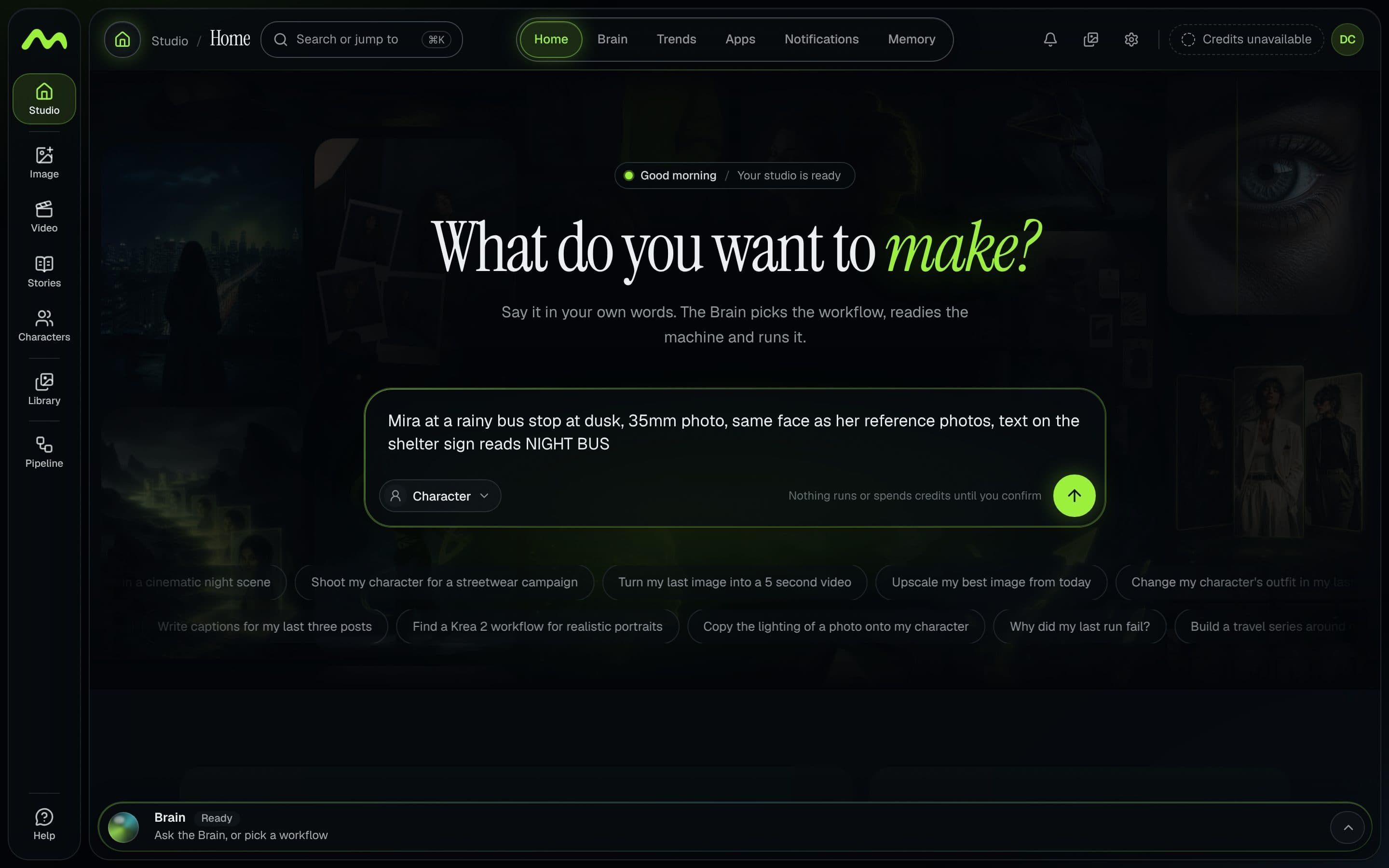
Musetta runs on your own ComfyUI and keeps each character's reference photos, so trying a new model on a character means installing what the workflow is missing, not rebuilding her. It does not change any license above, and it does not make a model take references that it does not. See how it compares with working in ComfyUI directly. For a three-way look at MOSS-Image, Krea 2 and Qwen-Image 2.1, see which license and reference support fit a recurring face. To train a character LoRA on it, see the best LoRA training tools.
Questions
- Is MOSS-Image free for commercial use?
- The weights and bundled inference code are under the Apache License 2.0 per the model card. The project page says the pipeline code and third-party components keep their own licenses, so check those if you ship anything built on the code.
- Does MOSS-Image work in ComfyUI?
- Yes. Core support was merged into ComfyUI master on October 16 in pull request 17095, so update your install. A Manager plugin also exists, but its example workflow needs the Diffusers checkpoint instead of the single-file weights.
- How much VRAM does MOSS-Image need?
- The model card gives no figure. One tester on an RTX 4070 with 12 GB measured peak use near 11,600 MiB with INT8 weights, including other apps. Another report relayed by a reviewer saw about 9.7 GB on a 3060 with an earlier quant.
- Can MOSS-Image keep the same face across images?
- Not from a reference photo, because the release takes no image input. Train a character LoRA on Base or Kromoss, as the tester quoted above did, and test it against your references before relying on it.
- What is Kromoss?
- A full fine-tune of MOSS-Image-Base by lodestones, trained at 1024 px on 704k images, under Apache-2.0, with two 8-step turbo LoRAs in the same repository.
Sources
- 01MOSS-Image project page · OpenMOSS, 2026-10-16
- 02MOSS-Image-SFT model card · OpenMOSS, Hugging Face, 2026-10
- 03Comfy-Org/MOSS-Image repack · Comfy-Org, Hugging Face, 2026-10
- 04feat: Add MOSS-image support, pull request 17095 · GitHub, Comfy-Org, 2026-10-16
- 05MOSS-Image: 5B DiT with Layout Control and ComfyUI Support · ComfyUI Wiki, 2026-10-16
- 06Kromoss · lodestones, Hugging Face, 2026-10
- 07Testing MOSS-Image in ComfyUI · note.com, 2026-10
- 08MOSS-Image Review: Text, Layout Control, NSFW, VRAM and ComfyUI · AirMore, 2026-10-20
- 09Simple workflow discussion · Hugging Face, 2026-10
Researched and written by the Musetta editorial desk with AI assistance, from the sources above. Numbers come from those sources; nothing is benchmarked by us unless the article says so. Spotted an error? Tell us on Discord and we fix it.