In short
For a character you want to monetize, Krea 2 Turbo is the safer pick: the best open photographic portraits in the one hands-on test we found, 8 steps, and a license that allows commercial use below USD 1 million in yearly revenue. Qwen-Image 2.1 is better at keeping a face across edits, with up to 10 reference images, but its license allows research and evaluation only unless Alibaba grants you a separate commercial license.
Two image models dominate this week's downloads for people who build a recurring character, and they split the job in half. Krea 2 makes the better-looking photo. Qwen-Image 2.1 is built to take your reference pictures and keep her face while it edits. The catch sits in the licenses: one of them lets a small creator business sell what it makes, and the other, read literally, does not.
This comparison puts the two side by side on what matters for a feed: portrait realism, identity, hardware, speed, ComfyUI support and the terms. Where nobody has run a proper head-to-head, it says so instead of inventing a score. Every spec below comes from the model cards, the licenses or the ComfyUI announcement, and the one hands-on test we found is described with its limits.
The verdict first
- Choose Krea 2 Turbo if the character earns money and your company makes under USD 1 million a year: it is the more photographic of the two in the test we found, it needs 8 steps, and its license has a clear commercial path.
- Choose Qwen-Image 2.1 if you are prototyping, researching or building a look from reference photos and edits, and you can live with the license or get a commercial one from Alibaba. Its 10-reference editing is the strongest identity tool in this pair.
- Use both: Qwen to explore a face from references, a trained LoRA on Krea 2 for the daily feed once the face is settled. A LoRA belongs to the base model it was trained on, so pick the one you can legally ship before you train.
Side by side
| Spec | Krea 2 (Turbo) | Qwen-Image 2.1 |
|---|---|---|
| Released | June 22, 2026 | September 20, 2026 (Turbo on October 9) |
| Size | 12B diffusion transformer (Hugging Face metadata shows 13B) | 7B visual generator, with a Qwen3-VL 8B text encoder |
| Steps | 8 (Turbo), 52 for the Raw base | 40 in the official example, 8 with Turbo |
| Reference images | Not part of the model card; text to image | Up to 10, generation and editing in one model |
| Native resolution | 1024 and 2048 in the official examples | 2K, portrait sizes such as 1792 by 2400 |
| ComfyUI | Core support since 0.26.0 (June 23) | Core support, announced as day 0 |
| Commercial use | Yes under USD 1M yearly company revenue, else an Enterprise license | No: research and evaluation only, separate commercial license on request |
| Outputs | You own them, and you are responsible for them | Not expressly granted in the license text |
Portrait realism: Krea 2 wins the one test we found
There is no published head-to-head built for AI influencers, and none ran identical settings across many generations of one face. The closest is a community test on one RTX 3090: five prompts with two seeds each at 1024 by 1024, Krea 2 Turbo at 8 steps against Qwen-Image 2.1 at 25, prompt enhancers off. Its author calls it "a sanity check, not a benchmark", and the ratings are subjective.
Within those limits the result is consistent: Krea scored three stars for portrait realism in both its fp8 and int8 builds, Qwen two, and two and a half with a community fix LoRA. The write-up says Krea "looks like an actual photo" where Qwen's subjects "skew younger and slightly plastic", and that base Qwen output looks flatter and more washed out. For a feed that lives on believable skin, that matters more than any spec.
| Variant | Steps and CFG | Seconds per image | Portrait realism |
|---|---|---|---|
| Krea 2 Turbo int8 | 8, CFG 1 | 10.2 | 3 of 3 stars |
| Krea 2 Turbo fp8 | 8, CFG 1 | 18.2 | 3 of 3 stars |
| Qwen-Image 2.1 | 25, CFG 1 | 17.7 | 2 of 3 stars |
| Qwen-Image 2.1 with Fix LoRA | 20, CFG 3 | 51.1 | 2.5 of 3 stars |
The speed row has a hardware footnote: the test card is an Ampere GPU without FP8 tensor cores, which is why int8 was 1.78 times faster than fp8 for Krea there. On a newer card the fp8 build may close that gap. Qwen's own Turbo (8 steps, CFG 1) arrived on October 9, after this test, so its portraits and timings are not covered here.
Keeping the same face
This is where the models differ in kind. Qwen-Image 2.1 takes up to 10 reference images in the same model that generates, and its GitHub page says it can "preserve identity for people and products", with showcase examples and no measurements. Krea 2's model card describes a text-to-image model only, and the ComfyUI post splits it into a Raw base meant for fine-tuning and LoRA training and the distilled Turbo.
So the honest comparison is two routes to one face. With Qwen you feed her reference set into every edit. With Krea you either train a LoRA on Raw or Turbo (a card you do not own can be rented by the hour) or follow a community workflow that holds the face by prompt and a locked base character. One tutorial built on a creator's post in r/StableDiffusion describes that workflow, and its own summary admits it is a single creator's method that nobody independently confirmed.
The licenses decide who can use which
Search summaries called Qwen-Image 2.1 Apache 2.0 within days of its release. It is not. The Qwen Research License, dated September 20, 2026, defines non-commercial as "for research or evaluation purposes only" and says you "shall not use the Materials for any commercial purpose without obtaining a separate commercial license". Its predecessors were Apache 2.0, which is why so many people assumed the same.
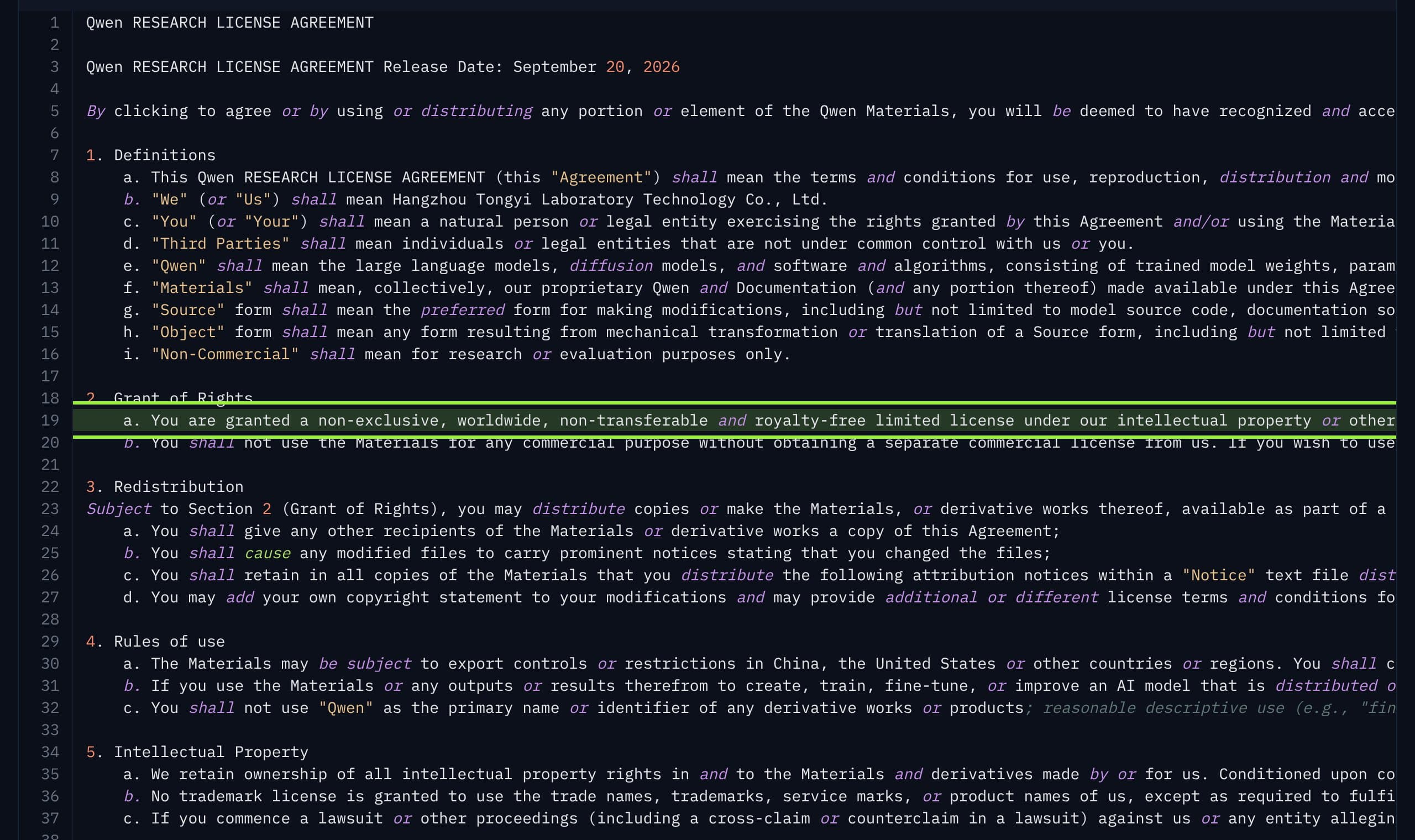
What the license does not say is whether the images you generate are covered by the same limit. The text grants no commercial rights to outputs, and commenters on the model page report that Qwen clarified on X that users keep their outputs, a statement that is not in the license file and that we could not read directly. That ambiguity is the reason to ask Alibaba in writing, at the contact address in the license, before a paid account depends on it. This is not legal advice.
The Krea 2 Community License, version 1 dated June 22, 2026, is clearer and stricter in other places. Commercial use of the model, derivatives or outputs is allowed only if your company, with affiliates, has less than USD 1,000,000 in total annual revenue over the trailing twelve months; above that you need an Enterprise license. You own your outputs and you are responsible for them. You must also run reasonable content filters in any deployment and disclose AI generation where a law or platform requires it.
License cheat sheet for a monetized character
- Krea 2: can I sell content?
- Yes, while company-wide revenue is under USD 1M a year
- Krea 2: what else?
- Content filters in your deployment, AI disclosure where required, "Krea" at the start of any model name you distribute
- Qwen-Image 2.1: can I sell content?
- Not under the research license; ask Alibaba for a commercial license
- Qwen-Image 2.1: fine-tunes?
- Same license, "Qwen" not as the primary name, "Built with Qwen" if you distribute a model made with it
- Qwen-Image 2.1: law and courts
- Chinese law, Hangzhou courts
What creators are saying
The research-only license makes the model unusable in practice; the author asked for terms like the ones MiniMax H3, LTX or Flux Klein ship with.
ComplaintHugging Face discussion on Qwen-Image-2.1, "License renders this model useless"
Commercial licenses can be requested by email, and fine-tunes only need a credit to the Qwen team, so the license is less blocking than it looks.
Under the current terms, everyday uses such as website art, teaching material and nonprofit work are excluded, which pushes people toward paid cloud APIs.
ComplaintHugging Face request to revert Qwen-Image-2.1 to Apache 2.0
Can people who keep rights to their outputs actually sell them? Nobody in the thread could answer from the license text.
A Krea 2 creator shared a five-stage recipe for a consistent character: base character, locked facial features, then poses, angles and environments.
Running them in ComfyUI
Both run in core ComfyUI, no custom node pack. Krea 2 needs version 0.26.0 or later and uses a Qwen3-VL text encoder with the Qwen Image VAE. Qwen-Image 2.1 arrived in ComfyUI 0.37.0 per our October news roundup. If a template opens with red nodes, update first.
On memory, the facts are thinner than the guides suggest. Krea's fp8 checkpoint is about 12.2 GB on disk in the RTX 3090 test, and several 16 GB card recipes report it fits because the text encoder is freed before sampling. For 12 GB the sources disagree: one recipe says the fp8 transformer alone leaves no room and recommends a GGUF quant instead. Qwen-Image 2.1's model card gives no VRAM figure at all and only suggests CPU offloading. Treat every number as one reporter's machine.
Both routes start from the same reference set. Only the Krea route has a clear commercial license for small businesses.
Which one should you pick
- 1
Krea 2 Turbo
The default for a character that earns money and a company under USD 1M a year.
Best for: Photographic portraits, fast daily output, a trained face LoRA
- Best portrait realism in the one test found
- 8 steps, about 10 seconds an image on a 3090 with int8
- Commercial use allowed under the revenue threshold
- No reference-image input on the model card
- Face consistency needs a LoRA or a community workflow
- Revenue above USD 1M requires an Enterprise license
- 2
Qwen-Image 2.1
The best open tool here for editing from references, and the one to license before you rely on it.
Best for: Prototyping a face, multi-reference edits, research
- Up to 10 reference images in one model
- 2K output with a compact 7B generator
- Turbo variant for 8-step runs
- Research and evaluation only without a separate license
- Flatter, more plastic skin in the test found
- No official VRAM guidance
- 3
- Undistilled base meant for fine-tuning
- Same license as Turbo
- The model card does not recommend it for inference
- 52 steps, slow for daily use
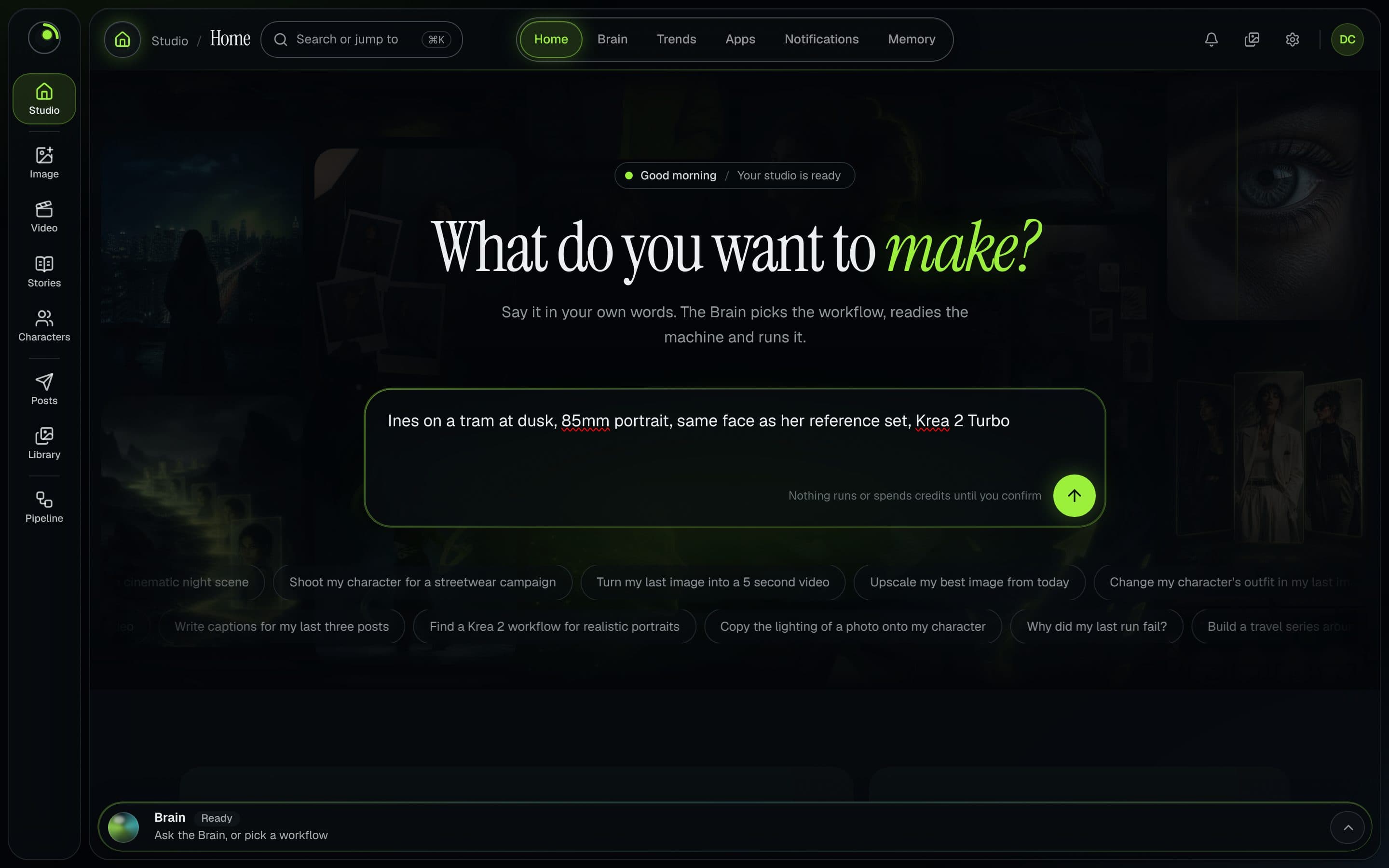
Our recommendation is the boring one: ship on the model whose license you can read in five minutes, and use the other to explore. If you want a tool that keeps her references in one place and lets you swap the model when a license or a result changes, that is what the Musetta studio is for, and it runs on your own ComfyUI.
Questions
- Is Qwen-Image 2.1 free for commercial use?
- Not under its published license. The Qwen Research License allows research and evaluation only and requires a separate commercial license from Alibaba for any commercial purpose. Its predecessors used Apache 2.0, which is why older advice does not apply.
- Can I use Krea 2 for a monetized AI influencer?
- Yes while your company, with affiliates, has under USD 1 million in annual revenue over the trailing twelve months. Above that you need an Enterprise license. You also have to run content filters in your deployment and disclose AI generation where required.
- Which model keeps a face more consistent?
- Qwen-Image 2.1 takes up to 10 reference images and is built for identity-preserving edits, but no independent test measures it against Krea 2. Krea 2 is text to image, so consistency comes from a trained LoRA or a community workflow. Test both with your own references.
- Does Krea 2 Turbo run on 12 GB?
- Sources disagree. The fp8 checkpoint is about 12.2 GB, so recipes for 12 GB cards use a GGUF quant, while 16 GB cards run fp8 in several reported setups. Check a quantized build and keep resolution low at first.
Sources
- 01Krea 2 Raw model card · Krea, Hugging Face, 2026-06-22
- 02Krea 2 Turbo model card · Krea, Hugging Face, 2026-06-22
- 03Krea 2 Community License Agreement v.1 · Krea, 2026-06-22
- 04Krea 2 open-source models are now available in ComfyUI · ComfyUI, 2026-06-23
- 05Qwen-Image-2.1 model card · Qwen, Hugging Face
- 06Qwen-Image-2.1 on GitHub · QwenLM, GitHub
- 07Qwen Research License Agreement · Qwen, Hugging Face, 2026-09-20
- 08Krea 2 Turbo vs Qwen-Image 2.1 on one RTX 3090 · Cybertiron, GitHub, 2026-10
- 09License renders this model useless (discussion 6) · Hugging Face community
- 10Revert Qwen-Image-2.1 to Apache 2.0 (discussion 39) · Hugging Face community
- 11Krea 2 character consistency: a Reddit creator's workflow · Reveo
Researched and written by the Musetta editorial desk with AI assistance, from the sources above. Numbers come from those sources; nothing is benchmarked by us unless the article says so. Spotted an error? Tell us on Discord and we fix it.