In short
For a character you want to monetize, the three open image models split on terms, not on looks. Qwen-Image 2.1 takes up to 10 reference images but its license is research or evaluation only. Krea 2 needs a trained LoRA and is free for commercial use only under USD 1 million of company revenue. MOSS-Image is Apache-2.0 for the weights but takes no reference images, so it also needs a LoRA. Nobody has measured face similarity across the three.
Three open image models share this week's ComfyUI downloads, and for an AI influencer they fail in three different ways. Qwen-Image 2.1 can hold a face from up to 10 reference photos, but its license text allows research or evaluation only. Krea 2 is free for commercial use until your company reaches USD 1,000,000 in yearly revenue. MOSS-Image has Apache-2.0 weights and no reference-image input at all.
Earlier comparisons put Krea 2 against Qwen-Image 2.1 (ours is here) and we reviewed MOSS-Image on its own. Nobody has lined up all three on what a character feed needs, so this article does that from the model cards, the license texts and the ComfyUI repack pages we read today. It also says plainly what is missing: no source we found measures face similarity for any of the three under identical settings, and we did not run them ourselves. If you pick Krea 2, the official template read node by node shows its settings and the prompt enhancer that is on by default.
The verdict first
- Choose Qwen-Image 2.1 to explore and lock a face from reference photos, as long as the output stays inside research or evaluation. It is the only one of the three that takes references in the model itself.
- Choose Krea 2 Turbo for a feed that earns money if your company stays under USD 1 million a year: 8 steps, a clear commercial path and a Raw base meant for LoRA training.
- Choose MOSS-Image if you cannot accept a revenue cap or a research-only license, and you are willing to train a character LoRA. It is the smallest at 5B, and the slowest by its own recommended 50 steps.
- Do not choose by looks yet. The only side-by-side test we found covers Krea and Qwen, on one card, with subjective ratings. Run ten renders of your own reference set before you commit.
Side by side
| Spec | Qwen-Image 2.1 | Krea 2 (Turbo) | MOSS-Image |
|---|---|---|---|
| Size | 7B | 12B (Hub metadata shows 13B) | 5B |
| Weights license | Qwen Research License | Krea 2 Community License | Apache-2.0 |
| Commercial use | Needs a separate license from Qwen | Under USD 1M yearly company revenue, else an Enterprise License | Allowed by the weights license; pipeline code and third-party parts keep their own |
| Reference images | Up to 10, in the same model | Text to image; style reference with 1 to 2 images in ComfyUI | None in the release |
| Steps | 40 in the card examples; Turbo 8 at CFG 1 | Turbo 8; Raw 52 | 50 at CFG 3 (vendor settings) |
| Text encoder in ComfyUI | Qwen3-VL 8B | Qwen3-VL 4B | Qwen3.5 9B |
| Made for LoRA training | Not stated on the card | Raw base for fine-tuning, per ComfyUI | Base checkpoint for fine-tuning, per the vendor |
Keeping the same face: references against LoRA
This is the real split. Qwen-Image 2.1 accepts up to 10 reference images and describes identity preservation for people and products on its model card, with showcase examples and no measurements. Krea 2 offers a style reference workflow with one or two images, which steers mood and look, not who the person is. MOSS-Image takes text, tags or a layout.
So two of the three route identity through training. A character LoRA means a reference set, a rented or local GPU and a test pass; our guide to consistent characters and the one on training a character LoRA cover that. One tester of MOSS-Image reported that a character LoRA turned decent photorealism into results he called amazing, which fits the pattern but is a single hands-on report. A LoRA belongs to the base it was trained on, so choose the base whose license you can live with before you spend the GPU hours.
The license decides more than the pixels
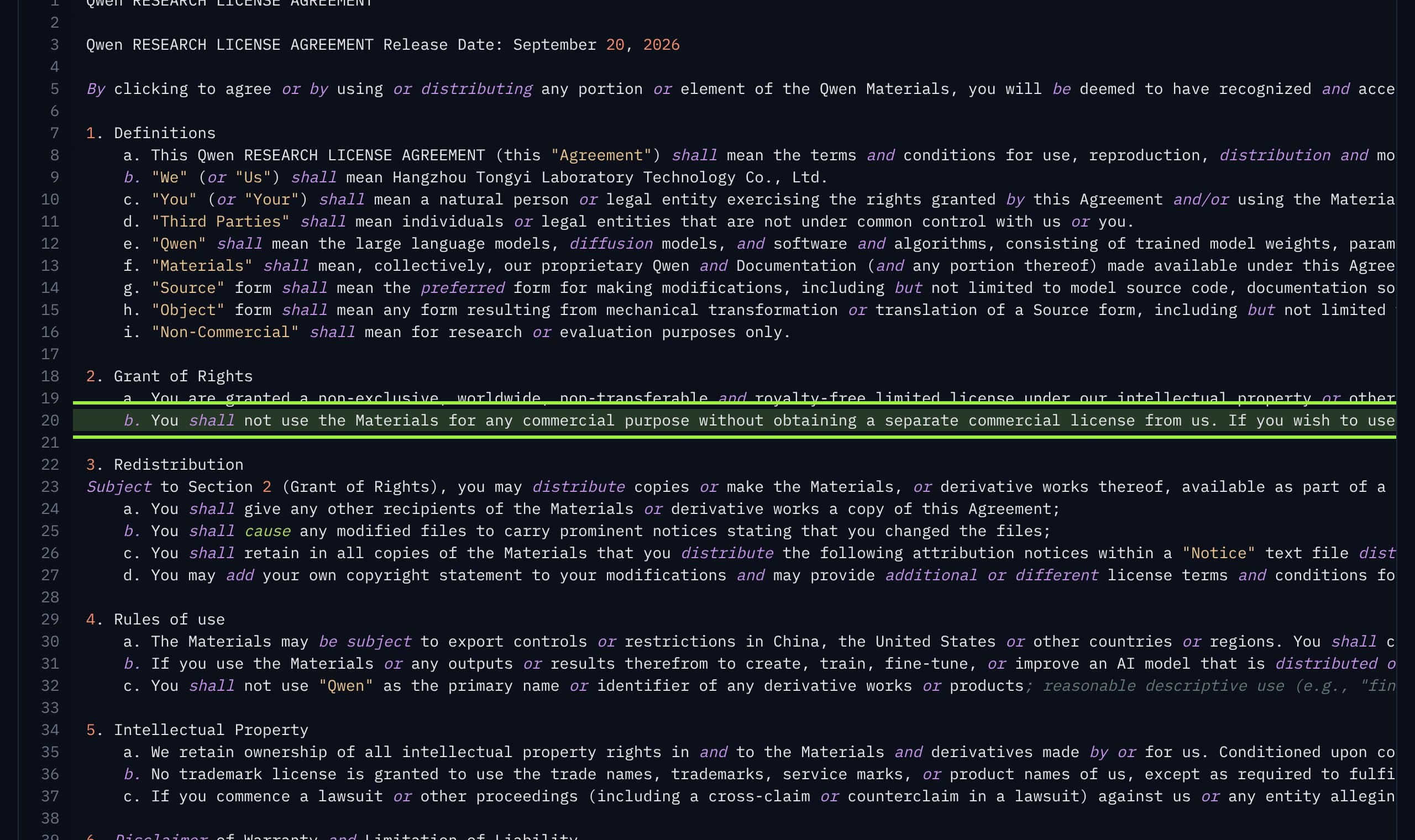
Qwen's license defines Non-Commercial as "for research or evaluation purposes only" and says in section 2.b that you shall not use the Materials for any commercial purpose without a separate commercial license. It does not separately address generated images, and that gap is exactly what a user asked the Qwen team to settle in a Hugging Face thread that showed no reply when we read it. We are not lawyers; if the output pays your rent, ask Qwen for the answer in writing.
Krea's terms are the opposite kind: clear and capped. Commercial use is allowed only while total company revenue, affiliates included, stays under USD 1,000,000 over the trailing twelve months; above that you stop and need an Enterprise License. You own what you generate and you are responsible for it. MOSS-Image has the plainest weights license, Apache-2.0, but the project page says the pipeline code and third-party components keep their own licenses, and the Qwen3.5 text encoder and FLUX.2 VAE it runs with are separate files you should check yourself.
What ComfyUI downloads tell you
The Comfy-Org repack pages show how many people pulled each model in the last month. The counts cover every file in a repack, including variants, so read them as interest, not as unique users.
Source: Comfy-Org repacks on Hugging Face, read October 22, 2026
Qwen leads by a wide margin despite its license, which says something about how many people are testing rather than selling. MOSS-Image is days old and already past a million. Download counts do not show quality; they show that a lot of people will hit the same ComfyUI problems you will, which is the next section.
Setup differences that bite
- Qwen-Image 2.1 Turbo gave poor results for some users in ComfyUI until they switched from KSampler to SamplerCustomAdvanced with a ManualSigmas node and the model's own schedule.
- MOSS-Image produced desaturated images with odd curl artifacts for one user until the --use-sage-attention launch flag was removed.
- Krea 2 ships fp8, int8, bf16, mxfp8 and nvfp4 Turbo files in its repack, so the first decision is which one your card runs fast. In a community test on an RTX 3090, int8 was 1.78 times faster than fp8; newer cards may not behave the same.
- All three put the biggest download in the text encoder or the model split. Our file size study explains why, and a rented GPU avoids the disk problem.
What creators are saying
Someone said Qwen-Image 2.1 Turbo gave poor results in ComfyUI, and a reply pointed to SamplerCustomAdvanced with a manual sigma list taken from the model files.
A user asked the Qwen team for a clear yes or no on commercial use of locally generated images, saying the wording allows conflicting readings.
One user found the official MOSS-Image workflow produced poor output; another traced desaturated curls to a sage-attention flag.
A Japanese tester found MOSS-Image photorealism decent but anime unusable, and called results after training a character LoRA amazing.
Praisenote.com hands-on test
When each one wins, and loses
- 1
Krea 2 Turbo
The safest commercial default for a small creator business, as long as the revenue cap holds.
Best for: A daily feed under USD 1M revenue with a trained LoRA
- 8 steps
- Clear commercial terms and output ownership
- Raw base for training, with an official ComfyUI template
- No identity reference input
- Revenue cap ends the free path
- Largest of the three at 12B
- 2
MOSS-Image
The cleanest weights license, with the weakest tooling and the slowest recommended settings.
Best for: Anyone who cannot accept a revenue cap and will train a LoRA
- Apache-2.0 weights
- 5B, the smallest
- Layout boxes and text rendering
- No reference images
- 50 steps at CFG 3
- Days old, few independent tests
- 3
Qwen-Image 2.1
The best tool for locking a face from references, held back by a research-only license.
Best for: Prototyping a look and editing from up to 10 references
- 10 reference images
- 2K output
- An 8-step Turbo exists
- Research or evaluation only
- Turbo needs a custom sigma setup for some users
- Commercial status of outputs unanswered
Where Musetta fits
Musetta runs on your own ComfyUI and keeps each character's reference photos, so trying a second base model means installing what the workflow is missing, not rebuilding her. It changes none of the licenses above. See how it compares with working in ComfyUI directly, or fix missing nodes first.
Questions
- Which model keeps the same face best: Krea 2, Qwen-Image 2.1 or MOSS-Image?
- Nobody has measured it for all three. Qwen-Image 2.1 is the only one that takes up to 10 reference images itself; Krea 2 and MOSS-Image rely on a trained LoRA. Test ten renders of your own reference set.
- Can I use Qwen-Image 2.1 for a monetized account?
- The license allows research or evaluation only and requires a separate commercial license for any commercial purpose. It does not separately address generated images, so ask Qwen in writing before you rely on it.
- Is Krea 2 free for commercial use?
- Only while total company revenue, affiliates included, stays under USD 1,000,000 over the trailing twelve months. Above that you need an Enterprise License from Krea. You own the outputs.
- Is MOSS-Image Apache-2.0?
- The weights and bundled inference code are Apache-2.0 per the model card. The project page says pipeline code and third-party components keep their own licenses, so check the text encoder and VAE too.
- Which is fastest in ComfyUI?
- By recommended settings, Krea 2 Turbo and Qwen-Image 2.1 Turbo use 8 steps and MOSS-Image 50. We found no timing for all three on one card.
Sources
- 01Krea-2-Turbo model card · Krea, Hugging Face, 2026-06-22
- 02Krea 2 licensing · Krea
- 03Krea-2 ComfyUI workflow example · ComfyUI docs
- 04Qwen-Image-2.1 model card · Qwen, Hugging Face
- 05Qwen-Image-2.1-Turbo model card · Qwen, Hugging Face
- 06Qwen Research License Agreement · Qwen, Hugging Face, 2026-09-20
- 07MOSS-Image-SFT model card · OpenMOSS, Hugging Face
- 08MOSS-Image project page · OpenMOSS, 2026-10-16
- 09Comfy-Org/MOSS-Image repack · Comfy-Org, Hugging Face
- 10Comfy-Org/Krea-2 repack · Comfy-Org, Hugging Face
- 11Comfy-Org/Qwen-Image-2.1 repack · Comfy-Org, Hugging Face
- 12Qwen-Image-2.1-Turbo discussion 4 · Hugging Face community
- 13Qwen-Image-2.1-Turbo discussion 11 · Hugging Face community
- 14Testing MOSS-Image in ComfyUI · note.com
Researched and written by the Musetta editorial desk with AI assistance, from the sources above. Numbers come from those sources; nothing is benchmarked by us unless the article says so. Spotted an error? Tell us on Discord and we fix it.