In short
Between October 13 and 16 three image models arrived. FLUX 3 Image Klein is a 5.6B open-weights model with up to 10 reference images, free for commercial use under $5M annual revenue. MOSS-Image is a 5B Apache-2.0 model that reads layout JSON, but early testers call it slow and weak on anime. Krea 3 is a hosted editor at $0.06 per 2K image, not open weights. For a character feed, test Klein first and keep Krea 3 as a paid fallback.
If you post the same face every day, the week of October 13 gave you three new ways to keep it, and one new license to read before you use any of them. FLUX 3 Image Klein, MOSS-Image and Krea 3 arrived within four days of each other, and ComfyUI shipped three releases around them. This briefing sorts them by what they change for a character feed, and says plainly where we could only read a vendor's own claims.
The week at a glance
Oct 13
ComfyUI 0.40.0 adds the 8-step Qwen-Image 2.1 Turbo checkpoint, LoRA stack loaders and camera nodes. The asset library is now off unless you start with
--enable-assets.Oct 15
Black Forest Labs publishes FLUX 3 Image Klein, a 5.6B open-weights model, with base and step-distilled checkpoints. ComfyUI 0.41.0 adds native support the same day.
Oct 15
Krea launches Krea 3, a hosted image editor at $0.06 per 2K edit. ComfyUI 0.41.1 adds it as a partner node.
Oct 16
OpenMOSS introduces MOSS-Image-Base and MOSS-Image-SFT, about 5B parameters, weights under Apache-2.0.
FLUX 3 Image Klein: the one to test first
Klein is a 5.6B-parameter model for text-to-image, editing and multi-reference work, released October 15. Black Forest Labs ships a base checkpoint for fine-tuning and a step-distilled one for speed, plus FP8, INT8 and NVFP4 builds. The generator weights need 11.2 GB in BF16 and 5.6 GB in FP8, and BFL says the INT8 build runs on GeForce RTX cards with as little as 8 GB of VRAM.
For a recurring face the headline is multi-reference: up to 10 reference images in one request, which is the feature that decides whether a character survives a change of scene. ComfyUI's changelog lists native support for both checkpoints with the Qwen3-VL-4B text encoder and the existing Flux2 VAE, so no custom node pack is needed. Our missing nodes guide still applies if a template asks for something your install lacks.
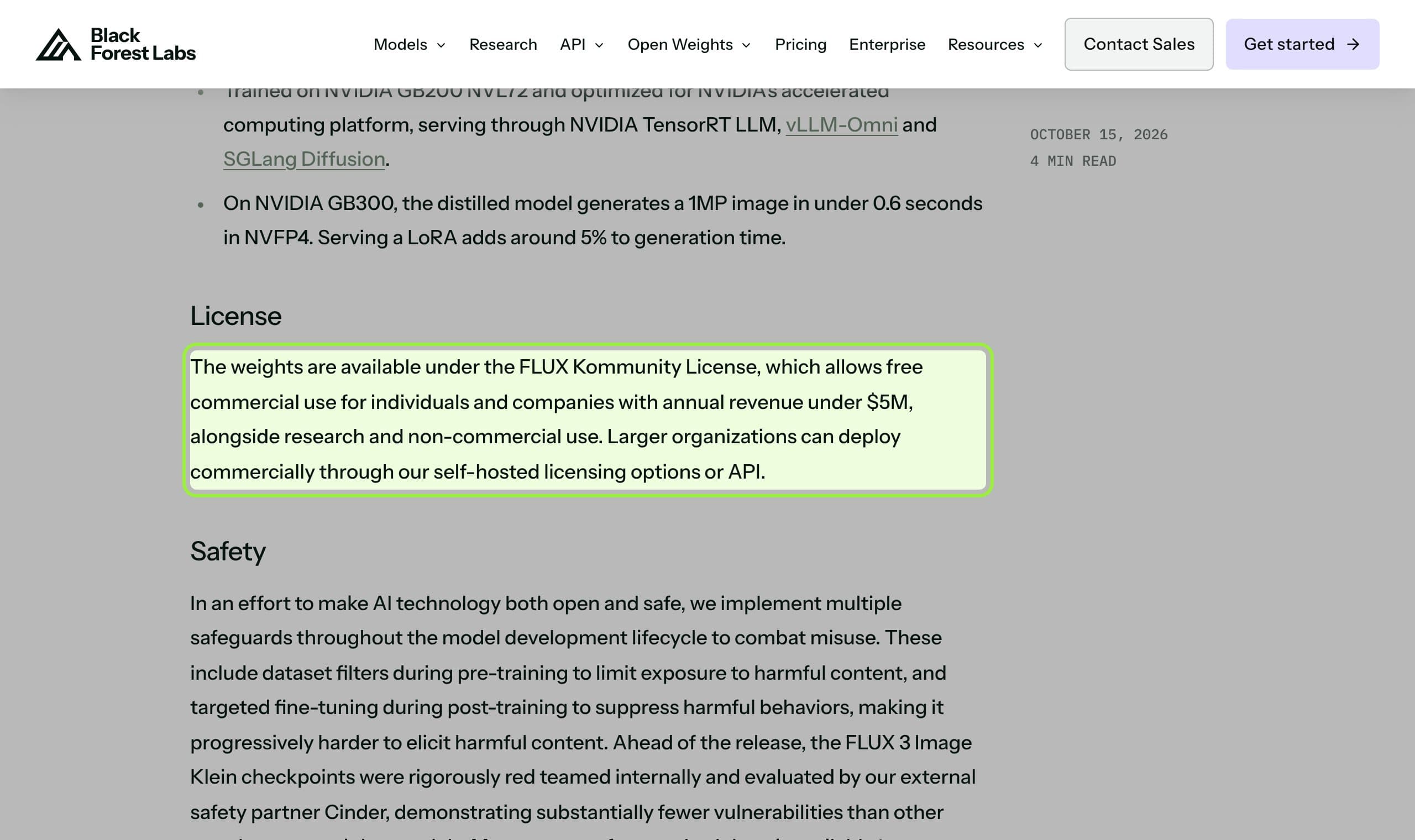
The license is the catch. The weights use the FLUX Kommunity License, which BFL says allows free commercial use for individuals and companies with annual revenue under $5M. Larger organizations need self-hosted licensing or the API. VentureBeat notes that the related FLUX 3 Action license counts revenue together with affiliates, so a small studio owned by a large company may not qualify; read the license that ships with the download before you rely on it.
One caution on the numbers. The speed and quality charts are BFL's own. VentureBeat reports 4.1 seconds for a 1024 by 1024 image on an RTX 5090 and 8.9 seconds on an RTX 4070 for the distilled INT8 model, and says the preference charts give no detail on prompts, judging or sample size. We have not reproduced them.
MOSS-Image: open, permissive, and slow so far
OpenMOSS introduced MOSS-Image on October 16. It has a compact 5B backbone, two checkpoints (Base for fine-tuning, SFT tuned on curated data), and weights under Apache-2.0, the most permissive license of the three. Its pitch is layout: it can take bounding boxes and text descriptions as structured prompts. The model card recommends 50 steps, CFG 3 and shift 5, and says a native ComfyUI plugin installs through the Manager while integration into the official ComfyUI repository is still in progress. The 0.40 to 0.41.1 changelog entries we read do not mention it. We have since published a full MOSS-Image review with file sizes, speed tests and the face verdict.
The Apache-2.0 line covers the weights. The project page adds that the pipeline code and third-party components keep their own licenses, so check those if you ship anything built on the code. File sizes are a separate story, and our download size study found MOSS-Image's text encoder is the biggest file in its stack.
What creators are saying
On a 12 GB RTX 4070 the Base INT8 model took about 51 seconds for an 832 by 1216 image at 50 steps. Anime looked far weaker than Anima or Krea 2, and photoreal was only acceptable.
A ComfyUI node author said MOSS-Image has the best seed variance they have seen since SD1.5 and makes 2K images in about five seconds, while noting their own support for it is still unfinished.
PraiseGitHub issue on ComfyUI-RBG-SmartSeedVariance, October 2026
A first Klein test found face distortion improved at 4K, but raw output lackluster and basic shapes warped. Sampling took about five seconds on an RTX 5060 Ti 16 GB.
That is three people, not a survey, and the mood is mixed: promising variance and a permissive license, against slow generation and unconvincing first results. Treat the Base checkpoint as a training target and the SFT checkpoint as the one to try for generation.
Krea 3: fast, hosted, not something you download
Krea 3 is an editing model, released October 15 and available on krea.ai and through hosts including fal, Replicate, Together AI and OpenRouter. Krea says most edits finish in under 8 seconds at native 2K and prices it at $0.06 per 2K image and $0.03 per 1K image. Krea's post does not mention open weights, and neither does anything else we found, so assume it is API only.
Reference limits differ by source: Krea's post says up to 6 reference images per edit, while ComfyUI's 0.41.1 notes for the partner node say up to 8, with 1K or 2K output and a precise edit mode that leaves the rest of the picture unchanged. Both can be true of different surfaces, so check the one you call. If you used Krea 2 for faces, our Krea 2 versus Qwen-Image 2.1 comparison is still the open-weights baseline.
The three side by side
| Model | FLUX 3 Image Klein | MOSS-Image | Krea 3 |
|---|---|---|---|
| Released | Oct 15 | Oct 16 | Oct 15 |
| Weights | Open, 5.6B | Open, about 5B | Hosted only |
| License or terms | FLUX Kommunity License, free commercial under $5M revenue | Apache-2.0 for weights | Paid API, $0.06 per 2K image |
| References | Up to 10 | Not listed on the model card | 6 per Krea, 8 per ComfyUI node |
| In ComfyUI | Native since 0.41.0 | Manager plugin, official support in progress | Partner node since 0.41.1 |
What to do this week
Test Klein with your own references before you change anything else: it is the only one that is both open and built for multi-reference. If it keeps your face, check the revenue line in its license against your account, then decide whether the distilled checkpoint is fast enough for daily use. If your results vary run to run, our distilled versus base explainer covers when to train on one and generate with the other.
Leave MOSS-Image for a weekend of testing unless you need Apache-2.0 or layout control, and keep Krea 3 as a paid fallback for hard edits rather than a pipeline dependency. Short on VRAM? Rent a card for the test instead of buying one, as described in the rent-a-GPU help page. For the earlier releases, see October's first briefing.
Cheat-sheet: what to try first
- Keep one face across scenes
- FLUX 3 Image Klein, up to 10 references
- Need Apache-2.0 weights
- MOSS-Image, SFT to generate, Base to train
- Hard edit, no local GPU
- Krea 3, $0.06 per 2K image
- Fast drafts
- Qwen-Image 2.1 Turbo, 8 steps, in ComfyUI 0.40.0
- Low VRAM
- Klein INT8, BFL says 8 GB RTX minimum
Where Musetta fits
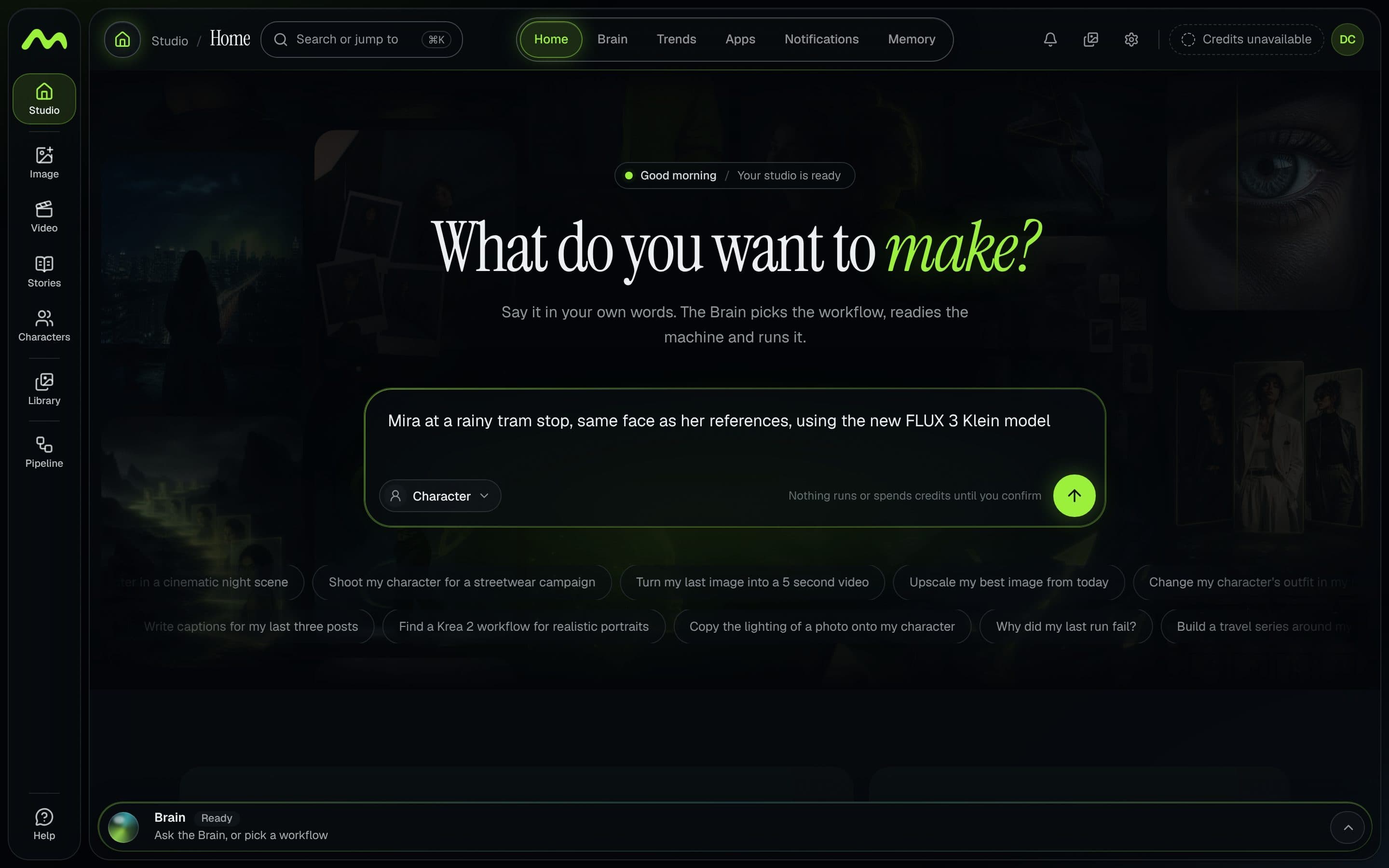
Musetta runs on your own ComfyUI and keeps each character's reference photos, so trying Klein on a character means installing what the workflow is missing rather than rebuilding the character. It does not change any license above; those apply to you. See how Musetta compares with working in ComfyUI directly.
Questions
- Is FLUX 3 Image Klein free for commercial use?
- BFL says the FLUX Kommunity License allows free commercial use for individuals and companies with annual revenue under $5M. Larger organizations need self-hosted licensing or the API. Read the license that ships with the download.
- Does MOSS-Image run in ComfyUI?
- Its model card says a native plugin installs through ComfyUI Manager by searching for MOSS-Image, and that integration into the official ComfyUI repository is still in progress.
- Is Krea 3 open weights?
- Krea's announcement lists krea.ai, its API and partner hosts, and does not mention open weights. Treat it as hosted only.
- Which new model keeps a face best?
- We have not measured it. Klein is the only one that is open and built for up to 10 references, so test it first with your own references.
Sources
- 01FLUX 3 Image Klein: open weights, 5.6 billion parameters · Black Forest Labs, 2026-10-15
- 02Black Forest Labs opens FLUX 3 Image Klein weights, with free commercial use limited to smaller businesses · VentureBeat, 2026-10
- 03MOSS-Image project page · OpenMOSS, 2026-10-16
- 04MOSS-Image-Base model card · OpenMOSS, Hugging Face, 2026-10
- 05Introducing Krea 3 · Krea, 2026-10-15
- 06ComfyUI changelog · Comfy documentation, 2026-10-15
- 07Testing MOSS-Image in ComfyUI · note.com, 2026-10
- 08My experience using Flux3-image-klein · note.com, 2026-10
- 09MOSS-Image support issue · GitHub, 2026-10
Researched and written by the Musetta editorial desk with AI assistance, from the sources above. Numbers come from those sources; nothing is benchmarked by us unless the article says so. Spotted an error? Tell us on Discord and we fix it.