In short
PAN 2 is a 29B world model from MBZUAI under Apache 2.0, native in ComfyUI since 15 November 2026. In its makers' own tests MiniMax H3 still leads on entity persistence (96.83 against 90.40) and on blind human preference (Elo 1620 against 1595, intervals overlapping). PAN 2 is silent, has no multi-image reference mode and needs a structured JSON caption. Its case is the license: no excluded territories. H3 for the face where its license allows, PAN 2 for action shots everywhere else.
If you run a character from Berlin, Austin, London or Seoul, the best open video model for faces is the one whose license says you may not use it there. PAN 2, a 29B model released under Apache 2.0 and loadable in stock ComfyUI since 15 November, is the first open model of that size without that problem. The question for a character feed is whether it keeps a face as well as MiniMax H3 does. By its makers' own numbers, not yet: H3 scores 96.83 on entity persistence, PAN 2 scores 90.40.
We did not render a head-to-head ourselves. This article compares the two model cards, both license files, the Hugging Face file listings, the ComfyUI pull request and the first community timings, all read on 19 November 2026. Every benchmark figure below comes from the PAN 2 team's own report, which is the only place the two models have been scored side by side so far. For H3 alone, see our MiniMax H3 review.
The short answer
- The face is the product and you are outside the US, EU, UK and South Korea: stay on H3. It leads on entity persistence, takes up to nine reference images and makes its own audio.
- You are inside one of those four territories: PAN 2 is now the strongest open option for shots built on an action (pouring, opening, walking, a camera move). Its Apache 2.0 terms cover commercial use with no territory list. We are not lawyers; read both files.
- You need speech or lip sync: H3, or LTX 2.5. PAN 2 generates silent video.
- You want a 20 second single take: PAN 2. Its card lists up to 481 frames at 24 fps; H3 stops at 15 seconds.
- You want to type one line and press Queue: not PAN 2. It needs a structured JSON caption written by a language model, and plain text gives noise.
PAN 2 vs MiniMax H3, side by side
| What | PAN 2 | MiniMax H3 |
|---|---|---|
| Maker | Institute of Foundation Models at MBZUAI | MiniMax |
| License | Apache License 2.0 for code and weights | MiniMax H3 Community License; excludes the EU, UK, South Korea and the US, outputs included |
| Size | 29B MMDiT (29,201,996,992 parameters in the Hub metadata) | 33B (33,122,992,896 parameters in the Hub metadata) |
| What it calls itself | A world model: simulates what happens after an action | An audio and video generation model |
| Output | 704 x 1248 at 24 fps, 241 frames by default (about 10 s), up to 481 (20 s) | 4 to 15 s at 24 fps, shorter side 768 by default |
| Audio | None. The team confirmed silent output is expected | Synchronized stereo audio |
| Keeping a character | One optional first frame plus text | First and last frame variants, and a reference variant with up to nine images |
| Prompt | Structured world-state caption in JSON, 1,536 tokens hard limit | Plain text |
| Default sampling | 50 steps, CFG 2.5, shift 9, euler and simple | Official templates; Turbo LoRA at 4 to 8 steps |
| Text encoder and VAE | Qwen3.5-9B, Wan 2.2 VAE | Qwen3-VL-32B, its own video and audio VAEs |
| ComfyUI | Core since PR #17755 (merged 15 November); no official template yet | Official templates for text, image, reference and more |
| Comfy-Org repack, downloads last month | 7,160 | 33,040,522 |
The license is PAN 2's whole argument
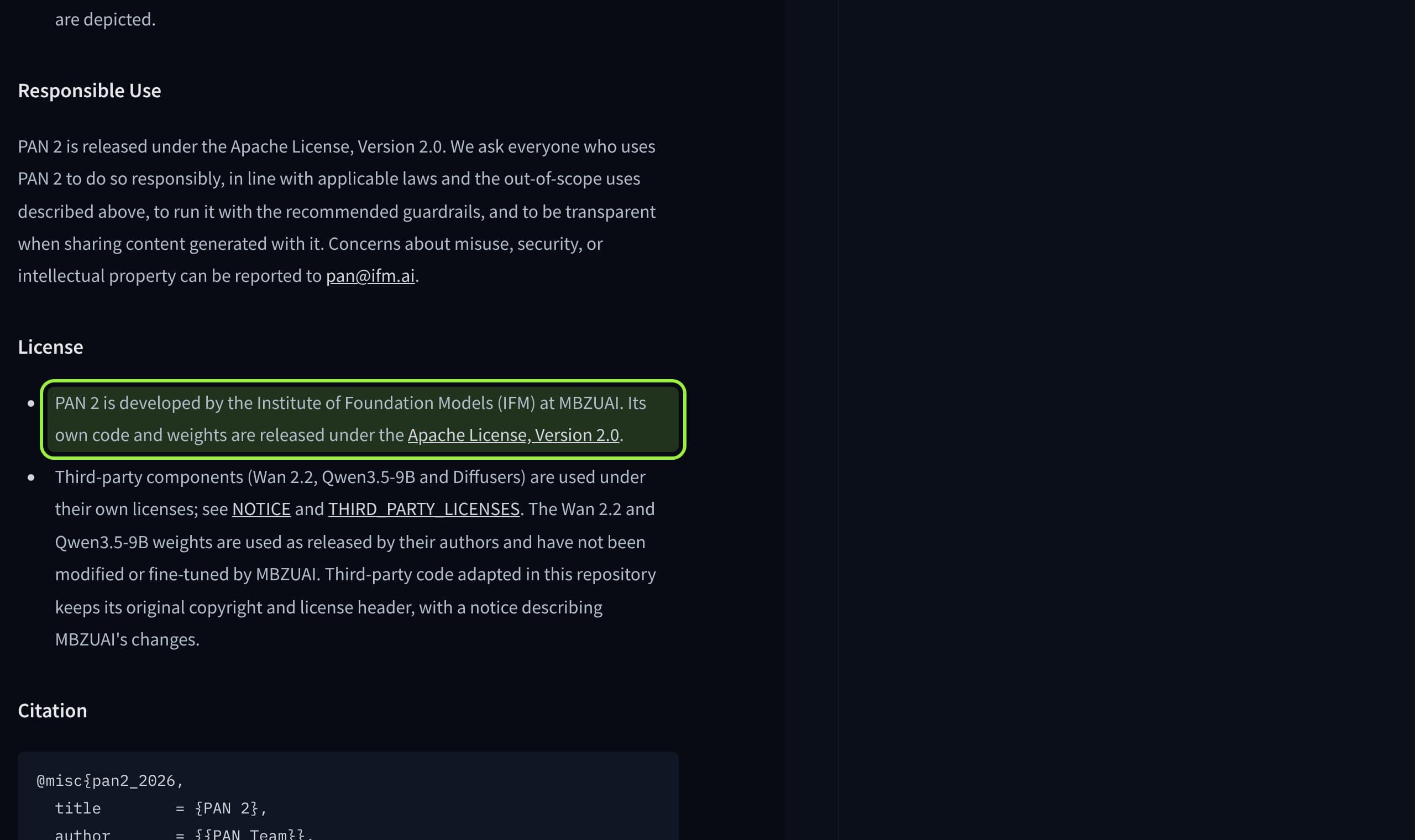
The PAN 2 card says its own code and weights are released under the Apache License, Version 2.0, and the repository's NOTICE file lists the two third-party parts, Wan 2.2 and Qwen3.5-9B, as Apache 2.0 as well. Apache 2.0 allows commercial use and has no list of countries. The card adds out-of-scope uses (deepfakes of real people, misinformation and similar) and asks users to say when content is AI-generated.
The H3 license reads differently. It defines the Excluded Territories as the European Union, the United Kingdom, the Republic of Korea and the United States of America, and Section V says you may not use, reproduce, modify, distribute or display the model or any of its outputs or results outside the Applicable Territory. We re-read the file today and that text is unchanged since our last comparison. For a monetized account in one of those four places, that clause decides the matter before quality does.
Faces: what the PAN 2 team's own numbers say
Nobody has published an identity score for PAN 2, and we found no hands-on test of a recurring face yet. The closest measurement is in the PAN 2 report itself, which scores six capabilities on 300 single-action test cases. One of them, entity persistence, asks whether the things in the scene stay the same things. That is not a face-match score, but it is the nearest proxy available.
H3 leads on entity persistence by more than six points (96.83 plus or minus 0.47 against 90.40 plus or minus 1.53, three seeds each) and on every one of the six capabilities. PAN 2's only win in the table is full-plan completion on multi-step tasks, 34.00 against 32.50, and the spread on both figures is about three points, so call that a tie. Credit to the PAN 2 team for publishing a table their model does not top.
The blind human study agrees: 13 reviewers, 140 prompts, 1,400 pairwise comparisons, judged on action adherence, physics and world consistency. H3 got Elo 1620 and won 68.8% of its comparisons; PAN 2 with its best reasoner got 1595 and 63.7%. The 95% intervals overlap (1599 to 1643 against 1572 to 1617), so the gap is small. Both sit far above LTX 2.5 at 1346 in the same study.
Two structural limits matter more for a character than any score. First, PAN 2 conditions on at most one starting frame; the card says appearance drifts across clips in long interactions because of it. H3's reference variant takes up to nine images of the same person. Second, the PAN 2 team says outright what the model is for. In a public reply on the model page a team member wrote that PAN 2 "is a world model, not a video generator" and "isn't built for the prettiest clip". Believe them. See our consistent character guide for why one frame is rarely enough.
Running PAN 2 in ComfyUI: files, VRAM and time
Pull request #17755 merged into ComfyUI on 15 November 2026. It loads PAN 2 through the built-in loaders, adds a pan2 type to CLIPLoader, and reuses the stock Wan22ImageToVideoLatent node for image to video. ComfyUI Wiki reports that the support is only in builds newer than 0.45.0, so update first; if an update has broken things for you lately, our update fixes apply.
| Stack | PAN 2 | MiniMax H3 |
|---|---|---|
| Diffusion model, int8 | 26.68 | 34.04 full, 20.97 pruned |
| Diffusion model, bf16 | 67.37 | 66.3 full, 40.2 pruned |
| Text encoder, int8 | 9.75 (Qwen3.5-9B) | 27.14 (Qwen3-VL-32B) |
| VAE | 1.41 (Wan 2.2) | 3.42 (video plus audio, int8) |
| Typical int8 stack | 37.84 | 64.60 full, 51.53 pruned |
| Smallest stack we found | 27.49 with the community NVFP4 file | 35.09 (w6a8, nvfp4 text encoder) |
PAN 2 is the lighter download, mostly because its text encoder is a third the size. It is not the lighter run. One community builder timed the official int8 file on an RTX 5090 at 1248 x 704, 50 steps, CFG 2.5: 262 seconds for a 5 second clip, 672 for 10 seconds and 2,450 for 20 seconds, with a peak of 30.1 GB of VRAM on the 5 second clip. Their own NVFP4 build brought that to 220, 602 and 1,819 seconds and a 20.4 GB peak. The pull request's own figure is 15.2 seconds per step at 241 frames on the same card, which over 50 steps is about 760 seconds by our arithmetic.
So a 24 GB card is the practical floor today, and only with the 4-bit community file on an RTX 50 series card. There is no distilled PAN 2 and no turbo LoRA yet. H3 has both a pruned model and a Turbo LoRA that drafts in 4 to 8 steps, which is why it remains the faster model to iterate on despite being larger. If you would rather not buy the card, renting a GPU by the hour covers either.
The prompt is a JSON caption, not a sentence
PAN 2 was trained on structured, time-stamped captions: events, actions tied to actors, camera motion. The card tells you to have a language model rewrite your idea into that format first, and the team publishes the system prompt and a fixed negative prompt in its repository. The caption has a hard capacity of 1,536 tokens. The pull request notes that the rewriter can run inside ComfyUI through TextGenerateV2 on the same Qwen3.5-9B file, so it does not need a paid API.
The graph described in the pull request and the community workflows. No official template ships yet.
One detail is friendly to a feed: 704 x 1248 is within a hair of 9:16, so the native size is already a vertical reel (flip it for 1248 x 704). Sizes for other models are in our 9:16 table.
What creators are saying
One early tester on a workstation card called the video decent, then asked why there was no audio VAE. The team answered that silent output is expected and sound has no timeline.
A user who loaded the first shared workflow got only noise, then found that removing ModelSamplingSD3 and feeding a structured JSON prompt fixed it.
ComplaintHugging Face, Comfy-Org/PAN2 discussion, 16 November 2026
“The workflow preset on 50 step , you can get same quality on 12 or 15 step”
TipHugging Face, Comfy-Org/PAN2 discussion, 16 November 2026
Someone running their own LLM for the caption warns that the default system prompt returns a wrapper object; unpack the refined prompt before it reaches the text encode node.
TipHugging Face, Comfy-Org/PAN2 discussion, 18 November 2026
A commenter told the team that with audio PAN 2 would be comparable with H3, and asked whether an audio version is planned.
The 12 to 15 step claim is one person's eye, not a measurement, and the card's default is 50. It is still the first thing worth testing, because it would cut a 10 second clip from about eleven minutes to about three. Reddit was not reachable from our research session, so these voices come from the two model pages.
Which one to run, by situation
PAN 2 or MiniMax H3
- Close-up, face on screen, outside the excluded territories
- H3 reference mode with several stills of the character
- Close-up, face on screen, in the US, EU, UK or South Korea
- PAN 2 from one strong still, 5 s, then check the last frame against the first; or LTX 2.5
- Action shot: pour, open, pick up, walk through a door
- PAN 2. This is what it was trained to get right
- Talking clip or lip sync
- H3 or LTX 2.5. PAN 2 is silent; one community workflow adds sound with LTX 2.5 afterwards
- One take longer than 15 s
- PAN 2, up to 20 s, about 40 minutes of sampling on an RTX 5090 with int8
- Fast drafts
- H3 with the Turbo LoRA
- 24 GB card
- H3 pruned files, or PAN 2 with the community NVFP4 file on an RTX 50 series card
- Training a LoRA to lock the face
- H3 today (our 12 GB guide); we found no PAN 2 character LoRA yet
How to test PAN 2 on your own character
- 1
Update ComfyUI and fetch three files
From Comfy-Org/PAN2, all .safetensors:
pan2_int8_convrotinto diffusion_models,qwen3.5_9b_int8_convrotinto text_encoders andwan2.2_vaeinto vae. - 2
Load a community workflow
The discussion on the Comfy-Org/PAN2 page has text and image to video graphs. Check there is no ModelSamplingSD3 node.
- 3
Rewrite the prompt
Give a language model the team's system_prompt.md, your scene and the duration. Paste the refined caption into the positive prompt and the team's generic negative into the negative.
- 4
Start with one still and 5 seconds
Use your best face-forward image, 704 x 1248, 121 frames. Ask for one action and a small head turn.
- 5
Compare first and last frame
Put them side by side at full size. If the last frame is someone else, shorten the action or keep the face smaller in frame. Then run the same still through H3 or LTX 2.5 if your license position allows.

Verdict
H3 is still the better model for a recurring face, and the evidence for that now comes from its rival's own report. PAN 2 does not change which model keeps a person the same person; it changes who is allowed to use a model of this class at all. If the H3 license shuts you out, PAN 2 is worth an evening this week for action shots, with honest expectations: silent clips, about eleven minutes of sampling per ten seconds, a caption you cannot write by hand, and one frame of identity. If H3 is open to you, keep it for faces and add PAN 2 only for the shots where something has to physically happen.
What would change this verdict: a distilled PAN 2, an audio release (the team says it is on their radar, with no date), or a first independent face test. We will update this page when one lands. Musetta runs on your own ComfyUI and installs the models and nodes a workflow is missing, so trying a new model against your character's saved references is one request; see how it compares with plain ComfyUI.
Questions
- Is PAN 2 better than MiniMax H3?
- Not for a recurring face. In the PAN 2 team's own evaluation H3 leads overall (87.20 to 84.48), on entity persistence (96.83 to 90.40) and in blind human preference (Elo 1620 to 1595, with overlapping intervals). PAN 2 edges ahead only on full multi-step plans, 34.00 to 32.50, within the spread.
- Can I use PAN 2 commercially in the US or EU?
- The model card says PAN 2's code and weights are under the Apache License 2.0, which permits commercial use and names no excluded territories. The card also lists out-of-scope uses such as deepfakes of real people. This is not legal advice; read the LICENSE and NOTICE files.
- Does PAN 2 generate audio?
- No. The team confirmed on the model page on 13 November 2026 that PAN 2 generates video only and that sound has no release date. A community workflow adds a soundtrack afterwards with LTX 2.5.
- How much VRAM does PAN 2 need in ComfyUI?
- One community test measured a 30.1 GB peak for a 5 second clip with the official 26.68 GB int8 file on an RTX 5090, and 20.4 GB with a community 16.33 GB NVFP4 file. The makers give no minimum.
- Why does PAN 2 output only noise in ComfyUI?
- Two reported causes: a free-text prompt (the model expects a structured JSON caption) and a ModelSamplingSD3 node in the graph. Remove the node, or use ModelSamplingAuraFlow, and have a language model write the caption with the team's system prompt.
- How long can a PAN 2 clip be?
- Up to 481 frames at 24 fps, about 20 seconds, at 704 x 1248. The default is 241 frames, about 10 seconds. MiniMax H3 makes 4 to 15 second clips.
Sources
- 01PAN 2 model card (license, checkpoints, results, limitations) · IFM at MBZUAI, Hugging Face
- 02feat: Support PAN2, pull request #17755 · Comfy-Org/ComfyUI, GitHub, 2026-11-15
- 03Comfy-Org/PAN2 repackaged files · Comfy-Org, Hugging Face, 2026-11-15
- 04Simple-Workflow, community discussion · Hugging Face discussions, 2026-11-16
- 05No audio vae? community discussion · Hugging Face discussions, 2026-11-12
- 06Question, community discussion with the team's reply · Hugging Face discussions, 2026-11-13
- 07PAN 2 NVFP4 for ComfyUI (community timings on an RTX 5090) · Community build, Hugging Face
- 08PAN 2 runs natively in ComfyUI: int8, 26.7 GB, 241 frames · ComfyUI Wiki, 2026-11-16
- 09MiniMax H3 LICENSE (Community License Agreement) · MiniMax, Hugging Face, 2026-08-02
- 10MiniMax-H3 model card · MiniMax, Hugging Face
- 11Comfy-Org/MiniMax-H3 file listing · Comfy-Org, Hugging Face
Researched and written by the Musetta editorial desk with AI assistance, from the sources above. Numbers come from those sources; nothing is benchmarked by us unless the article says so. Spotted an error? Tell us on Discord and we fix it.