In short
Both open image models landed on 24 November 2026. SenseNova U1.6 is Apache 2.0, loads natively in ComfyUI 0.46 and proofreads its own poster text. Nemotron Labs Image is NVIDIA's 30B autoregressive model under a non-commercial research license, runs in ComfyUI only through a community node pack, and NVIDIA's own card shows the older SenseNova U1.5 ahead of it on both text benchmarks. For anything you post or sell, SenseNova U1.6 is the one you can use; neither replaces your face model.
Two open image models came out on the same day, 24 November 2026, and both are sold on the same skill: getting the words on a poster right. If your character's feed needs launch posters, merch mockups or thumbnails with a headline, only one of them is legal to post from. SenseNova U1.6 ships under Apache 2.0. Nemotron Labs Image ships under NVIDIA's license "for non-commercial research and evaluation", and that limit follows every port.
We did not render a head-to-head ourselves. This comparison reads the two model cards, NVIDIA's license, the ComfyUI changelog and tutorial, the community ComfyUI port's measurements, and the first same-prompt test a creator posted. Read on 29 November 2026. Our full reviews: SenseNova U1.6 and Nemotron Labs Image.
The short answer
- Posters, slides and thumbnails you will publish: SenseNova U1.6. Apache 2.0, native ComfyUI nodes, an 8-step LoRA, and self-correction that rereads the text and redraws what is wrong.
- Research, evaluation, or curiosity about a language model that draws: Nemotron Labs Image. It is the more unusual model, but nothing you make with it may be used commercially.
- A recurring face: neither. SenseNova's card warns about limb proportions in portraits, and nobody has tested either on one character across a set. Keep your character workflow on the model you trust.
- Text accuracy on paper: NVIDIA's own table puts SenseNova's previous version, U1.5, ahead of Nemotron on LongTextBench and CVTG-2K.
SenseNova U1.6 vs Nemotron Labs Image, row by row
| Row | SenseNova U1.6 (8B-MoT) | Nemotron Labs Image (30B-A3B) |
|---|---|---|
| Maker | SenseTime | NVIDIA |
| Released | 24 Nov 2026 | 24 Nov 2026 (release snapshot, 21:55 UTC) |
| Kind | Unified model, encoder-free and VAE-free (NEO-unify) | Autoregressive mixture of experts, writes images as tokens |
| Parameters | Named 8B-MoT; Hugging Face counts 17.5B stored | 30B total, 3B active; Hugging Face counts 32.6B |
| License | Apache 2.0, weights and code | NVIDIA License, non-commercial research and evaluation only |
| ComfyUI | Native since v0.46.0 (18 Nov), official template | Not in core (v0.46.2); community node pack |
| Main ComfyUI file | int8_convrot 17.6 GB (Comfy-Org) | W4A8 22.7 GB (community port) |
| Fast mode | 8-step LoRA, 0.81 GB, CFG 1 | None; one token stream per image |
| Default size | 2368 x 1760 (4 MP) | 1024 x 1024 and three 1 MP shapes |
| Reported speed | 5.2 s at 8 steps, 4 MP, RTX 5090 | 21.8 to 26.1 s per 1 MP image, RTX 4090 |
| Fixes its own text | Yes, up to 5 self-correction passes | Only through NVIDIA's harness, not yet released |
| Downloads, last month | 112,944 (Comfy-Org repack) | 2,042 (NVIDIA repo) |
NVIDIA's own table favors SenseNova on text
The Nemotron card has a collapsed section titled "More comparisons" that sets NVIDIA's framework against SenseNova-U1.5, FLUX.2 Dev and Qwen-Image. U1.5 has a score on six rows and wins four of them, including both text benchmarks: LongTextBench 98.80 vs 97.98 and CVTG-2K 94.80 vs 92.53. The card says so itself. Nemotron keeps GenEval (92.86 vs 92.00) and GenEval2 (65.43 vs 55.00), which test whether objects, counts and positions match the prompt.
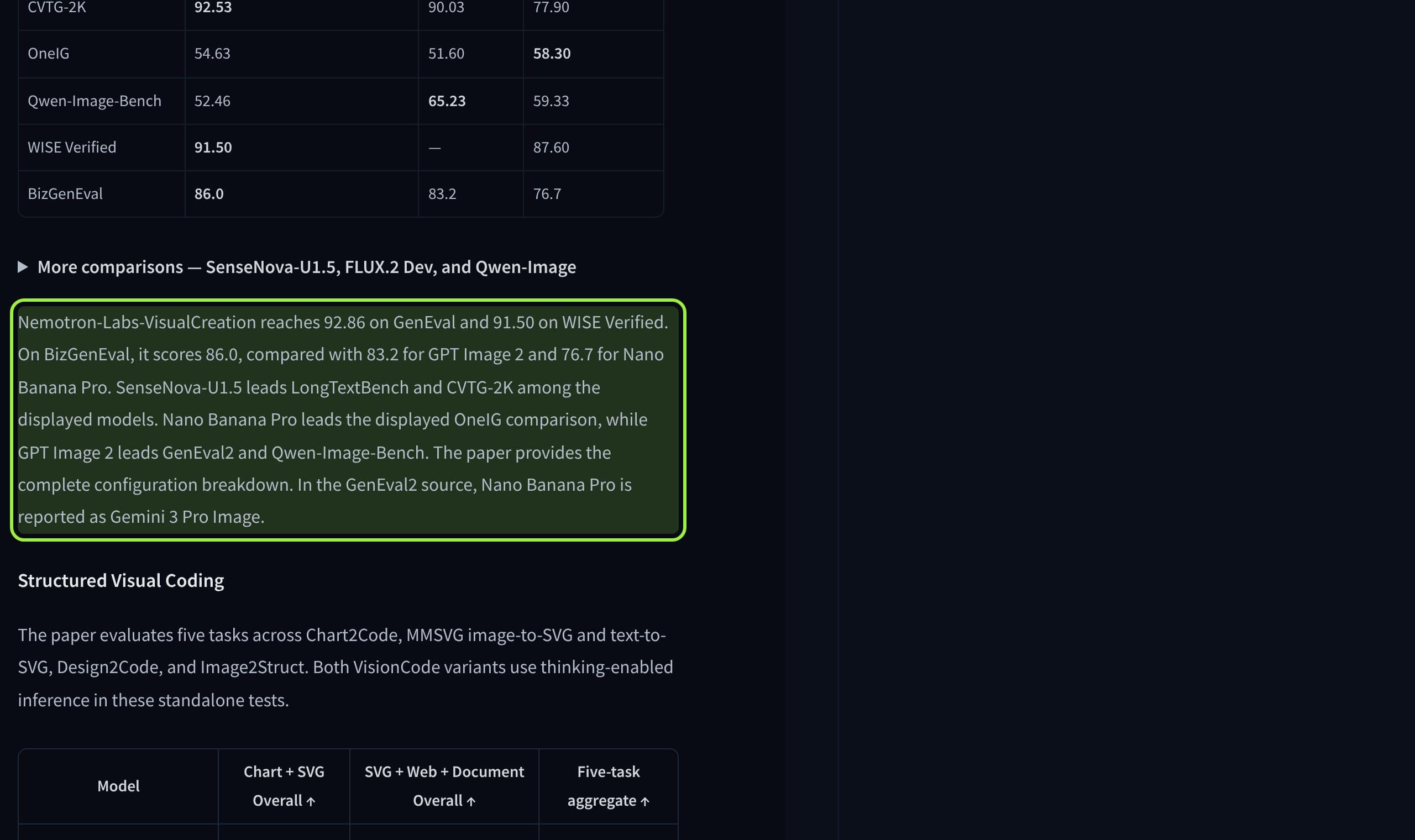
Source: Nemotron-Labs-Image-30B-A3B model card, More comparisons table, read 29 Nov 2026
Two cautions cut both ways. The Nemotron column is Nemotron-Labs-VisualCreation, the card's "best score for each benchmark across the configurations evaluated", which includes a harness that is "released upon legal clearance". The weights you can download alone may score lower. And the SenseNova column is U1.5, not U1.6. SenseTime reports U1.6's self-correction adds a 7% average relative improvement on UltraTextBench's dense infographics over single-pass output, so the gap on text is unlikely to close in Nemotron's favor.
The same prompts, side by side
The first like-for-like test came from a Reddit user who pasted NVIDIA's own Nemotron gallery prompts, unchanged, into three open models you can run at home: SenseNova U1.6, MOSS Image and Qwen-Image 2.1, one to three seeds each, and set the results next to NVIDIA's published images. As AGI Hunt summarised the post, SenseNova U1.6 was the tester's overall favorite: every line of text came out right on the slide and the movie poster prompts. MOSS Image won the picnic prompt and Qwen-Image 2.1 the jellyfish.
What creators are saying
Running Nemotron's own gallery prompts through three home-runnable models, the tester picked SenseNova U1.6 as the overall favorite, with every line of text correct on the slide and the movie poster.
The post about Nemotron's ComfyUI port liked the speed, 26 s per 1024 image on a 4090, but called the results disappointing: distorted images, wrong text, bad anatomy.
A tester ran 32 posters through SenseNova U1.6 self-correction on a 16 GB card: 18 clean first try, 7 caught and fixed, 7 slipped through. Write prompts in English and update ComfyUI first.
“Native self-correction is an optional, multi-step protocol, not a guarantee of correct output.”
ComplaintDEV Community
Commenters doubted Nemotron's launch framing and noted the harness behind its best scores is still waiting on legal clearance.
“Please add W4A8 quantization support”
The license decides before quality does
SenseNova's card is short on this: the model and the GitHub code are under the Apache 2.0 License, no revenue cap, no excluded country. NVIDIA's LICENSE says the model "only may be used or intended for use non-commercially", defines that as "research or evaluation purposes only", and section 3.2 carries the same limit to derivative works. A W4A8 port, a GGUF or a LoRA trained on it inherits it.
Running each in ComfyUI
SenseNova U1.6 is a template away. ComfyUI 0.46.0 added "Thinking, interleaved generation and self-correction" plus a ModelSamplingSenseNova node. Comfy's tutorial runs it two ways: Turbo, 8 steps at CFG 1 with the LoRA, or Quality, 50 steps at CFG 4. SenseTime recommends a 24 GB card and 64 GB of system RAM for the balanced setup. The GGUF files on SenseTime's page are for its own Python runtime, not the ComfyUI GGUF loader.
Nemotron Labs Image is not in core ComfyUI as of v0.46.2. The community ComfyUI-Nemotron-Image pack loads a 22.7 GB W4A8 file at 18.8 GiB of VRAM and reports 21.8 to 26.1 s per 1024 image on an RTX 4090; on a 12 GB card its expert cache stretches that to about 77 s. NVIDIA's own reference setup is four H100 80 GB cards. If an update breaks a custom pack, our after-update fix list covers the usual causes.
Cheat sheet: which one, for what
- Launch poster with a headline and prices
- SenseNova U1.6, 8-step LoRA, self-correction on
- Slide, infographic, dense text
- SenseNova U1.6, Quality mode, check every line anyway
- Same face across a feed
- Neither; use references or a character LoRA
- A monetized account, any country
- SenseNova U1.6 (Apache 2.0); never Nemotron
- A 12 to 16 GB card
- SenseNova int8 with offloading, or Nemotron at about 77 s per image, research only
- Studying autoregressive image generation
- Nemotron Labs Image, for research and evaluation
Our verdict
SenseNova U1.6 wins this pair for anyone who publishes. It is permissive, native in ComfyUI, fast with its LoRA, and the only one of the two that rereads its own text. Nemotron Labs Image is the more interesting research object, and its framework scores well on composition benchmarks like GenEval and WISE, but NVIDIA's own table shows SenseNova ahead on text, the very skill both are marketed on, and its license rules out every use a creator has.
Where SenseNova loses: portraits. Its card warns of "unnatural limb proportions or poses in generated portraits", and one tester comparing it with U1.5 saw bigger gains in posters than in portraits. The workable split is the one we suggested in our review: keep your face model for the character, let SenseNova draw the poster around an empty space, then composite.
If you run your character on your own ComfyUI, Musetta installs the models and nodes a workflow is missing and keeps each character's reference photos in one place, so a new model like SenseNova U1.6 is tried on the same face and prompts you already use.
Questions
- Is SenseNova U1.6 better than Nemotron Labs Image?
- For text on posters and slides, the evidence points to SenseNova. NVIDIA's own card shows the older SenseNova U1.5 ahead on LongTextBench (98.80 vs 97.98) and CVTG-2K (94.80 vs 92.53), and the one same-prompt community test picked U1.6 as its favorite. Neither has been tested on one recurring face.
- Can I use Nemotron Labs Image commercially?
- No. NVIDIA licenses it for non-commercial research and evaluation only, and section 3.2 of the license carries that limit to derivative works, including community ComfyUI ports and quantizations.
- Does Nemotron Labs Image run in ComfyUI?
- Not in core ComfyUI as of v0.46.2 (20 November 2026). A community node pack loads a 22.7 GB W4A8 file and reports 21.8 to 26.1 s per 1024 image on an RTX 4090.
- How much VRAM does SenseNova U1.6 need?
- SenseTime recommends a 24 GB GPU and 64 GB of system RAM. The Comfy-Org int8_convrot checkpoint is 17.6 GB, and one tester ran poster self-correction on a 16 GB card at about 15.5 GB peak.
- Why is SenseNova U1.6 called 8B if Hugging Face shows 17.5B?
- The name refers to the 8B-MoT design; the Hugging Face counter adds up every stored tensor in the BF16 checkpoint, 17,532,854,464 parameters on 29 November 2026.
Sources
- 01SenseNova-U1.6-8B-MoT model card · SenseTime on Hugging Face, 2026-11-27
- 02SenseNova-U1 repository · OpenSenseNova, GitHub
- 03nvidia/Nemotron-Labs-Image-30B-A3B model card · NVIDIA on Hugging Face, 2026-11-25
- 04NVIDIA License (LICENSE file) · NVIDIA, 2026-11-24
- 05ComfyUI changelog · Comfy Org, 2026-11-20
- 06SenseNova U1.6 ComfyUI tutorial · Comfy Org
- 07Comfy-Org/SenseNova-U1 files · Comfy Org on Hugging Face, 2026-11-24
- 08Nemotron-Labs-Image-ComfyUI (ComfyUI-Nemotron-Image files) · Hugging Face, 2026-11-25
- 09NVIDIA's Nemotron gallery prompts tested on three open models (Reddit roundup) · AGI Hunt
- 10Nemotron-Image ported to ComfyUI: 26s per 1024 (Reddit roundup) · AGI Hunt, 2026-11-25
- 11NVIDIA quietly open-weights Nemotron-Labs-Image (Reddit roundup) · AGI Hunt, 2026-11-25
- 12Testing SenseNova U1.6 self-correction on 32 posters (Reddit roundup) · AGI Hunt
- 13SenseNova U1.6 adds native image self-correction · DEV Community
- 14Please add W4A8 quantization support (discussion) · Hugging Face
- 15AI Image & Video Model News Roundup, November 28, 2026 · Kombitz, 2026-11-28
Researched and written by the Musetta editorial desk with AI assistance, from the sources above. Numbers come from those sources; nothing is benchmarked by us unless the article says so. Spotted an error? Tell us on Discord and we fix it.