In short
MiniMax H3 (33B) kept a character's face better than LTX 2.5 (22B) in two public hands-on tests, while LTX is several times faster (2 min 34 s against 17 min 29 s on one RTX 5090 report, with unequal steps). The catch is the license: H3's file bars use of the model and its outputs in the US, EU, UK and South Korea. Smallest file stacks are about 35 GB each. No identity benchmark exists for either, so test your own face.
If your character has to look like the same person in every clip, the video model decides whether the feed works, and two open models are fighting for that job: MiniMax H3, a 33B model with a nine-image reference mode, and LTX 2.5, a 22B model that renders a clip several times faster. Hands-on testers keep landing on the same split: H3 holds the face, LTX holds the schedule. The part nobody leads with is that H3's license also covers the clips it makes.
We did not render a head-to-head ourselves. This article compares the model cards, the license file, the Hugging Face file listings and three public hands-on tests, all read on 8 November 2026, and says where that is not enough. For each model alone, see our MiniMax H3 review and the LTX 2.5 image to video guide.
The short answer: face first, then territory, then speed
- You are in the US, EU, UK or South Korea: run LTX 2.5. The H3 license names those four as Excluded Territories and says you may not use the model or its outputs outside the Applicable Territory. We are not lawyers; read the file before you decide.
- You are elsewhere and the face is the product: use H3, in its reference mode, for every shot where the face is on screen. Two testers preferred it for likeness.
- You make many short clips and iterate: LTX 2.5. One RTX 5090 test measured 2 min 34 s for a distilled 10 second clip against 17 min 29 s for H3, and the tester called that gap unfair to H3.
- You want both: cut the edit by shot. H3 for faces, LTX for rear views, wide shots and anything long. One tester made exactly that call.
The two models side by side
| What | MiniMax H3 | LTX 2.5 |
|---|---|---|
| Maker and license | MiniMax; MiniMax H3 Community License, dated 2 August 2026 | Lightricks; LTX-2.x Community License, free for commercial use under a revenue threshold per the card |
| Size | 33B dense transformer (33,122,992,896 parameters in the Hub metadata); text encoder is Qwen3-VL-32B | 22B per the file names; Gemma 4 12B text encoder files |
| Clip | 4 to 15 s at 24 fps, 32 kHz stereo audio, 11 languages, shorter side 768 by default | Frame count must be a multiple of 8 plus 1 (121 for about 5 s); width and height divisible by 32 |
| Faces and references | Reference to video variant with up to nine reference images, plus first and last frame variants | Image to video: image conditioned by frame index and strength |
| Fast path | Turbo LoRA, 4 to 8 steps, 6 to 8 look better than 4 | Distilled checkpoint and a distilled LoRA, 8 steps in the speed test |
| ComfyUI | Official templates: text, image, continuation, reference, multiframe, ControlNet | Official templates ship with ComfyUI; some int8 files are ComfyUI only |
| Hub activity | Comfy-Org repack: 32,357,570 downloads last month | 2,643,778 downloads last month, 11k likes |
The license decides first, for H3
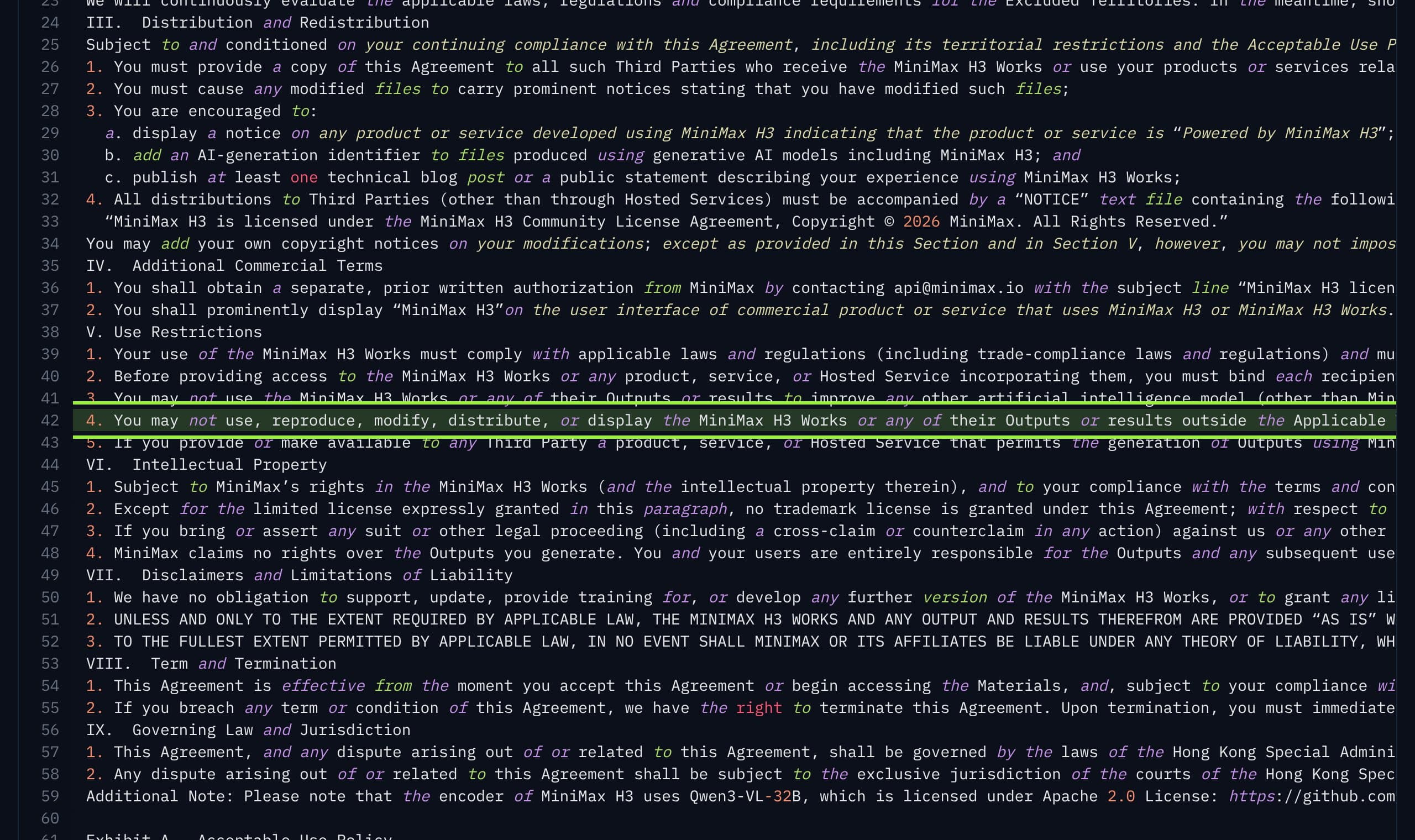
The H3 license defines the Applicable Territory as worldwide excluding the European Union, the United Kingdom, the Republic of Korea and the United States of America. Section V then says you may not use, reproduce, modify, distribute or display the model or any of its outputs or results outside that territory. Section IV adds that commercial products need separate prior written authorization from MiniMax and must display "MiniMax H3" in the user interface.
For a creator in Berlin, Austin or Seoul that is not a footnote: a reel made with H3 sits inside the restriction. The card tells people in the excluded territories to contact MiniMax for a license, and the Comfy repack makes the files easy to download, which is a separate matter from permission. LTX 2.5 asks only that companies above a revenue threshold take a paid license; the model card says commercial and production use is free under its community license below that line, and its card lists a 10 million dollar annual revenue figure.
If you are inside the Applicable Territory, the H3 clause is a compliance chore (the display notice, the authorization above the revenue line), not a blocker. The errors guide covers what goes wrong once you are running it.
Faces: what testers found
There is no controlled benchmark, no published identity score for either model, and the three public tests we found used different settings. They agree on direction more than on size.
What creators are saying
A Japanese tester ran one portrait through both. H3 kept the likeness even after a profile turn; LTX also did not turn the person into someone else, but its face got smoother and more AI-refined as the camera zoomed in.
A music-video creator found H3 held the eyes, outline and hairstyle of the source image while LTX drifted over time, but saw ghost-like artifacts around a rider in H3's rear view.
The same creator found LTX's lip sync matched the dialogue nicely, while H3's speech was clear but its lip movement was lacking.
A secondhand summary of Reddit threads, from a rival product's vendor, says H3 can add unrequested speech, that halving steps hurt audio more than picture, and that EasyCache hurt likeness for some.
ComplaintLeadde blog, updated 6 November 2026
Read together: if a face is visible for several seconds and has to match a reference, H3 is the safer pick. If the face is small, hidden or turned away, LTX gives up little. Neither tester measured identity with a number, so "safer" is a reading of people's eyes, not a metric.
Speed and files: closer on disk than in time
Time is where LTX wins. The two timed tests we found disagree on the size of the gap because they differ in settings. On one Mac-based test, a 5 second portrait clip took 8 min 43 s on H3 (8-bit, 960 by 544, 30 steps) and 5 min 42 s on LTX 2.5 Fast in LTX Desktop at 540p, a gap of 3 min 1 s. On an RTX 5090, a Reddit-sourced report put a 10 second 1920 by 1088 H3 clip at 17 min 29 s with 20 steps, SageAttention and EasyCache, against 2 min 34 s for LTX's distilled 8-step run, and noted the step counts make that unequal.
On disk the gap is smaller than the reputation. Summing the files in each Hugging Face listing by hand, a typical int8 stack for H3 is about 51.5 GB, and for LTX about 38.3 GB. The smallest stack we could assemble from each listing is almost a tie.
| Stack | MiniMax H3 | LTX 2.5 |
|---|---|---|
| Diffusion model, int8 | 20.97 (pruned) or 34.04 (full) | 21.50 |
| Text encoder, int8 | 27.14 | 15.37 |
| VAEs, int8 video plus audio | 3.42 (2.81 + 0.61) | 1.47 (one video VAE listed) |
| Typical int8 stack | 51.53 | 38.34 |
| Smallest stack | 35.09 (w6a8 15.98 + nvfp4 text 15.69 + VAEs 3.42) | 35.56 (nvfp4 18.72 + int8 text 15.37 + VAE 1.47) |
Disk is not VRAM. Neither card publishes a minimum, H3's own example uses four GPUs, and community reports describe H3 on 24 GB with quantization and offloading. If you are sizing a card, renting a GPU for a test day costs less than buying for the wrong model.
Which one for a recurring character
Pick by situation
- Face on screen, in the Applicable Territory
- H3 reference mode, turbo LoRA for drafts, full steps for finals
- Face on screen, in the US, EU, UK or South Korea
- LTX 2.5; keep image strength and compression as in our guide and test one clip first
- Dialogue and lip sync
- Test both: LTX matched lips better in one test, H3 speech was clearer; neither is settled
- Rear views, wide shots, 30 second clips
- LTX 2.5; one tester made a 30 second clip in one pass
- Fast daily iteration
- LTX 2.5 distilled
- Training a LoRA to lock the face
- Both can take one; see our LoRA guide. H3 LoRAs inherit the H3 license
Whichever you choose, the face starts in the still, not the video model. A character built from reference images and a trained LoRA gives either model a better start, which is covered in our consistent character guide. For other open video models for 9:16, see best open video models for vertical reels.
Run your own A/B in 30 minutes
Match resolution and clip length; unequal settings are the flaw in two of the public tests.
- 1
Pick one portrait and one prompt
Use a face-forward still of your character and a prompt with a slow head turn and one line of motion. No speech in the first round.
- 2
Match the settings
Same aspect ratio, same pixel count, same frame count. For LTX, use a frame count that is a multiple of 8 plus 1; for H3, 4 to 15 seconds at 24 fps.
- 3
Run H3 with the reference variant
Use the official reference template. Add the turbo LoRA at strength 1.0, scheduler simple, 6 to 8 steps, for a draft.
- 4
Run LTX with the distilled checkpoint
Use the image to video template. Start from image strength 0.70 and compression 18 from our guide.
- 5
Score three frames
Look at the first frame, the middle of the head turn and the last frame. Note which face you would post under your character's name.

Verdict
For a recurring character the order is face, then territory, then speed. If you are inside the Applicable Territory and the face is on screen, H3 is the stronger bet on what testers have posted. If you are in the US, EU, UK or South Korea, the license question settles it before quality matters, and LTX 2.5 is the model you can run.
What we cannot call is a winner on identity with numbers: no one has published an identity score for either model, the tests above used unequal settings, and two of three are blog posts. Run the 30 minute test with your own face and decide on those frames.
If you want to try both without rebuilding a graph, Musetta runs on your own ComfyUI, installs the nodes and models a workflow is missing and keeps each character's reference photos. We make it, so weigh that line accordingly.
Questions
- Is LTX 2.5 or MiniMax H3 better for keeping the same face?
- In the three public hands-on tests we found, H3 kept the face better, especially after a head turn. None used an identity score, and settings were unequal, so treat it as a strong hint rather than a measurement.
- Can I use MiniMax H3 in the US or EU?
- The license file defines the Applicable Territory as worldwide excluding the EU, UK, South Korea and the US, and Section V forbids using the model or its outputs outside it. Contact MiniMax for a license, or use LTX 2.5. This is not legal advice.
- Is LTX 2.5 free for commercial use?
- The model card says commercial and production use is free under the LTX-2.x Community License, and companies above 10 million dollars of annual revenue need a paid agreement. Read the license before you rely on it.
- Which is faster in ComfyUI?
- LTX 2.5. One RTX 5090 report gave 2 min 34 s for a distilled 10 second clip against 17 min 29 s for H3 at 20 steps, which the tester said is not an equal comparison. A Mac test gave 5 min 42 s against 8 min 43 s for a 5 second clip.
- Do both need the same amount of disk space?
- Close when you pick the smallest files: about 35 GB each by our sums. A typical int8 stack is about 51.5 GB for H3 and 38.3 GB for LTX.
Sources
- 01MiniMax-H3 model card · MiniMax, Hugging Face
- 02MiniMax H3 LICENSE (Community License Agreement) · MiniMax, Hugging Face, 2026-08-02
- 03LTX-2.5 model card · Lightricks, Hugging Face
- 04Lightricks/LTX-2.5 file listing · Lightricks, Hugging Face
- 05Comfy-Org/MiniMax-H3 file listing · Comfy-Org, Hugging Face
- 06LTX-2.5 vs MiniMax H3: same single image, 5 second videos · Tami, note.com, 2026-08-18
- 07MiniMax H3 vs LTX-2.5: comparing quality using the same MV footage · AI Creative Log, note.com, 2026-08-24
- 08MiniMax H3 Reddit Review 2026 · Leadde blog, 2026-11-06
- 09MiniMax-H3 Turbo LoRA model card · Hugging Face
Researched and written by the Musetta editorial desk with AI assistance, from the sources above. Numbers come from those sources; nothing is benchmarked by us unless the article says so. Spotted an error? Tell us on Discord and we fix it.