In short
NVIDIA published Nemotron-Labs-Image-30B-A3B on Hugging Face on November 24: a 30B mixture-of-experts language model, 3B active, that writes a picture as 16-pixel codes row by row instead of denoising it. NVIDIA's own example needs four H100s, but by the evening of November 25 a community port ran it in ComfyUI at 21.8 s per 1024x1024 image on an RTX 4090 and 77 s on 12 GB. The catch for a monetized feed is the license: non-commercial research and evaluation only, ports included.
If you run a character feed, you will see Nemotron-Labs-Image in your timeline this week, with headlines saying it beats GPT Image 2. Here is the fact to hold before you download 65 GB: NVIDIA licenses it for non-commercial research and evaluation only, and every ComfyUI port so far inherits that license. It is worth testing. It is not something to post from.
What makes it news is the architecture. Every image model in our best open source image models list is a diffusion model. This one is a language model that writes images: a 1024x1024 picture is 4,250 tokens, generated one 16x16 patch at a time and turned into pixels by a separate 642M decoder. And two days after release, it already runs on a 12 GB card.
Three days at a glance
Sep 24
NVIDIA creates the
nvidia/Nemotron-Labs-Image-30B-A3Brepository on Hugging Face (creation date from the Hugging Face API). It stays out of public view until release.Nov 24
The "Clean release snapshot" commit lands at 21:55 UTC. ComfyUI Wiki reports the release the same day and notes no ComfyUI support yet: no native nodes, no Comfy-Org repack.
Nov 25, morning
An NVFP4 quantization appears, followed by the first GGUF repos in the afternoon. A free Hugging Face Spaces demo opens; launch-day users report it refusing jobs.
Nov 25, 19:11 UTC
ComfyUI-Nemotron-Image ships with five model files (W4A8 to bf16) and a stock-VAE pixel decoder, with measured times on RTX 3090 and 4090.
Nov 25, 22:05 UTC
A second port publishes a 24.4 GB W4A8 file for a separate node pack, measured at about 293 s per 1024 image on an RTX 5060 Ti 16 GB.
Nov 26
MLX 5-bit and 8-bit builds for Apple silicon and more GGUF repos. ComfyUI core is still at v0.46.2 (November 20), with nothing about Nemotron in its changelog.
What NVIDIA released, and what it held back
The model card describes a larger system called Nemotron-Labs-VisualCreation, an agent that plans a deliverable, generates candidates, inspects them and repairs them. Nemotron-Labs-Image is its raster component, initialized from Nemotron 3 Nano and trained with progressive mid-training and GRPO. The release covers the image generator and its tokenizer. The harness and the VisionCode models that write SVG and HTML are listed as "Will be released upon legal clearance."
That matters for the benchmark headlines. The results table on the card is labelled as the framework's best score per benchmark across the configurations in the paper. It shows 92.86 on GenEval against 89.00 for GPT Image 2, but GPT Image 2 leads GenEval2 (81.00 against 65.43) and Qwen-Image-Bench. Those numbers describe the full agent loop, which you cannot download, so treat them as a ceiling rather than what one ComfyUI run gives you.
Nemotron-Labs-Image-30B-A3B, the cheat sheet
- Type
- Autoregressive mixture-of-experts LM, not diffusion
- Parameters
- 30B total, 3B active per token (NVIDIA); the Hugging Face counter reads 32.6B
- Pixel decoder
- Nemotron-Labs-Image-Tokenizer, about 642M, 16x16 patches
- Recommended sizes
- 1024x1024, 1184x880, 1248x832, 880x1184 (multiples of 16)
- Sampling
- temperature 0.9, top-p 1.0, max 4,352 tokens
- Reference hardware
- 4x H100 80 GB, vLLM, tensor parallel 4
- Community ComfyUI
- W4A8 on 24 GB: 21.8 to 26.1 s per 1024 image (RTX 4090)
- License
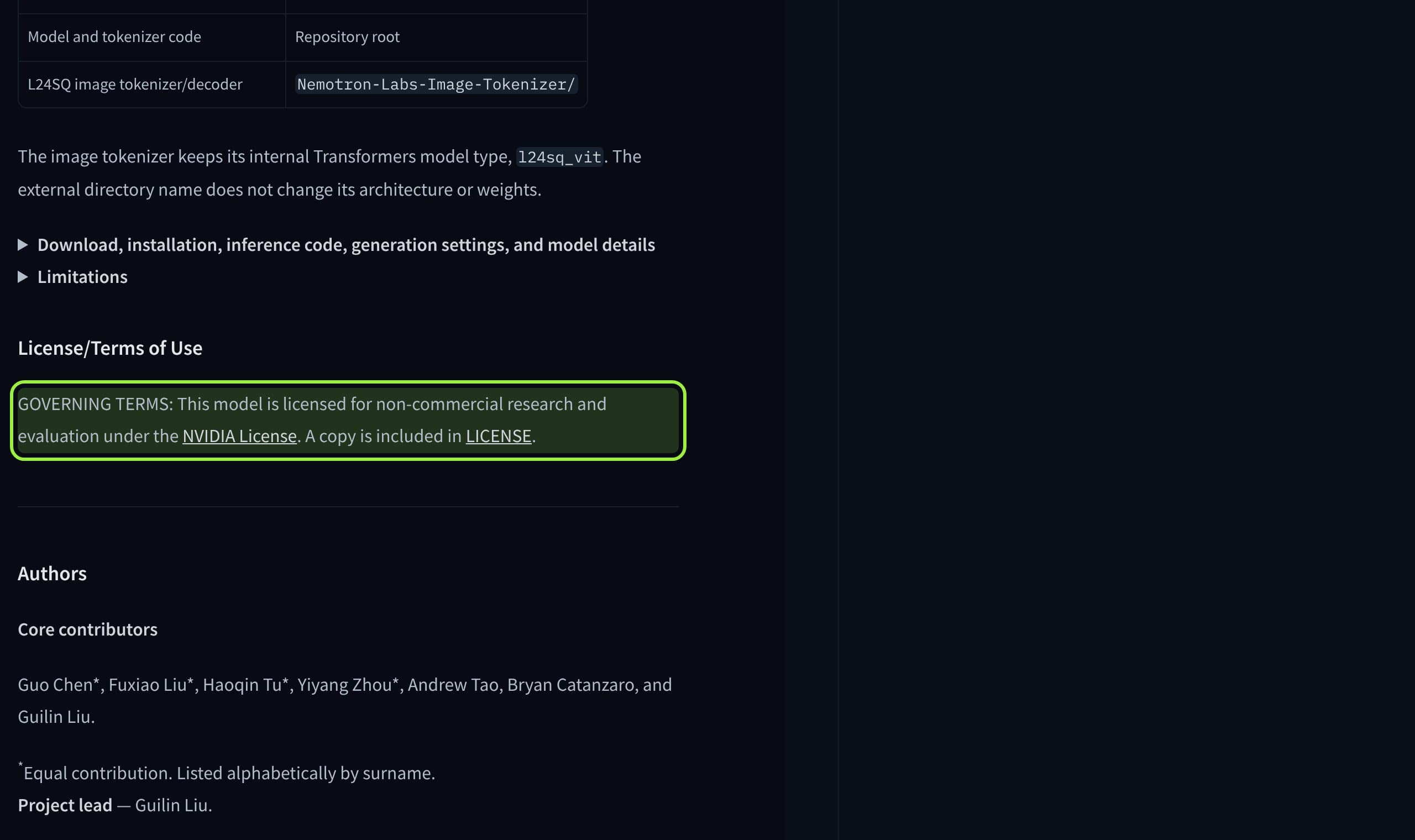
- NVIDIA License: non-commercial, research or evaluation only
Running it in ComfyUI: the numbers
The port that matters is ComfyUI-Nemotron-Image. It stacks the 128 routed experts per layer into banks, quantizes them (they are 90% of the weights) and keeps the router, norms and codebook in bf16. The workflow is three pack nodes plus core VAE Decode and Save Image: the generate node returns a LATENT the way KSampler does, and shows rows as they are written.
| File | Size | Where the experts live | RTX 4090 | RTX 3090 |
|---|---|---|---|---|
| W4A8 int8 dense | 21.6 GB | on the card, 1 GiB less VRAM than W4A8 | 21.8 s | 26.7 s |
| W4A8 | 22.7 GB | on the card: 18.8 GiB VRAM | 26.1 s | 30.8 s |
| W6A8 | 30.0 GB | 27 GiB system RAM, card cache | 33.1 s | 38.7 s |
| int8 | 35.5 GB | 30.5 GiB system RAM, card cache | 36.6 s | 40.3 s |
| bf16 | 65.3 GB | about 80 GB RAM needed | 232.7 s | 222.6 s |
Smaller cards work through an expert cache in system RAM. The card measures 36.1 s on 16 GB and 77.2 s on 12 GB with W4A8, both simulated on a 4090 with the rest of the memory held by another process. Batching is where an autoregressive model pays off: eight images at once take 6.1 s each on the 4090. If your card is smaller, our rent a GPU guide covers the hourly route.
On quality the port's own test is narrow but specific: in 36 images, requested text was exact on 34 of 36 signs and labels, with no extra limbs on foxes and a cat. It also warns that short prompts invite unrequested text: the model card's one-line fox prompt added a garbled signpost in 4 of 6 images. NVIDIA's limitations section says the same in general terms, and adds that loading runs repository code through trust_remote_code.
The license, in one clause
Section 3.3 of the included NVIDIA License says the work and any derivative works "only may be used or intended for use non-commercially", and defines non-commercially as research or evaluation purposes only. NVIDIA reserves commercial use for itself. Section 3.2 makes any derivative carry the same limit, which is why both ComfyUI ports state research or evaluation only on their cards.
For an account with sponsors, affiliate links or a subscription, that rules it out as a production model, the same verdict we reached for Apple FastFrames three days ago. Our license table for 13 open models lists what you can monetize instead; MiniMax H3 Image remains the strongest open choice for a recurring face, with its own territory limits covered in our H3 Image review.
What creators are saying
Two people trying the free Hugging Face demo on launch day hit an error saying the requested GPU time, 2,400 seconds, is over the allowed maximum.
ComplaintModel discussion on Hugging Face
The post about the ComfyUI port praised the speed, 26 s per 1024 image on a 4090, but called the output disappointing: distorted images, wrong text, bad anatomy, a research preview at best.
Commenters were skeptical of the promotional framing and pointed out that the harness behind the best benchmark scores is still waiting on legal clearance.
Others welcomed it as possibly the first autoregressive image model they can realistically run at home, because only 3B parameters work per token.
Japanese creators mostly asked about VRAM, speed, ComfyUI support and an INT8 quantization, according to a roundup of reactions.
QuestionRoundup post on X
A feature request asks stable-diffusion.cpp to support the model with GGUF quantization and CPU and GPU offloading, to make it practical on limited VRAM.
Note the disagreement: the port's card reports exact text on 34 of 36 signs, while the Reddit verdict says wrong text. Both can be true, since the card's prompts were long and detailed and the model card itself asks for prompts that spell out colour, quantity, text and position. Nobody has yet posted a same-prompt comparison against a diffusion model.
What it means for a character feed
Nothing changes in your production graph this week. There is no LoRA training path, no reference or edit input in the release, and no way to hold a face except by prompt. What it does show is where image models are heading: an LM that writes images can share a context with a planner, and NVIDIA's withheld harness already picks and repairs candidates. If that loop ships under a commercial license, it becomes a real option for product shots with readable labels.
What to do this week
- 1
Test it only if you have 24 GB or patience
Clone ComfyUI-Nemotron-Image into
custom_nodes, download the W4A8 file and the 1.24 GB pixel decoder, and open the pack's example workflow. If a node shows as missing, our missing nodes guide covers the fix. - 2
Write long prompts
Spell out colours, counts, the exact text and where things sit, at one of the four recommended sizes. A one-line prompt invites stray text.
- 3
Keep its renders off your feed
Anything you make with it is research or evaluation under section 3.3. Label the folder that way so nothing slips into a scheduled post.
- 4
Do not update core for it
No ComfyUI release adds Nemotron support; it runs as a custom node on current versions. If an update breaks something else, see ComfyUI broken after update.
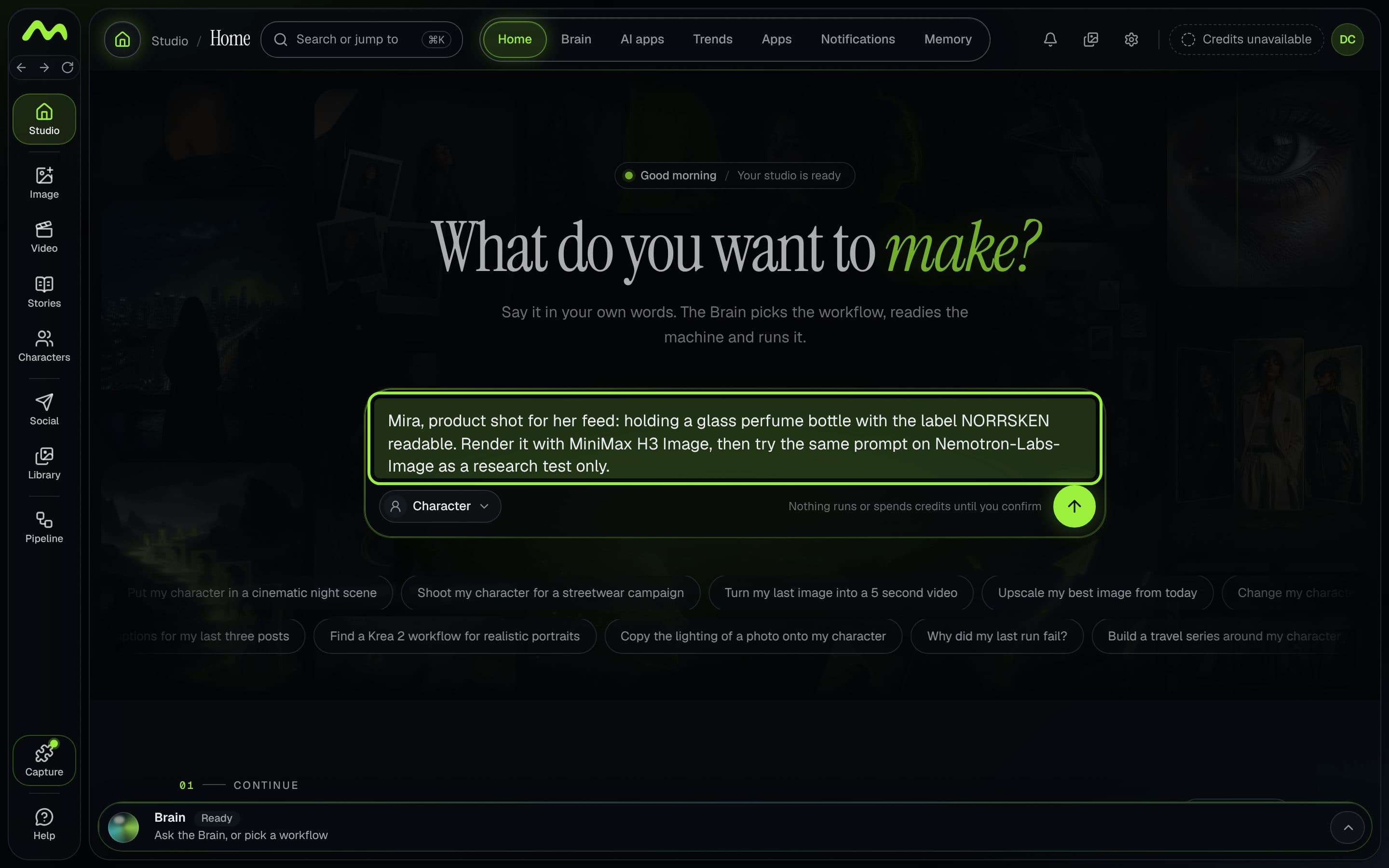
If you want to try it next to your current model without rebuilding graphs, Musetta runs on your own ComfyUI, installs the nodes and models a workflow is missing, and keeps each character's reference photos together. Keep the Nemotron renders as a test, for the license reason above.
Questions
- What is Nemotron-Labs-Image-30B-A3B?
- An NVIDIA text-to-image model released on Hugging Face on November 24, 2026. It is a 30B mixture-of-experts language model with 3B active parameters that generates an image as visual tokens, decoded to pixels by a separate 642M tokenizer, rather than a diffusion model.
- Can I use Nemotron-Labs-Image commercially?
- No. The model card and the included NVIDIA License limit the model and any derivative works to non-commercial research or evaluation. Community ComfyUI ports carry the same license.
- Does Nemotron-Labs-Image run in ComfyUI?
- Not natively: ComfyUI core v0.46.2 has no Nemotron support. The community ComfyUI-Nemotron-Image node pack runs it, with a W4A8 file measured at 21.8 to 26.1 s per 1024x1024 image on an RTX 4090.
- How much VRAM does Nemotron-Labs-Image need?
- NVIDIA's reference script uses four H100 80 GB cards. The community W4A8 file fits a 24 GB card at 18.8 GiB, and runs on 16 GB (36 s per image) and 12 GB (77 s) by caching experts from system RAM.
- Is it better than GPT Image 2?
- Only on some benchmarks, and those scores are for NVIDIA's full VisualCreation agent, which is not released. GPT Image 2 leads on GenEval2 and Qwen-Image-Bench in NVIDIA's own table.
Sources
- 01nvidia/Nemotron-Labs-Image-30B-A3B model card · NVIDIA on Hugging Face, 2026-11-25
- 02NVIDIA License (LICENSE file) · NVIDIA, 2026-11-24
- 03Nemotron-Labs-Image-ComfyUI (ComfyUI-Nemotron-Image files) · Hugging Face, 2026-11-25
- 04Nemotron-Labs-Image-30B-A3B for ComfyUI (W4A8 experts) · Hugging Face, 2026-11-25
- 05Demo for this model on Spaces (discussion) · Hugging Face, 2026-11-25
- 06NVIDIA Nemotron-Labs-Image 30B-A3B: Pixel as Code Image Model · ComfyUI Wiki, 2026-11-24
- 07ComfyUI changelog · Comfy Org, 2026-11-20
- 08NVIDIA Releases Open Weights For Nemotron-Labs-Image-30B-A3B · Wccftech, 2026-11-25
- 09Nemotron-Image ported to ComfyUI: 26s per 1024 (Reddit roundup) · AGI Hunt, 2026-11-25
- 10NVIDIA quietly open-weights Nemotron-Labs-Image (Reddit roundup) · AGI Hunt, 2026-11-25
- 11[Feature] Support NVIDIA Nemotron-Labs-Image-30B-A3B model, issue #2430 · stable-diffusion.cpp on GitHub, 2026-11-25
Researched and written by the Musetta editorial desk with AI assistance, from the sources above. Numbers come from those sources; nothing is benchmarked by us unless the article says so. Spotted an error? Tell us on Discord and we fix it.