In short
Apple's FastFrames (1.3B and 14B, distilled from Wan 2.1) makes 832 × 480 video in two steps, 36 ms a frame on one B200 for the small model. For a character feed it is not usable yet: research-only weights, text to video only on its cards, no ComfyUI node. Keep Wan 2.2, which is Apache 2.0 and takes a reference image.
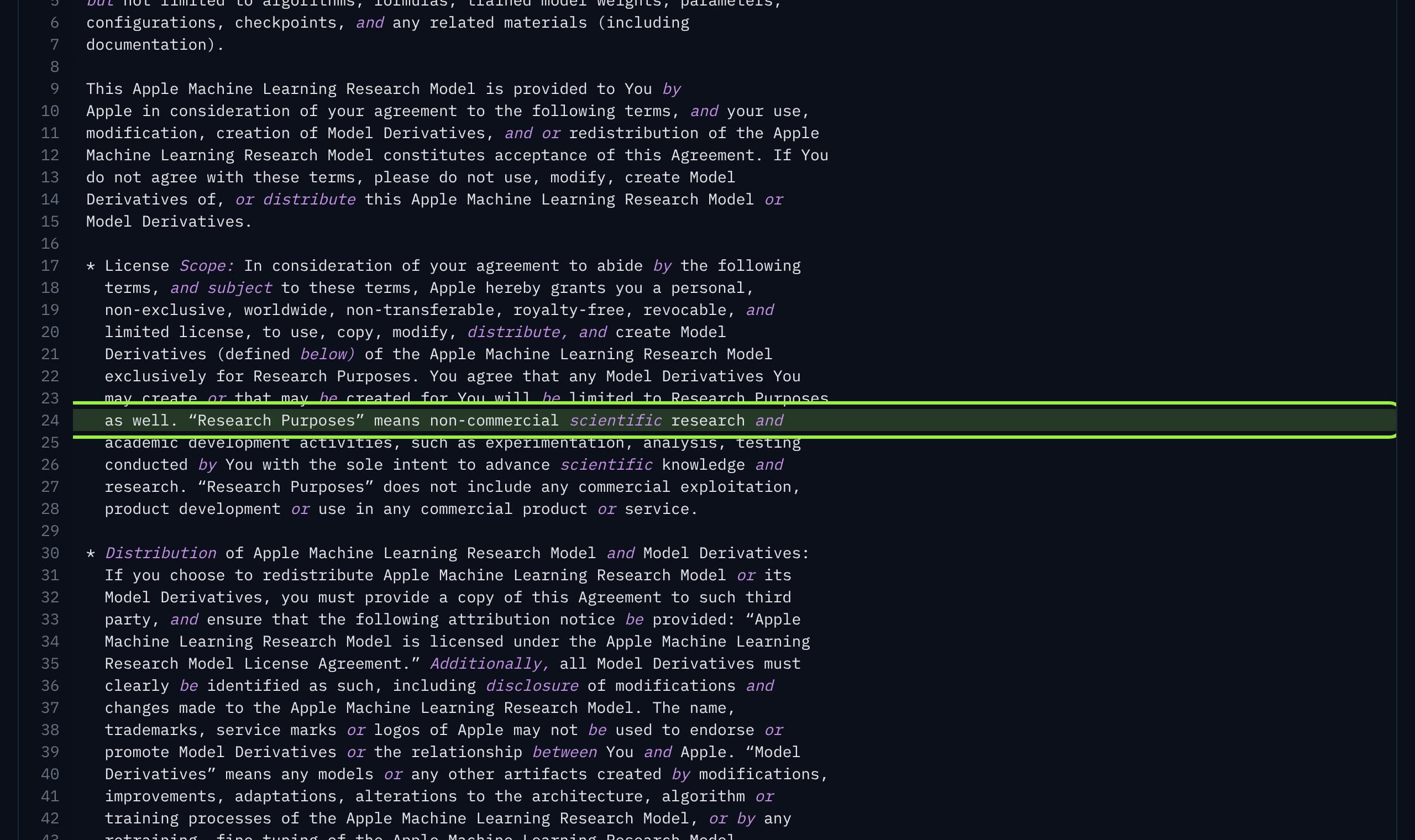
Apple's FastFrames is the most liked new text-to-video model on Hugging Face this week, and it is built on the same Wan family that many character feeds already run. So the question for anyone posting a recurring face is simple: can you use it, and does it beat the Wan 2.2 you already run? The license answers first. FastFrames weights are licensed exclusively for Research Purposes, and Apple's agreement says that excludes use in any commercial product or service.
We did not render FastFrames ourselves: the official code needs Linux and an NVIDIA GPU, and nobody has published a node for ComfyUI. This review reads Apple's model cards, repository and paper, the Wan 2.2 repository, and the one hands-on run anyone has reported, a community port to a Mac.
FastFrames specs
Apple FastFrames at a glance
- Maker
- Apple, paper on arXiv 17 Nov 2026
- Sizes
- FastFrames-S 1.3B, FastFrames-L 14B
- Base
- Wan 2.1 T2V (1.3B and 14B), distilled to two steps
- Task on the cards
- Text to video
- Output
- 832 × 480, 81 frames, 16 fps
- Speed claimed
- S: 36 ms a frame on one B200. L: 45 ms on eight B200s
- Runs on
- Linux, NVIDIA GPU, CUDA 12.8 driver
- Weights license
- Apple ML Research Model License, research only
- ComfyUI
- No node or template as of 23 Nov 2026
The short answer
- For a monetized character feed, keep Wan 2.2. It is Apache 2.0, it is in ComfyUI with official templates, and it takes a reference image.
- FastFrames is a speed result, not a creator tool yet. Two sampling steps, 36 ms a frame for the 1.3B model on one B200, but research use only, text to video only on its cards, 832 × 480 at 16 fps.
- Watch it anyway. It is a distillation of Wan 2.1, so the ideas (cheaper decoding, cheaper cache updates) are the kind that end up in ComfyUI ports under other licenses.
FastFrames vs Wan 2.2, the model you already run
| Spec | FastFrames (S / L) | Wan 2.2 (TI2V-5B / A14B) |
|---|---|---|
| Released | Paper 17 Nov 2026 | Weights 28 Jul 2025 |
| Size | 1.3B / 14B | 5B / two 14B experts, 27B total, 14B active |
| Built from | Wan 2.1 (1.3B and 14B), distilled to two steps | Wan 2.2's own training |
| Weights license | Apple ML Research Model License: research only | Apache 2.0 |
| Inputs on the cards | Text to video | Text to video and image to video |
| Output | 832 × 480, 81 frames, 16 fps | 720P at 24 fps (5B) |
| Sampling | Two steps, autoregressive | Full diffusion schedule |
| Speed claimed | 36 ms per frame (S, one B200); 45 ms (L, eight B200s) | 5 second 720P clip in under 9 minutes on one consumer GPU (5B) |
| Hardware | Linux, NVIDIA GPU, CUDA 12.8; no VRAM figure | 5B single-GPU command needs 24 GB (e.g. RTX 4090) |
| ComfyUI | No node, no template | In core, official templates |
Why FastFrames is fast
FastFrames is not a new base model. Apple took Wan 2.1, distilled it into a two-step causal model that writes the video a frame at a time, then went after the parts people usually leave alone. The paper says VAE decoding and KV cache updates were over half of the end-to-end latency, so the team replaced both with light networks: a pixel decoder and a KV refinement step.
Source: apple/FastFrames-S model card
The two denoising steps are almost all of the 35.4 ms. The decoder that usually dominates a video model costs under a millisecond. That is the engineering worth reading about, and it is why the larger model reaches 45 ms a frame, 22 responses a second, on an eight-GPU node.
Note what those numbers are. They are Apple's, measured on NVIDIA B200s, a data-center card, and the large model's figure needs eight of them. No one has published an independent timing on a consumer GPU yet.
The license is the whole story for a feed
Wan 2.2's repository says its models are under the Apache 2.0 License, and Comfy's repackaged files carry the same tag. You can post what you make, sell it, and fine-tune it.
FastFrames' weights carry the Apple Machine Learning Research Model License Agreement. It grants use only for research, and defines research as non-commercial scientific and academic work. Anything you derive from the model, including a fine-tune or a LoRA, is held to the same limit.
Running each one today
Wan 2.2 is the easy one. The Wan 2.2 repository announced the ComfyUI integration on release day, and the Comfy-Org repack lists templates for 5B video, 14B text to video and 14B image to video. Comfy's repack was downloaded 10,441,225 times last month on Hugging Face. For a step-by-step setup with a character, see our Wan 2.2 guide.
FastFrames runs from Apple's own scripts. The repository asks for Linux x86-64, an NVIDIA GPU and a CUDA 12.8 driver, and lists no VRAM figure. ComfyUI's changelog shows v0.46.0 on 18 November with PAN 2 in core and no FastFrames, and our search found no custom node.
The only measured run outside Apple is a community port to Apple Silicon. On an M4 Max with 64 GB it made an 81-frame 480p clip in about 63 seconds at about 20 GB peak, later 45 to 50 seconds with a Metal attention kernel. The port covers FastFrames-S only: the 14B model did not fit in 64 GB without offloading.
FastFrames' cards document text to video only, so it cannot start from a character's reference photo.
Good and bad for a recurring face
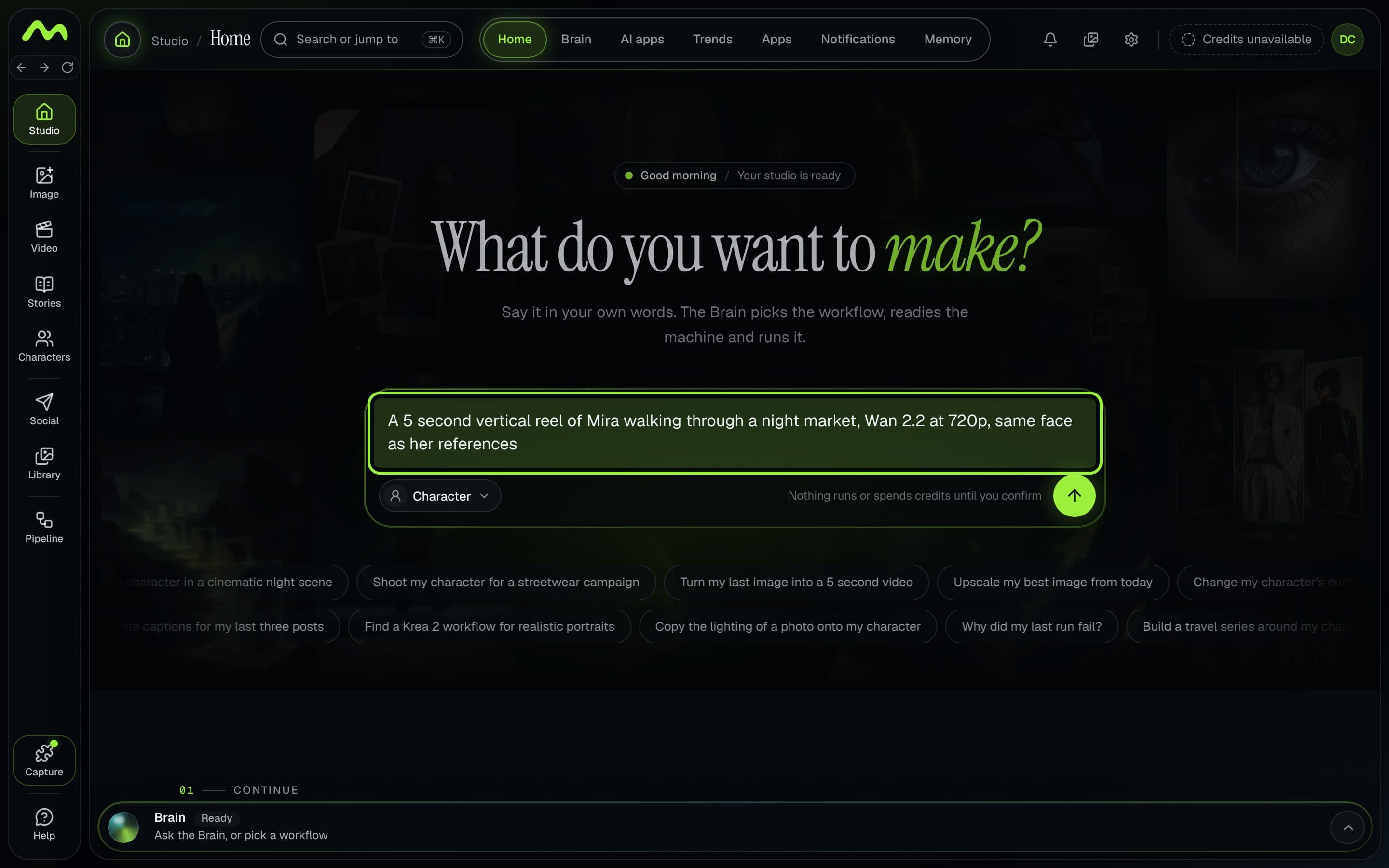
A character feed lives on image to video: you start from a picture that already has the right face and let the model move it. Wan 2.2 does that. FastFrames' cards describe text to video, and a prompt alone does not hold a face from clip to clip. If you want the full playbook for keeping a face, our consistent character guide covers references and LoRAs.
Format matters too. FastFrames documents one output size, 832 × 480, which is landscape. A reel is portrait. We found no portrait setting in Apple's docs. For the sizes each model accepts in 9:16, see vertical image sizes per model, and for video options our ranking of the best open video models for vertical reels.
What creators are saying
“Only installation instructions (now) are for linux”
ComplaintHacker News
“Interactive latency isn't reachable here.”
A reply to the Mac port says its memory fix and its exact match with the CUDA results make a real case for batch generation on Apple Silicon.
A user asks why an Apple model ships for CUDA rather than for Apple's own hardware.
A developer write-up calls the engineering good and the release generous to researchers, but says you cannot build a product on research-only weights and points readers to Wan instead.
ComplaintDEV Community
Reddit was not reachable from our research session, and no Reddit thread on FastFrames surfaced in search, so these voices come from Hacker News, Hugging Face and a developer blog.
Which one to run, by situation
FastFrames or Wan 2.2
- Your character earns money
- Wan 2.2. FastFrames is research only
- You start from the character's photo
- Wan 2.2 image to video
- You want it inside ComfyUI today
- Wan 2.2, built in with templates
- You have a 24 GB card
- Wan 2.2 5B; FastFrames lists no VRAM figure
- You study fast video generation
- FastFrames: read the paper, run S on Linux
- You only own a Mac
- FastFrames-S through the community port, for tests
- You need portrait 9:16
- Wan 2.2; FastFrames documents 832 × 480 only
How to keep your options open
- 1
Keep Wan 2.2 as the feed model
Run your image to video renders on Wan 2.2 in ComfyUI, from a fixed reference photo of the character.
- 2
Test FastFrames on the side, privately
If you have a Linux box with an NVIDIA card, run FastFrames-S from Apple's scripts to see what two-step video looks like. Do not post the output.
- 3
Watch the ComfyUI changelog
A core node or template would show up in Comfy's changelog first. Until then, any node you find is a third party's code.
- 4
Re-read the license before any change
If Apple or anyone else ships the same technique under an open license, the verdict below changes. A port does not change the license of the weights it loads.
Verdict
Wan 2.2 wins for anyone running a character, and it is not close: Apache 2.0, image to video from the character's own photo, in ComfyUI since launch. FastFrames is an impressive result with three blockers for a feed: research-only weights, text to video only on its cards, and no ComfyUI path.
What would change this: a FastFrames release under an open license, an image to video checkpoint, or a ComfyUI node with a consumer-GPU timing someone has measured. Until one of those lands, read the paper and keep rendering on Wan.
Disclosure: we make Musetta, a studio that runs on your own ComfyUI. It does not run FastFrames.
Questions
- Can I use FastFrames for a monetized Instagram or TikTok account?
- No. The weights are under Apple's Machine Learning Research Model License, which allows research purposes only and excludes use in any commercial product or service. Derivatives such as fine-tunes are held to the same limit.
- Does FastFrames work in ComfyUI?
- Not as of 23 November 2026. ComfyUI v0.46.0 (18 November) added PAN 2 but no FastFrames, and we found no custom node. Apple's code runs from its own scripts on Linux with an NVIDIA GPU and CUDA 12.8.
- Is FastFrames faster than Wan 2.2?
- On Apple's numbers, by a wide margin: 36 ms per frame for FastFrames-S on one B200 and 45 ms for FastFrames-L on eight. Wan 2.2's 5B model makes a 5 second 720P clip in under 9 minutes on one consumer GPU. Nobody has published a side-by-side on the same card.
- Will FastFrames run on a Mac?
- Apple's code does not. A community port runs FastFrames-S on an M4 Max with 64 GB at about 45 to 63 seconds per 81-frame clip. The 14B model did not fit in 64 GB without offloading.
- What resolution does FastFrames make?
- 832 × 480, 81 frames at 16 fps, about five seconds, according to both model cards. No portrait size is documented.
Sources
- 01apple/FastFrames-L model card · Apple, Hugging Face, 2026-11
- 02apple/FastFrames-S model card · Apple, Hugging Face, 2026-11
- 03FastFrames-L LICENSE (Apple Machine Learning Research Model License Agreement) · Apple, Hugging Face
- 04ml-fastframes repository · Apple, GitHub
- 05FastFrames: Video Generation at Interactive Latency · arXiv, 2026-11-17
- 06Wan2.2 repository · Wan-Video, GitHub, 2025-07-28
- 07Comfy-Org/Wan-2.2 · Comfy-Org, Hugging Face
- 08What's new in ComfyUI: recent changes · Comfy, 2026-11-18
- 09Running FastFrames-S on Apple Silicon (MPS) · Hugging Face discussions
- 10FastFrames-L discussion #1 · Hugging Face discussions
- 11Apple/FastFrames-L Model · Hacker News, 2026-11-18
- 12How to Run Apple's FastFrames-L Video Model Locally (It Won't Run on a Mac) · DEV Community
Researched and written by the Musetta editorial desk with AI assistance, from the sources above. Numbers come from those sources; nothing is benchmarked by us unless the article says so. Spotted an error? Tell us on Discord and we fix it.