In short
We read the license of 13 open models a character feed is likely to run, at the source, on 24 November 2026. Five are plain Apache 2.0 or MIT: use and sell. Three are free until a revenue line (Krea 2 at $1M, FLUX 3 Klein at $5M, LTX 2.5 at $10M). The two MiniMax H3 licenses exclude the US, EU, UK and South Korea, outputs included. Qwen-Image 2.1, Apple FastFrames and Kyutai AURA are non-commercial.
A character feed that takes one brand deal is a commercial product, and the model that drew its face decides whether that deal was allowed. The two most downloaded image repacks on Hugging Face this month sit under two very different licenses: Comfy's Krea 2 repack shows 4.6 million downloads last month, and Krea 2 is free to use commercially only while you and your affiliates earn under $1,000,000 a year, while the MiniMax H3 Image repack (4.0 million) is not licensed at all in the US, EU, UK or South Korea.
This explainer sorts 13 open models into those four kinds, with the clause that matters for each, read at the license itself on 24 November 2026. It is a reading guide, not legal advice: where money is serious, a lawyer reads the full text.
The four kinds of open model license
- Permissive (Apache 2.0, MIT). Use it, sell what it makes, change it, ship it. You keep the license and notices with any copy of the weights you pass on. MOSS Image, Z-Image Turbo, Wan 2.2, PAN 2 and LongCat Avatar 1.6.
- Revenue-capped community licenses. Commercial use is free until a revenue line, counted with your affiliates, then you need a paid agreement. Krea 2 ($1M), FLUX 3 Klein ($5M), LTX 2.5 ($10M).
- Territory-gated. The license only applies outside a list of countries, and it reaches what you generate. Both MiniMax H3 licenses exclude the European Union, the United Kingdom, South Korea and the United States.
- Non-commercial. Research, evaluation or personal use only, whatever your revenue. Qwen-Image 2.1 (Qwen Research License), Apple FastFrames (Apple ML Research license), Kyutai AURA-1.3B (CC BY-NC 4.0).
| Model | License | Paid feed allowed? | The clause that bites |
|---|---|---|---|
| MOSS Image (SFT, Base) | Apache 2.0 | Yes | Keep the license with any weights you redistribute |
| Z-Image Turbo | Apache 2.0 | Yes | Same; check the license of each LoRA you stack |
| Wan 2.2 | Apache 2.0 | Yes | Same |
| PAN 2 | Apache 2.0 | Yes | Same |
| LongCat Video Avatar 1.6 | MIT | Yes | Keep the copyright notice with copies |
| Krea 2 (Raw, Turbo) | Krea 2 Community License | Under $1M revenue | 2.3: trailing twelve months, all sources; stop at once if you cross it |
| FLUX 3 Image Klein | FLUX Kommunity License v1.0 | Under $5M revenue | 1.e: gross annualized revenue with affiliates; content filter and AI disclosure terms |
| LTX 2.5 | LTX-2.x Community License | Under $10M revenue | Card: whole entity counted; transferring fine-tunes may need a paid license |
| MiniMax H3 (video) | MiniMax H3 Community License | Not in US, EU, UK, KR | V.4: no use of outputs outside the territory; over $20M needs written authorization |
| MiniMax H3 Image | MiniMax-H3-Image Community License | Not in US, EU, UK, KR | IV.1: over $1M revenue or a hosted service needs authorization; show the name in your UI |
| Qwen-Image 2.1 | Qwen Research License | No | 2.b: no commercial purpose without a separate license |
| Apple FastFrames | Apple ML Research Model License | No | Research only; excludes any commercial product or service |
| Kyutai AURA-1.3B | CC BY-NC 4.0 | No | Non-commercial use only, merged and LoRA weights alike |
Permissive: Apache 2.0 and MIT
These are the boring, good ones. The Hugging Face metadata for MOSS-Image-SFT, Z-Image Turbo, Wan 2.2 and PAN 2 reads apache-2.0, and LongCat Video Avatar 1.6 reads mit. Neither license has a revenue line, a country list or a rule about outputs. You may sell prints, take sponsorships and fine-tune a LoRA without asking anyone.
The duty is small: if you hand the weights (or a merge of them) to someone else, the license and notices travel with them. Rendering pictures and posting them is not redistribution. For a face that has to stay the same across posts, our MOSS Image vs Krea 2 vs Qwen 2.1 comparison and the Wan 2.2 reel guide cover the permissive picks in practice.
Revenue-capped: Krea 2, FLUX 3 Klein, LTX 2.5
These licenses say yes to commercial use, then draw a line. Read who counts toward the line, because it is never only you.
The three revenue lines, side by side
- Krea 2
- Under $1,000,000 company-wide annual revenue, all affiliates, trailing twelve months, all sources (2.3)
- FLUX 3 Klein
- Under $5,000,000 gross annualized revenue with your affiliates (1.e)
- LTX 2.5
- Under $10M annual revenue, measured across the whole entity with subsidiaries and affiliates (card)
- Above the line
- Krea: enterprise license before any commercial use. BFL: separate license. Lightricks: paid commercial agreement
- Outputs
- Krea: you own them. BFL: claims no ownership. Both still tie commercial use of outputs to the line
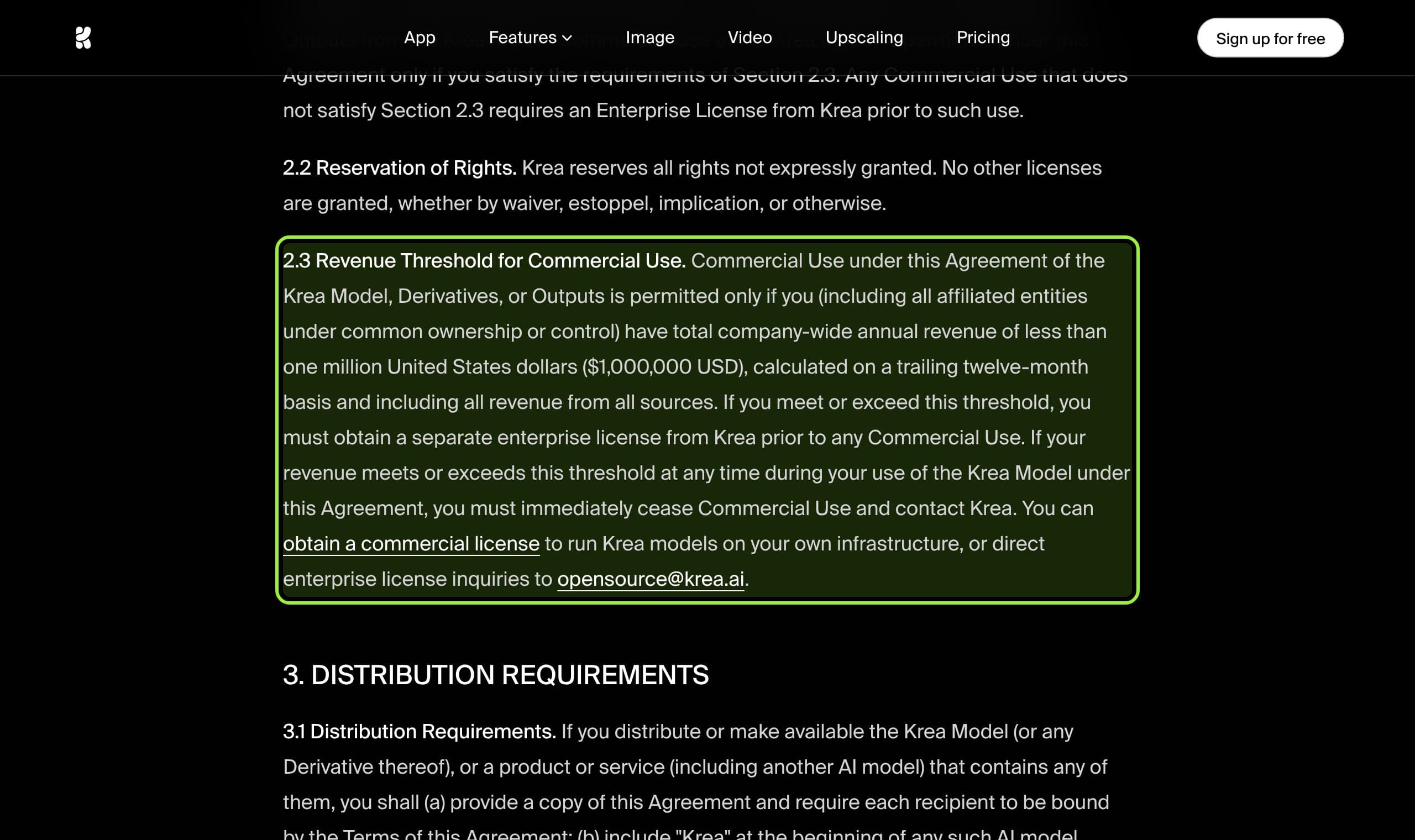
Krea's wording is the strictest of the three. Section 2.3 covers "the Krea Model, Derivatives, or Outputs", counts "all revenue from all sources", and says that if you cross $1M while using the model you "must immediately cease Commercial Use and contact Krea". Section 5.3 still says you own the outputs you generate. Krea also asks that any model containing Krea 2 start its name with "Krea" (3.1), which matters if you publish a fine-tune.
The FLUX Kommunity License lets a Qualifying User use outputs, "including Outputs from Derivatives, for commercial purposes", and says any restriction on the model also applies to any derivative you create. Lightricks' LTX 2.5 card is the most generous line at $10M, and it names the binding text as the LICENSE file in its GitHub repository.
Territory-gated: the two MiniMax H3 licenses
The MiniMax H3 video license (dated 2 August 2026) and the MiniMax-H3-Image license (10 November 2026) both define the Excluded Territories as the European Union, the United Kingdom, the Republic of Korea and the United States. Section V.4 then bars using, reproducing or displaying the works "or any of their Outputs" outside the territory. So the line runs through your audience as well as your desk: a creator in Germany is outside, and a creator elsewhere posting to a US audience is in a grey zone.
The two differ on money. The video license asks for written authorization above $20 million of yearly revenue from commercial products. The image license asks for it above $1 million of annualized revenue, or as soon as you offer a hosted service to third parties, and requires commercial products to "prominently display" the model name in their interface. Both say outputs are not model derivatives, and the image license says MiniMax "claims no rights over the Outputs you generate".
There is a door. In the pinned discussion on the H3 Image page, MiniMax staff write that the exclusion is about regulation that is still moving, not a permanent no, that people in those regions can apply for a license, and that the waiver is free under $1M of annual revenue, after which posting images worldwide is fine. That is a staff reply, not license text, so keep the email you get. Our PAN 2 vs MiniMax H3 comparison weighs this against an Apache 2.0 video model.
Non-commercial: Qwen-Image 2.1, FastFrames, AURA
The Qwen Research License for Qwen-Image 2.1 (release date 20 September 2026) defines Non-Commercial as "research or evaluation purposes only" and says in 2.b you "shall not use the Materials for any commercial purpose without obtaining a separate commercial license". It does not separately settle whether pictures you made locally may be sold, and a creator's direct question on the Turbo page still has no answer.
Apple's FastFrames license is clearer: research only, which "does not include any commercial exploitation, product development or use in any commercial product or service" (our FastFrames review has the rest). Kyutai's new real-time talking head, AURA-1.3B, says its merged and LoRA weights are CC BY-NC 4.0, non-commercial use only. NVIDIA's Nemotron-Labs-Image, released two days after this page, sits in the same group: research or evaluation only, ComfyUI ports included.
How to check any model in five questions
The strictest file in the stack sets the terms. A LoRA trained on a base model is a fine-tune under these licenses' definitions.
- 1
List every file in the graph
Checkpoint, each LoRA, the text encoder if it is separate, the upscaler. ComfyUI workflows often pull four or five. The strictest one sets your terms.
- 2
Read the base model's license, not a blog summary
Open the LICENSE file on the model page. Search summaries got Qwen-Image 2.1's license wrong in our own research in October.
- 3
Check for a country list
Search the text for "territor". If your country, or your audience's, is excluded, stop or apply for the license the maker offers.
- 4
Do the revenue math with affiliates
Use the group's revenue over the period the license names (Krea: trailing twelve months). Put a reminder at 80% of the line.
- 5
Check each LoRA and save copies
A LoRA inherits its base model's terms and its author can add more. Save the license PDF and the date you read it with each project.
Krea defines a Derivative as "any fine-tuned, distilled, or merged version" of its model, BFL says its restrictions apply to any derivative, and MiniMax counts "any modification". None names LoRAs, but a character LoRA is a fine-tune of its base, so we read it as carrying the base license. If you train your own, our character LoRA guide covers the trainers, and a permissive base keeps the result yours outright.
What creators are saying
Critics in the license thread call Qwen-Image 2.1's non-commercial terms unusable for real work and ask for a standard license such as Apache 2.0 or MIT instead of custom terms that need a lawyer.
Others in the same thread point out that a commercial license can be requested from the Qwen team by email, while noting that fine-tunes must carry the same license.
A creator asks for a plain yes or no: may images generated locally with Qwen-Image 2.1, without sharing the weights, be used commercially? No answer yet.
Creators ask whether pictures may be posted worldwide and used on a small monetized channel; staff point them to the free waiver under $1M of revenue.
A developer who ran FastFrames calls it good engineering, but says a research license means you cannot build a product on the weights, so build on Wan instead.
ComplaintDEV Community
Reddit was not reachable from our research session, and searches turned up no Reddit thread on these licenses, so the voices come from the model pages' own discussions and a developer blog.
Verdict
For a feed that earns money, start from the permissive five: MOSS Image or Z-Image Turbo for stills, Wan 2.2 or PAN 2 for motion, LongCat Avatar for talking clips. Krea 2 and FLUX 3 Klein are fine for a solo creator well under the line, with a reminder set before you reach it. Treat MiniMax H3 as a no from the US, EU, UK or South Korea until you hold the waiver email. Keep Qwen-Image 2.1, FastFrames and AURA for tests.
What would change this: Qwen answering the outputs question in writing, Ideogram publishing the 4.6 weights it has promised with a license, or MiniMax widening its territory. We will update this page when any of them happens.
Disclosure: we make Musetta, a studio that runs on your own ComfyUI. It runs whichever models you install and does not grant any model license; the license is between you and each model's maker.
Questions
- Can I sell AI images made with an open source model?
- With Apache 2.0 or MIT models such as MOSS Image, Z-Image Turbo or Wan 2.2, yes. With community licenses (Krea 2, FLUX 3 Klein, LTX 2.5) only under their revenue line, counted with affiliates. With research or non-commercial licenses (Qwen-Image 2.1, FastFrames, AURA), no.
- Is a sponsored Instagram post commercial use?
- Under the plain reading of these licenses, yes: a post that earns money through a brand deal, ads or sales is commercial use, so the model behind it must allow it.
- Does a LoRA have its own license?
- A LoRA carries its base model's terms, because the licenses we read define derivatives to include fine-tuned or modified versions. The LoRA's author can add restrictions on top. Check both.
- Can I use MiniMax H3 in the US or EU?
- Not under the community license: both H3 licenses exclude the US, EU, UK and South Korea, outputs included. MiniMax staff say users there can apply for a license, free under $1M of annual revenue.
- Is the Krea 2 revenue limit per account or per company?
- Per company, including all affiliated entities under common ownership or control, on a trailing twelve-month basis, counting revenue from all sources.
Sources
- 01Krea 2 Community License (licensing page) · Krea
- 02FLUX Kommunity License v1.0 (FLUX 3 Image Klein) · Black Forest Labs, Hugging Face
- 03LTX-2.5 model card · Lightricks, Hugging Face
- 04MiniMax H3 Community License Agreement · MiniMax, Hugging Face, 2026-08-02
- 05MiniMax-H3-Image Community License Agreement · MiniMax, Hugging Face, 2026-11-10
- 06MiniMax-H3-Image discussion: license questions and staff answers · Hugging Face
- 07Qwen Research License Agreement (Qwen-Image 2.1) · Qwen, Hugging Face, 2026-09-20
- 08Qwen-Image-2.1 license discussion · Hugging Face
- 09Qwen-Image-2.1-Turbo: commercial use of generated images · Hugging Face
- 10Apple Machine Learning Research Model License (FastFrames-L) · Apple, Hugging Face
- 11AURA-1.3B model card · Kyutai, Hugging Face
- 12MOSS-Image-SFT model card · OpenMOSS, Hugging Face
- 13Z-Image-Turbo model card · Tongyi-MAI, Hugging Face
- 14Wan2.2-T2V-A14B model card · Wan-AI, Hugging Face
- 15PAN2 model card · IFM, Hugging Face
- 16LongCat-Video-Avatar-1.6 model card · Meituan LongCat, Hugging Face
- 17How to run Apple's FastFrames-L video model locally · DEV Community
Researched and written by the Musetta editorial desk with AI assistance, from the sources above. Numbers come from those sources; nothing is benchmarked by us unless the article says so. Spotted an error? Tell us on Discord and we fix it.