In short
P-H3-Image, released by Pruna AI on 3 November, turns MiniMax H3 into an 8-step still and edit model with about 21 GB peak VRAM at 8 MP in 4-bit, but it inherits a license that excludes the US, EU, UK and South Korea. MOSS Image is 5B, Apache-2.0 and about 13 GB on disk. No independent face test exists, so we call no quality winner: use MOSS anywhere, try P-H3-Image only outside the excluded territories.
A character feed needs a still model you can legally run and afford to iterate on. P-H3-Image, open-sourced by Pruna AI on 3 November, is the newest candidate: MiniMax's H3 video model turned into a still-image and editing model that samples in 8 steps instead of 50. It also inherits H3's license, which excludes the US, EU, UK and South Korea, while MOSS Image is 5B and Apache-2.0.
We did not render a head-to-head, and we found no published face test of the two. This article compares what the model cards, the license file, the Comfy docs and the file listings say, read on 5 November 2026, and says where that is not enough. For the earlier H3 still fine-tune, see Chroma-H3 vs MOSS Image. MiniMax has since released its own still model; see MiniMax H3 Image vs P-H3-Image.
The short answer: license first, then speed
- You are in the US, EU, UK or South Korea, or you are not sure: run MOSS Image. Its weights are Apache-2.0 and the smallest stack is about 13 GB.
- You are outside those territories and want fast, large stills or multi-image edits: try P-H3-Image. It needs 8 steps, no CFG and no negative prompt, and its docs list sizes up to 3872 by 2176.
- You want to keep a face with a trained LoRA today: MOSS has an established LoRA route (our guide); for P-H3-Image the only evidence is a question on its page, with no answer yet.
- You sell to clients or run an agency: read the license file yourself. We are not lawyers and this is not legal advice.
The two models side by side
| What | P-H3-Image | MOSS Image SFT |
|---|---|---|
| What it is | Still and edit model distilled from the MiniMax H3 video model, by Pruna AI | 5B text-to-image diffusion transformer by OpenMOSS |
| Parameters | 33.1B transformer on the card (Pruna's post says the backbone went from 33B to 20B and the text encoder from 32B to 4B) | 5.08B (Hugging Face metadata) |
| License | MiniMax H3 Community License: excludes the EU, UK, South Korea and US; must show "Powered by MiniMax H3"; Apache-2.0 only for the text encoder parts and the upsampler | Apache-2.0 |
| Steps and guidance | 8 steps, no CFG, no negative prompt | 50 steps, CFG 3, shift 5 by default; 8-step LoRAs on the card |
| Resolution | 8 MP is the trained point (default 2912 by 2912); 2 and 4 MP show more artifacts | 1024 by 1024 in the vendor example, sizes in multiples of 16 |
| ComfyUI | 0.44.0 or later; two templates, text to image and edit | Core support since mid-October; Comfy-Org repack |
| Edit and references | Edit template takes up to nine images in the docs | No reference images in the release per our review; the repack lists a small edit LoRA we did not test |
| Repo created | 27 October 2026, announced 3 November | 11 October 2026 |
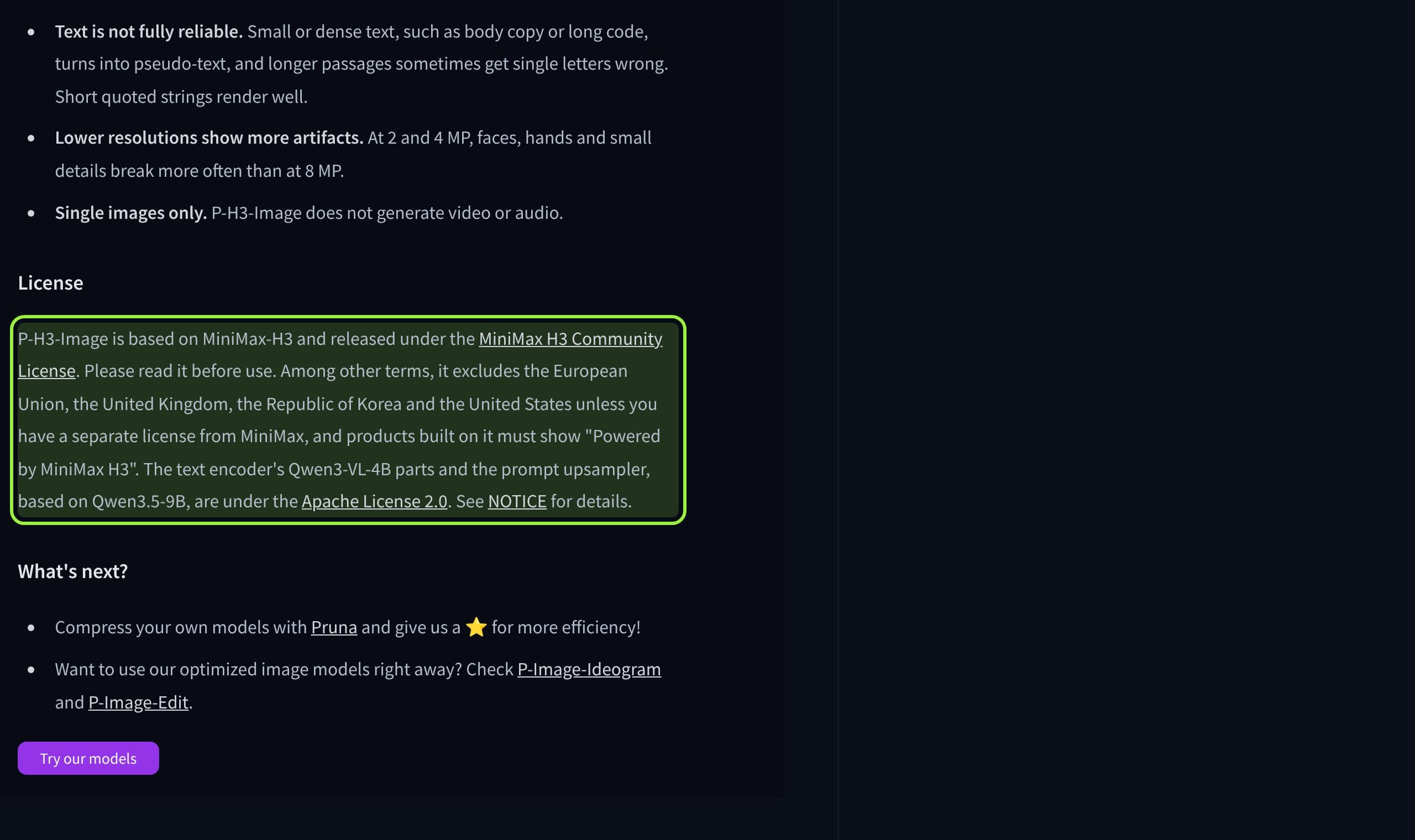
Who may run P-H3-Image
The license file is the MiniMax H3 Community License, dated 2 August 2026. It defines the Applicable Territory as worldwide excluding the European Union, the United Kingdom, the Republic of Korea and the United States of America.
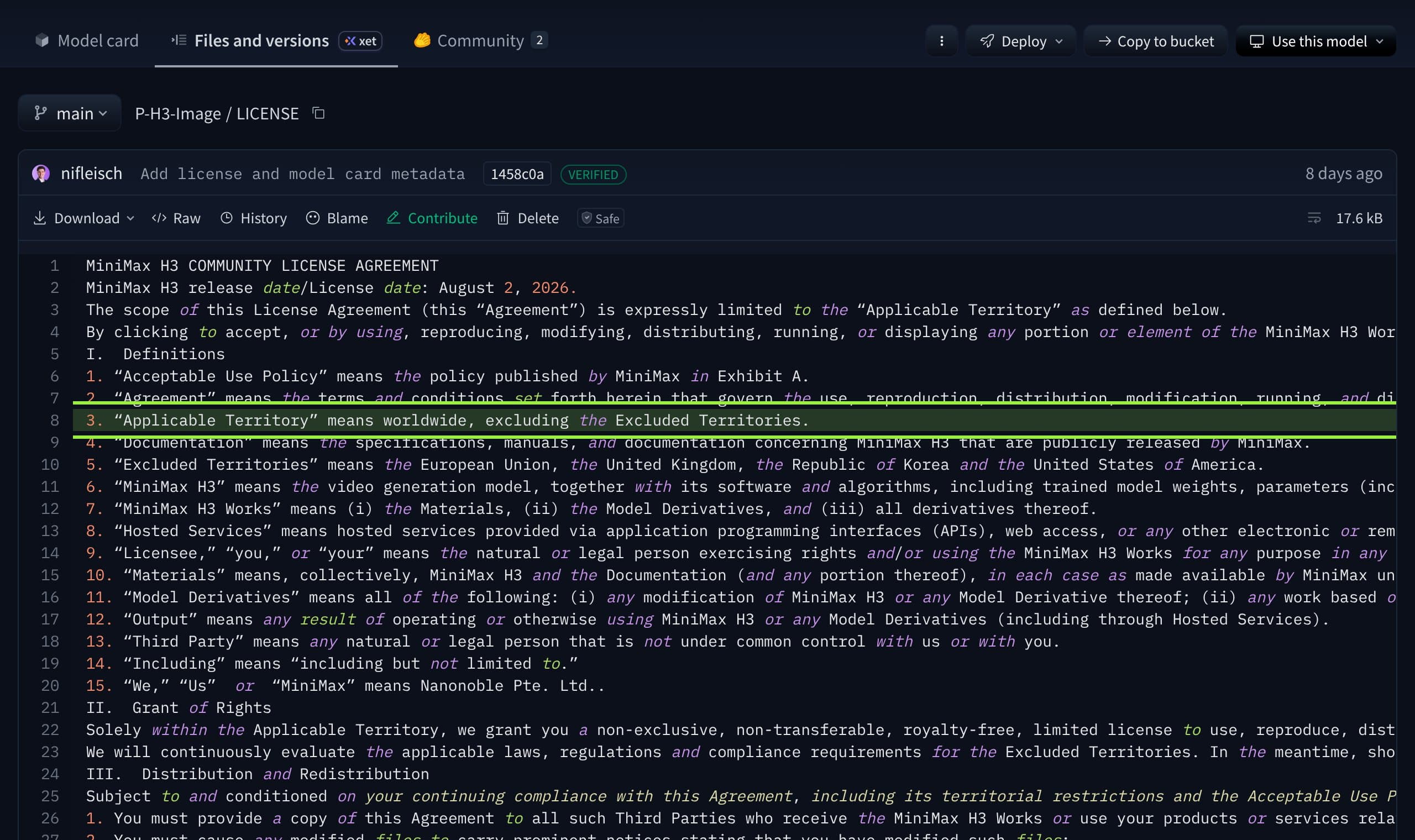
Three more clauses matter to a creator. Products above 20 million US dollars in yearly revenue need written authorization from MiniMax. A commercial product must show "MiniMax H3" in its interface. And outputs may not be used to improve any other AI model, except H3 and its derivatives, which rules out training a rival model or a competing LoRA base on a feed of P-H3-Image pictures.
One person asked on the Comfy repo's discussion board whether local use in the USA is allowed, noting that the license does not grant it. We saw no answer from Pruna on that thread. Until there is one, treat a US-based account as outside the license.
What it costs to run: files and VRAM
P-H3-Image is the heavier stack. Pruna's smallest set, the 4-bit diffusion model with the 4-bit text encoder and the int8 VAE, is the 20 GB the launch post quotes: 13.36 GB plus 3.58 GB plus 3.15 GB. The ComfyUI templates also load a 6.72 GB prompt upsampler, which takes our sum to about 26.8 GB. The docs list the int8 files at about 35 GB and about 21 GB of VRAM; Pruna's post gives a 21 GB peak at 8 MP for the 4-bit set.
MOSS Image is about half of that. Using Comfy-Org's smallest listed files, the 5.41 GB int8 model, the 7.34 GB W4A8 text encoder and the 0.25 GB small VAE come to about 13.0 GB. The MOSS card gives no VRAM figure; our review cites one 12 GB card measurement of about 52 seconds for one image at 50 steps.
Smallest stacks, our sums from the file listings
- P-H3-Image, 4-bit
- About 20.1 GB: 13.36 GB model, 3.58 GB text encoder, 3.15 GB VAE
- P-H3-Image with the upsampler
- About 26.8 GB: add the 6.72 GB W4A8 prompt upsampler the templates use
- P-H3-Image, int8 files
- 21.21 GB model, 5.12 GB text encoder, 6.72 GB upsampler, 3.15 GB VAE: about 36.2 GB, matching the docs' about 35 GB
- MOSS Image SFT
- About 13.0 GB: 5.41 GB model, 7.34 GB text encoder, 0.25 GB VAE
- Peak VRAM
- P-H3-Image 21 GB at 8 MP (Pruna, 4-bit); MOSS has no vendor figure
A commenter asked for a diffusion file under 10 GB. A reply said the model is simply that big, and that ComfyUI offloads blocks automatically so an 8 GB card can run H3 if you are patient. That is one person's report, not a benchmark, and we did not measure it.
Speed: 8 steps against 50, and what is not comparable
Pruna's launch post gives timings on a B200 against its own parent, MiniMax H3 in bf16: 12.4 seconds down to 2.6 seconds at 4 MP and 30.6 down to 5.8 at 8 MP, and on an L40S with 48 GB 19 seconds offloaded in bf16 against 6.3 seconds in 4-bit at 4 MP. It lists no benchmark scores, only side by side images.
Those numbers compare P-H3-Image with H3, not with MOSS. Nobody we found has timed the two on the same card. What can be said: P-H3-Image samples at 8 steps with no negative branch, MOSS defaults to 50 with CFG 3, and MOSS closes part of that gap with its 8-step LoRAs at CFG 1. A fair speed test is the one in the steps below.
Where each one loses
- P-H3-Image loses on access. The territory exclusion rules out most of the English-speaking market, the stack is about twice MOSS's size, and its card warns that short, very long or hype-filled prompts hurt results.
- P-H3-Image loses on small details. The card and the Comfy docs say faces, hands and small details break more often at 2 and 4 MP than at 8 MP, background people can distort, and dense text becomes pseudo-text. For a face that has to match across a set, that is the part to test.
- P-H3-Image loses on lower resolutions. A 9:16 frame at the docs' 8 MP size is 2176 by 3872, far larger than a phone reel needs (exact sizes per model), so you pay for 8 MP and scale down.
- MOSS Image loses on steps. At defaults it is 50 steps with a negative branch, and its card's only benchmark is a CLIP score on 100 prompts, which measures prompt alignment, not identity.
- MOSS Image loses on editing. It is a generator first; for reference-driven edits P-H3-Image's template is the more direct tool, for people who may use it.
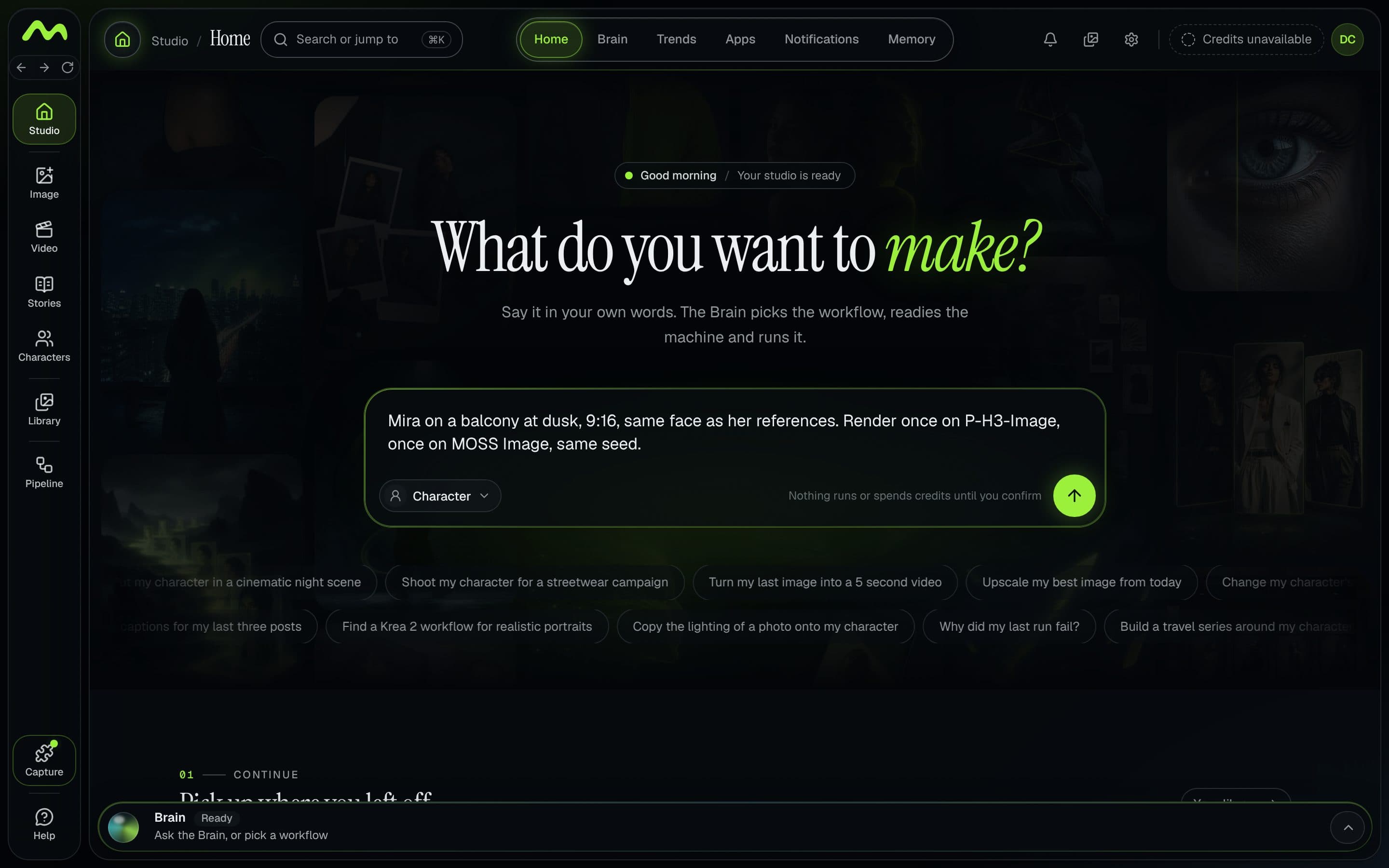
A test worth running yourself
- 1
Fix the inputs
One prompt, one seed, one character, same aspect ratio. Use a LoRA trained for the base you test, or reference photos where the model takes them.
- 2
Render each at its own recipe
P-H3-Image at 8 steps, no CFG, 8 MP, and again at 4 MP. MOSS at 50 steps, CFG 3, shift 5, around 1 MP.
- 3
Render the fast versions
MOSS with an 8-step LoRA at CFG 1, 4-bit P-H3-Image if the 8 MP bf16 set does not fit your card.
- 4
Time it and judge faces at 100 percent
Write down seconds per image on your card. Look at eyes, jawline and skin, keep the files, and have a second person judge blind.
What creators are saying
One tester said it is fast at 4 MP and gave better results than the earlier MiniMax image workarounds they had tried.
Someone asked for a diffusion file under 10 GB; a reply said ComfyUI block swaps automatically and H3 can run on an 8 GB GPU if you are patient.
A user noted the license does not grant use in the USA, asked whether that is an oversight, and said they only want local use but want to respect the terms.
Two people asked for the prompt upsampler's system prompt; one suspects it censors, because a hand-written request came out only described after the upsampler ran in edit mode.
ComplaintPrunaAI/P-H3-Image-Comfy discussion on Hugging Face
Another person wants to train a character LoRA on it and said concept LoRAs they tried were not effective.
Verdict
For most creators the answer today is MOSS Image, because you can run it anywhere, it is half the size and it has the LoRA route a recurring face needs. P-H3-Image is the model to try if you are outside the excluded territories and your bottleneck is time per image or editing with several reference pictures: 8 steps and 8 MP is a real change from 50 steps, and Pruna's measurements against its own parent are large.
What we cannot call is the winner on faces. Pruna publishes no scores, MOSS publishes only a CLIP score, and no independent head-to-head exists yet. The only license-safe move for a US or EU feed is to keep MOSS in the graph and revisit P-H3-Image if its license changes. The H3 review covers the video parent, and Kromoss vs MOSS SFT shows what the MOSS fine-tune route looks like.
If you want to try either on your own ComfyUI without rebuilding a graph each time, Musetta installs the nodes and models a workflow is missing and keeps each character's reference photos. We make it, so weigh that line accordingly.
Questions
- Is P-H3-Image free for commercial use?
- Under the MiniMax H3 Community License, use is allowed only outside the EU, UK, South Korea and the US, products above 20 million USD yearly revenue need written authorization, and commercial products must show "MiniMax H3". The Comfy tutorial adds that commercial use needs a license from Comfy. Read both before you sell.
- How much VRAM does P-H3-Image need in ComfyUI?
- The Comfy docs say about 21 GB for the int8 files, and Pruna's post gives a 21 GB peak at 8 MP for the 4-bit set. One commenter says ComfyUI block swaps so an 8 GB card can run H3 slowly; we did not measure that.
- Which ComfyUI version do I need for P-H3-Image?
- ComfyUI 0.44.0 or later. Both official templates use the PH3ImageConditioning node, added in that release.
- Is P-H3-Image better than MOSS Image for a recurring face?
- Unknown. Neither model card publishes an identity test, and we found no independent head-to-head. P-H3-Image is faster per image by its step count; MOSS is lighter, Apache-2.0 and has a LoRA route.
- What resolution should I use with P-H3-Image?
- Its docs treat 8 MP as the operating point, for example 2176 by 3872 for 9:16. The model card says 2 and 4 MP show more artifacts in faces, hands and small details.
Sources
- 01P-H3-Image model card · Pruna AI, Hugging Face, 2026-11-03
- 02P-H3-Image LICENSE (MiniMax H3 Community License Agreement) · Hugging Face, 2026-08-02
- 03P-H3-Image: Turning a SOTA Video Model into an Efficient Open Image Model · Pruna AI, 2026-11-03
- 04P-H3-Image in ComfyUI: 8-Step Text to Image and Edit · Comfy docs
- 05PrunaAI/P-H3-Image-Comfy file listing · Pruna AI, Hugging Face
- 06P-H3-Image Puts MiniMax H3 Image Generation in ComfyUI · ComfyUI Wiki, 2026-11-03
- 07OpenMOSS-Team/MOSS-Image-SFT model card · OpenMOSS, Hugging Face
- 08Comfy-Org/MOSS-Image file listing · Comfy-Org, Hugging Face
- 09Discussion: quality is nice · Hugging Face discussions, 2026-11-04
- 10Discussion: OK to use in the USA? · Hugging Face discussions, 2026-11-04
Researched and written by the Musetta editorial desk with AI assistance, from the sources above. Numbers come from those sources; nothing is benchmarked by us unless the article says so. Spotted an error? Tell us on Discord and we fix it.