In short
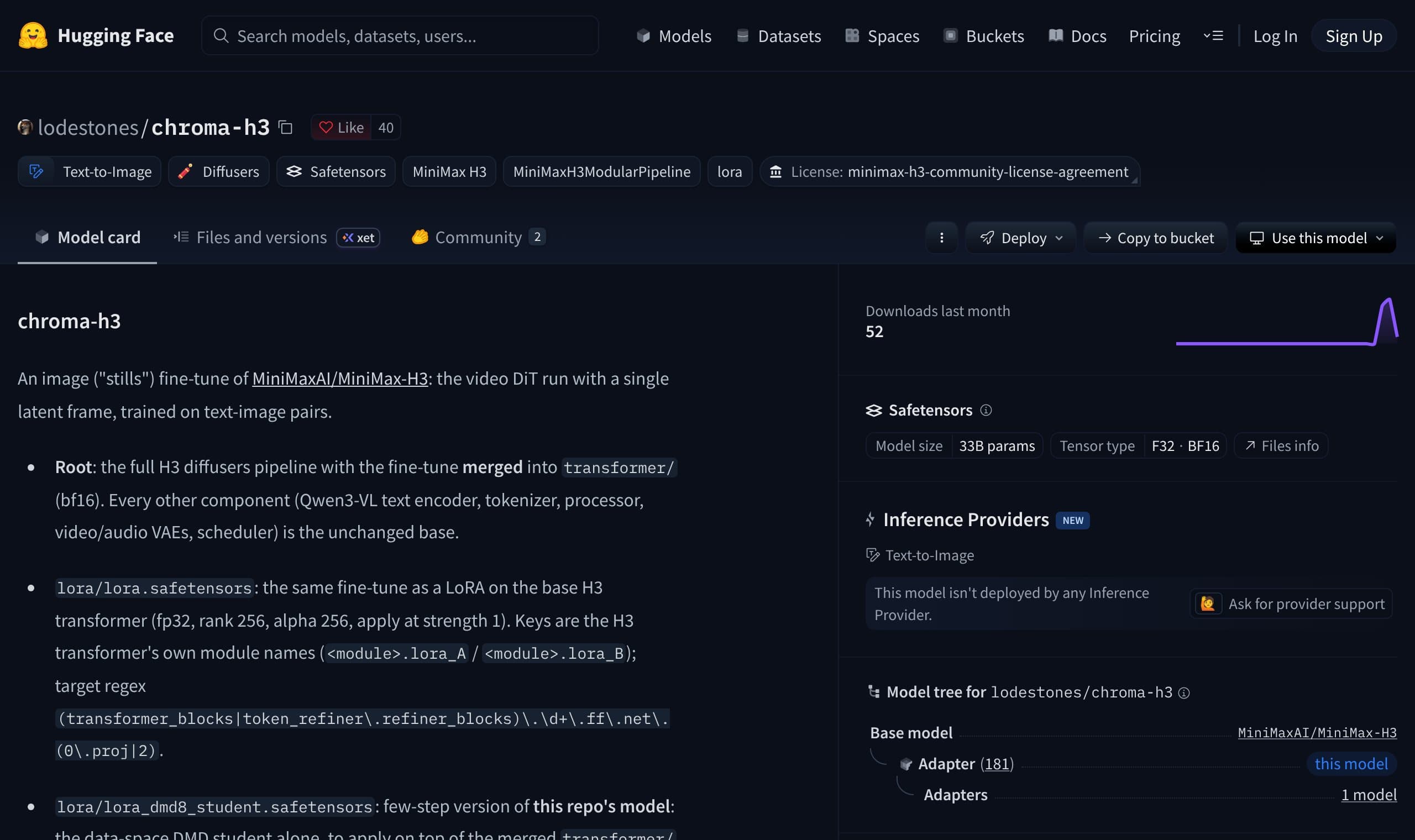
Chroma-H3, uploaded on 31 October, is a 33B still-image fine-tune of MiniMax H3 that inherits its license, which excludes the US, EU, UK and South Korea. MOSS Image is 5B, Apache-2.0 and about 13 GB on disk against about 34.5 GB for Chroma-H3 on stock H3. No published face test of the two exists, so we did not call a quality winner: use MOSS anywhere, try Chroma-H3 only inside the licensed territory.
If your character feed needs stills, Chroma-H3 is the newest thing to try: lodestone's image fine-tune of the MiniMax H3 video model, uploaded on October 31. It is also a 33B-parameter model that inherits a license excluding the US, EU, UK and South Korea, while MOSS Image is 5B and Apache-2.0. Which one you can run is decided before which one looks better.
We did not render a head-to-head, and nobody we found has published a face test of the two. This article compares what the model cards, the license text and the Comfy-Org file listings support, adds the file sizes we summed ourselves, and says where the open questions are. Everything was read on November 3, 2026.
The short answer: pick by license, then by card
- Outside the US, EU, UK and South Korea, and you want maximum detail: try Chroma-H3. Its model card says it adds detail over the base, one early tester reported gains up to 8 megapixels, and it ships a few-step LoRA. It is two days old.
- Anywhere, or you sell to anyone in those regions: use MOSS Image. Its weights are Apache-2.0 and the whole stack is about 13 GB at the smallest listed sizes.
- You need a face to stay the same: neither takes reference photos in a still workflow we could verify. Train a character LoRA; on MOSS the Kromoss fine-tune has 8-step LoRAs.
- You already run MiniMax H3 for video: Chroma-H3 reuses the same text encoder and transformer, so the extra download is a 2.86 GB LoRA, not a new model.
The two models side by side
| What | Chroma-H3 | MOSS Image SFT |
|---|---|---|
| What it is | Still-image fine-tune of MiniMax H3: the video transformer run on one latent frame | 5B text-to-image diffusion transformer, from a Base checkpoint |
| Parameters | 33.1B total in the merged repo (Hugging Face metadata) | 5.08B (Hugging Face metadata) |
| License | MiniMax H3 Community License: excludes the EU, UK, South Korea and US; written authorization above 20 million USD yearly revenue | Apache-2.0 |
| Released | Repo created 31 October 2026 | Repo created 11 October 2026 |
| Text encoder | Qwen3-VL, unchanged from H3; 15.69 GB at NVFP4, 27.14 GB at int8 (Comfy-Org H3 repack) | Qwen3.5-9B; 7.34 GB at W4A8, 9.75 GB at int8, 19.31 GB at bf16 (Comfy-Org repack) |
| Model file | Stock H3 transformer: 15.98 GB (W6A8 pruned) to 34.04 GB (int8), plus a 2.86 GB Chroma-H3 LoRA | 5.41 GB at int8, 10.16 GB at bf16, nothing to merge |
| Steps and CFG | Merged: about 30 Euler steps, CFG about 3, shift 3. DMD LoRA: 4 or 8 steps, CFG 1 | Vendor settings: Euler, 50 steps, CFG 3, shift 5; 8-step community LoRAs exist |
| Resolution | About 1 MP on the card; one tester reported gains up to 8 MP | 1024 by 1024, sizes in multiples of 16 |
| ComfyUI | LoRA files in ComfyUI format; no official template or workflow found | Core support since 16 October; docs page and Comfy-Org repack |
Who may run Chroma-H3
Chroma-H3 is a derivative of MiniMax H3, and the H3 license covers derivatives. Its definition of excluded territories names the European Union, the United Kingdom, the Republic of Korea and the United States of America. Section V adds that you may not use, modify, distribute or display the Works or their outputs outside the Applicable Territory, and may not use them to improve another AI model.
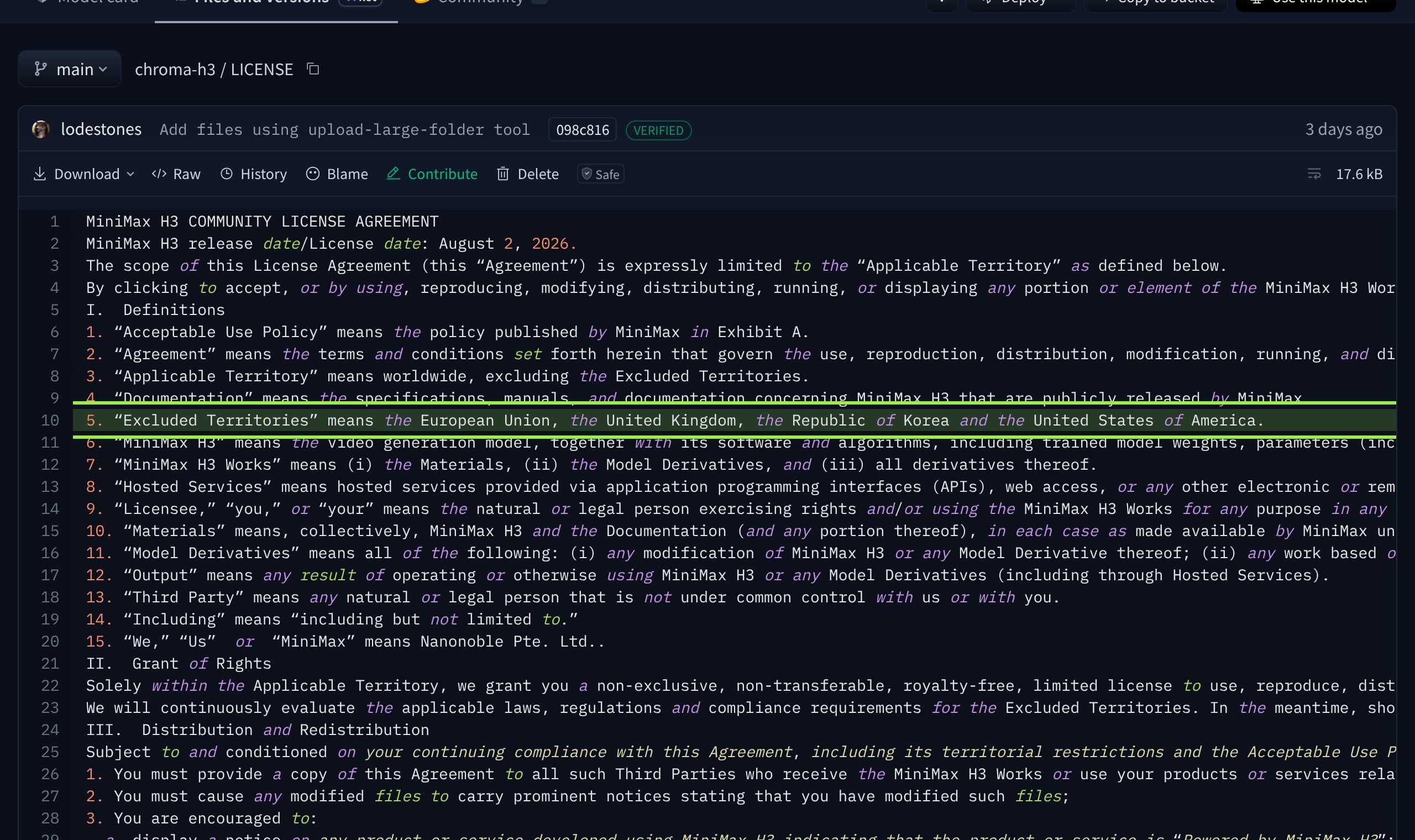
Commercial terms matter too: more than 20 million US dollars of yearly revenue needs written authorization from MiniMax, and a commercial product must show "MiniMax H3" in its interface. For a small creator account the revenue line is far away. The territory line is not. We covered the same terms in our MiniMax H3 review and the Pika Flex comparison. We are not lawyers; read the file and ask MiniMax if you are in doubt.
What it costs to run: files and VRAM
MOSS Image is the lighter stack. Using Comfy-Org's smallest listed files, the 5.41 GB int8 model, the 7.34 GB W4A8 text encoder and the 0.25 GB small VAE come to about 13.0 GB on disk. Chroma-H3 starts higher: the 15.98 GB W6A8 H3 transformer, the 15.69 GB NVFP4 text encoder and the 2.86 GB LoRA add up to about 34.5 GB before a VAE. Those sums are ours.
What we could not verify: whether the Chroma-H3 LoRA applies cleanly to the pruned and quantized H3 files, since the card says to apply it to the stock transformer. The conversion's README names only the stock base. Video VRAM figures for H3 do not transfer to a one-frame job either, and nobody has posted a stills VRAM number yet. We will not guess one.
Smallest stack on disk, our sums from the file listings
- MOSS Image SFT
- About 13.0 GB: 5.41 GB model, 7.34 GB text encoder, 0.25 GB VAE
- Chroma-H3 on stock H3
- About 34.5 GB before a VAE: 15.98 GB model, 15.69 GB text encoder, 2.86 GB LoRA
- Chroma-H3 DMD route
- 6.63 GB ComfyUI LoRA on stock H3 instead of the 2.86 GB one; 4 or 8 steps at CFG 1
- Open question
- Whether the LoRA works on the pruned or quantized H3 files is not stated on either card
Speed: 30 steps against 8, and what is claimed
The Chroma-H3 card gives two recipes. Merged weights want classifier-free guidance near 3 and about 30 Euler steps at shift 3. The distilled route, a data-space DMD student distilled at CFG 3 on stills, runs at CFG 1 in 4 or 8 steps, which also halves the cost per image because there is no negative pass. MOSS's vendor settings are 50 steps at CFG 3, and the Kromoss 8-step LoRAs are the shortcut there. The usual distilled-versus-base caution applies to both: few-step output is a draft until you have compared it with a full-step render of the same seed.
The training facts from the card: a rank 256 LoRA on the feed-forward layers, 13,605 updates at a global batch of 48 images, one pass over the data, with captions mixing booru tags, short and long descriptions and scene graphs. That is the author's description, not an independent evaluation.
Where each one loses
- Chroma-H3 loses on access. The territory exclusion rules out most of the English-speaking market, a 34 GB stack is heavy, and there is no official workflow yet. A request for example workflows was open on its model page two days after release.
- Chroma-H3 loses on evidence. 52 downloads in its first month on Hugging Face and no published comparison. Treat every quality claim as the author's.
- MOSS Image loses on references. It takes no reference images, as our review found, and it is slow at 50 steps.
- MOSS Image loses on detail claims. Nothing we found shows it matching a 33B model at high resolution; nobody has tested them against each other.
A test worth running yourself
- 1
Fix the inputs
One prompt, one seed, one character LoRA trained for the base you test, same aspect ratio, about 1 MP.
- 2
Render each model at its full recipe
MOSS at 50 steps, CFG 3. Chroma-H3 merged at about 30 steps, CFG about 3. These are the vendors' own settings.
- 3
Render the few-step versions
MOSS with an 8-step LoRA, Chroma-H3 with the DMD LoRA at 8 steps and CFG 1.
- 4
Compare faces at 100 percent
Look at eyes, jawline and skin texture, not the thumbnail, and keep the files so a second person can judge blind.
What creators are saying
One person asked on the model page for example workflows, and two others added their agreement within a day.
A tester said it works for them and kept improving as they raised the resolution up to 8 megapixels, adding detail compared with the base model.
A news account summarised the release as H3 turned into a stills model, with merged weights, a LoRA and an 8-step DMD LoRA that reportedly carries over to H3 video.
TipPost on X
On the MOSS side, a user found the ComfyUI CLIP type missing on stable 0.41.3 and was advised to use the nightly build.
Verdict
For most creators the answer today is MOSS Image, because you can legally run it anywhere, it is a fifth of the size and it already has a LoRA ecosystem. Chroma-H3 is the one to watch if you are inside the licensed territory and already run H3: its distilled LoRA is cheap to add, and a 33B base is where a detail gain would come from. We would not move a character feed to it until someone posts a same-seed face test. Two days later Pruna released P-H3-Image, another still model distilled from H3 with the same territory license, which we compared in the same way.
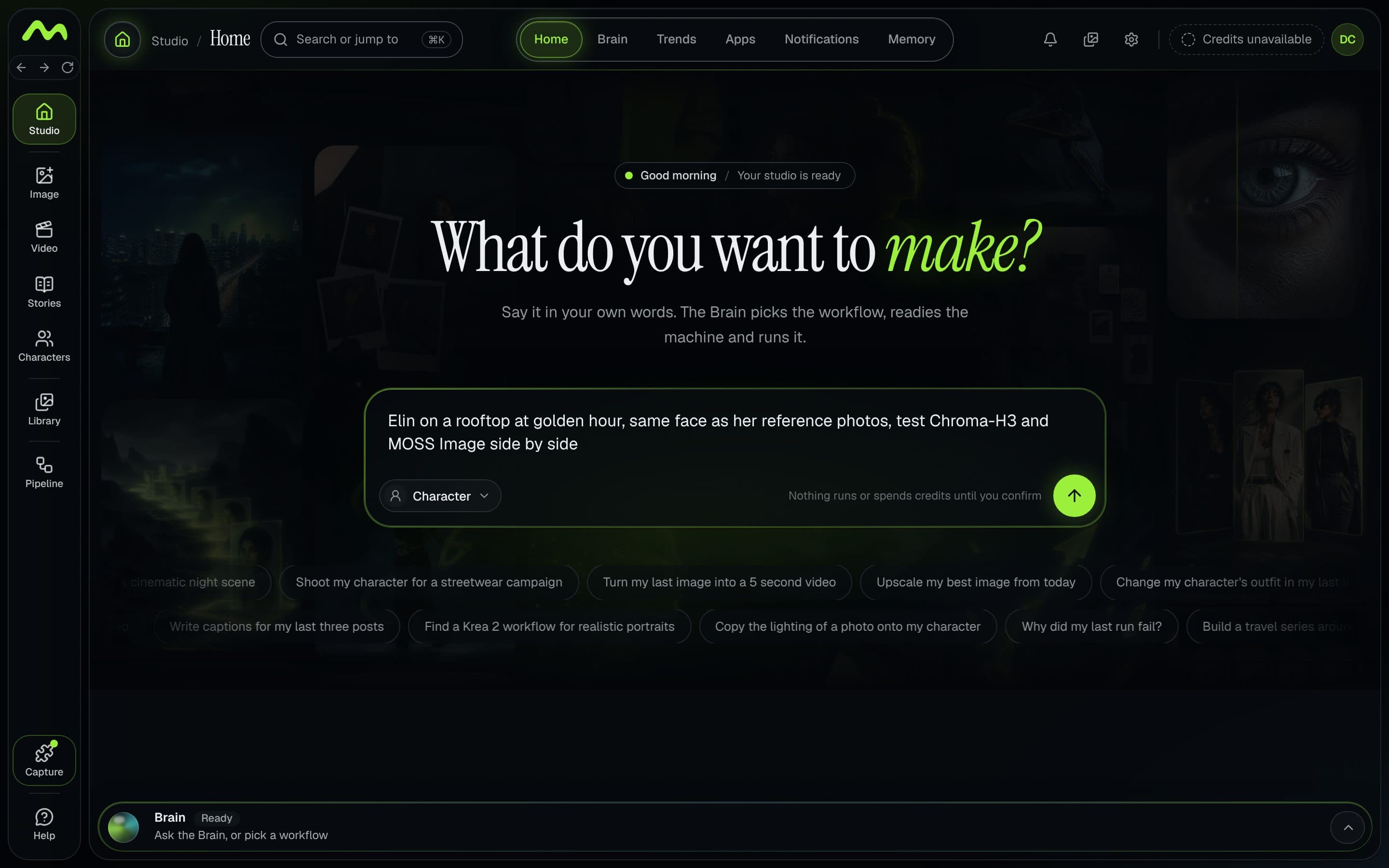
If you want to try either on your own ComfyUI without rebuilding a graph each time, Musetta installs the nodes and models a workflow is missing and keeps each character's reference photos. It does not change either model's license.
Questions
- Is Chroma-H3 free for commercial use?
- Under the MiniMax H3 Community License, use is allowed only in the applicable territory, which excludes the EU, UK, South Korea and the US, with written authorization needed above 20 million USD yearly revenue. Read the license file before you rely on it.
- Is Chroma-H3 a new model or a LoRA?
- Both. The repo holds the full pipeline with the fine-tune merged into the transformer, plus the same fine-tune as a rank 256 LoRA for stock MiniMax H3, plus few-step DMD versions.
- How much disk space does Chroma-H3 need in ComfyUI?
- On Comfy-Org's smallest H3 files, about 34.5 GB before a VAE by our sum: 15.98 GB model, 15.69 GB text encoder and the 2.86 GB LoRA. Whether the LoRA works on the pruned files is not stated.
- Which is better for a recurring face, Chroma-H3 or MOSS Image?
- No published test answers this, and neither accepts reference photos in the workflows we could verify. Train a character LoRA for the model you pick and compare with the same seed.
- Does MOSS Image have a license that excludes countries?
- No. The MOSS-Image-SFT card lists Apache-2.0, though third-party parts keep their own terms.
Sources
- 01lodestones/chroma-h3 model card · Hugging Face, 2026-11-01
- 02Chroma-H3 LICENSE (MiniMax H3 Community License Agreement) · Hugging Face, 2026-08-02
- 03MiniMaxAI/MiniMax-H3 model card · MiniMax, Hugging Face
- 04OpenMOSS-Team/MOSS-Image-SFT model card · OpenMOSS, Hugging Face, 2026-10-21
- 05Comfy-Org/MiniMax-H3 file listing · Comfy-Org, Hugging Face
- 06Comfy-Org/MOSS-Image file listing · Comfy-Org, Hugging Face
- 07chroma-H3-comfyui LoRA conversions · Hugging Face community, 2026-10-31
- 08Chroma-H3 discussion: example workflows · Hugging Face discussions, 2026-11-01
- 09MOSS-Image in ComfyUI, docs · Comfy docs
- 10Post on the Chroma-H3 release · X
Researched and written by the Musetta editorial desk with AI assistance, from the sources above. Numbers come from those sources; nothing is benchmarked by us unless the article says so. Spotted an error? Tell us on Discord and we fix it.