In short
Five Hugging Face repos publish 34 GGUF files of MiniMax H3 Image's pruned transformer. The same label is not the same file: Q4_K_M is 11.43 to 12.72 GB depending on the repo. Unsloth measured peak VRAM at about the file size plus 2.2 GiB at 1 MP, so nothing fits an 8 GB card whole. Plain Q2_K scores worst in both public tests. The text encoder adds 12 to 27 GB whichever quant you pick.
If you run a character on a 12 GB card, the GGUF you pick for MiniMax H3 Image decides whether her face holds its small details or gets redrawn every render. The label on the file does not tell you that. On 16 November 2026 a file called Q4_K_M was 11.43 GB in one repository and 12.72 GB in another, and two public tests put the plain 2-bit file last by a wide margin.
This data study reads the file lists of five GGUF repositories byte by byte, sets them next to the three measurement tables their authors published, and adds the part most VRAM tables leave out: the text encoder and VAE you still have to download. For the model itself, start with our MiniMax H3 Image review.
What we measured and how
We read file sizes from the Hugging Face API (/api/models/<repo>/tree/main) on 16 November 2026 for five repositories: Abiray, AtomicChat, Hearthscale, realrebelai and unsloth, plus Comfy-Org's repack and the official repo. That is 34 GGUF files of the image transformer. Sizes are decimal gigabytes (bytes divided by one billion), the unit the Hub shows.
Quality and memory numbers are not ours. They come from three model cards that publish a method: unsloth (8 prompts x 2 seeds at 1024x1024, stable-diffusion.cpp on an A100), AtomicChat (40 captions at 2048x2048, ComfyUI on an H100) and Hearthscale (timings on an RTX 3080 10 GB). We did not render an image or load a file. Where a number is the publisher's, we say whose.
Same label, different file
| Label | Hearthscale | Abiray | realrebelai | AtomicChat (AD) | unsloth |
|---|---|---|---|---|---|
| Q2_K | - | 6.88 | 6.88 | 7.57 | 7.75 |
| Q3_K_M (AD-Q3_K) | 8.77 | 8.91 | 8.91 | 8.73 | 10.42 |
| Q4_K_M (AD-Q4_K) | 11.43 | 11.57 | 11.57 | 11.57 | 12.72 |
| Q5_K_M (AD-Q5_K) | 13.93 | 14.08 | 14.08 | 13.84 | 14.60 |
| Q6_K (AD-Q6_K) | - | - | 16.74 | 16.67 | 16.60 |
| Q8_0 | 21.45 | - | - | 21.45 | 22.03 |
The spread inside one label is real money on a small card. Q3_K_M runs from 8.77 to 10.42 GB, a 1.65 GB gap. Q4_K_M runs from 11.43 to 12.72 GB, 1.29 GB apart. The label names the block type most weights use; each converter decides for itself which sensitive layers keep more bits, and those choices are where the bytes go.
- Abiray's Q4_K_S and Q4_K_M are the same size: 11,573,106,304 bytes each, with different file hashes. The card rounds both to 11.60 GB and lists them for different cards.
- AtomicChat's AD-Q2_K is not really 2-bit: its card gives 3.01 bits per weight, because the last 20 blocks stay at Q3_K to Q4_K.
- unsloth also ships five UD files (8.68 to 17.58 GB) and three K_S files that fit between the rows above.
- realrebelai's card lists Q8_0, but the repo held no Q8_0 file when we read it.
- Hearthscale publishes no 2-bit file and says why: at Q2_K, lettering and detail break.
Peak VRAM: the file plus about 2.2 GiB
unsloth's card is the only one that reports peak VRAM per file. The peak covers sampling and VAE decode at 1024x1024 on an A100; the text encoder runs first and is not in it. We converted each file size to GiB and subtracted: the gap is 2.1 to 2.2 GiB for every file from Q2_K to Q6_K, and 2.5 GiB for Q8_0. That subtraction is ours; the two columns are unsloth's.
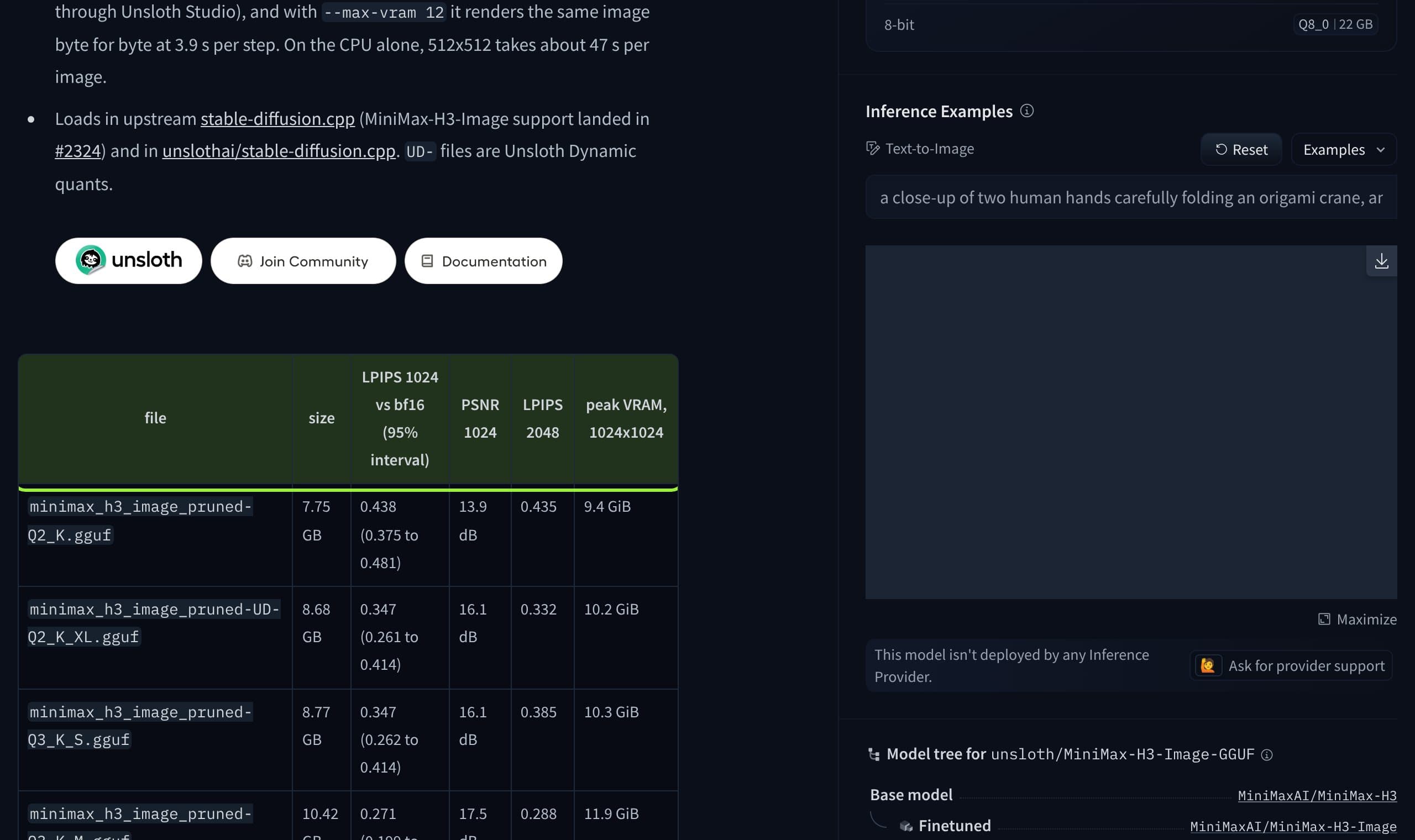
Read that against your card. The smallest file in the table peaks at 9.4 GiB, so no quant holds the transformer whole on 8 GB, even at 1 MP. A 12 GB card holds a Q3-class file with room, and unsloth's larger Q3_K_M only just (11.9 GiB). A 16 GB card holds Q4_K_M at 14.0 GiB and is tight at Q5_K_M (15.8 GiB). Q8_0 at 23.0 GiB leaves a 24 GB card almost nothing.
Two limits apply. The test ran at 1 MP, and MiniMax's model card puts the working range at about 4 to 20 MP, where activations need more memory than this table shows. And it ran in stable-diffusion.cpp, not ComfyUI. ComfyUI streams weights from system RAM when a file does not fit, which is why a file larger than your card still runs, slower.
What each step down costs in the picture
AtomicChat rendered 40 captions at 2048x2048 with each of its files and compared every picture to the BF16 render of the same caption and seed. LPIPS is the distance between the two pictures, lower is closer. For scale, its card says BF16 itself moves by 0.627 when only the seed changes.
Source: AtomicChat/MiniMax-H3-Image-GGUF model card, 40 captions, ComfyUI on an H100
The curve bends between 5 and 4 bits: 0.164 at 13.84 GB, 0.254 at 11.57 GB. AtomicChat's own reading is that Q5 and Q4 keep the composition of most pictures while small objects, faces and text strokes move. For a recurring character that is the line that matters, because a face is a small object.
The same stand also measured other people's files. Abiray's plain Q2_K scored 0.546, close to a different seed. Its Q3_K_M scored 0.397, its Q4_K_M 0.247 (a tie with AD-Q4_K at the same 11.57 GB) and its Q5_K_M 0.195. Comfy-Org's own int8_convrot scored 0.129 at 20.98 GB, level with the 16.67 GB AD-Q6_K, and its w4a8 scored 0.274 at 12.55 GB. unsloth's separate test agrees on direction: its plain Q2_K is 0.438 and its recommended UD-Q4_K_XL is 0.172. The two tests use different resolutions and engines, so compare files inside one test, never across.
The encoder is the bigger download
Every GGUF above replaces one file out of three. The model still needs the Qwen3-VL-32B text encoder and the 1.17 GB image VAE, and at 4 bits the encoder is larger than the transformer. Comfy-Org's nvfp4_awq encoder is 15.69 GB and its int8_convrot encoder is 27.14 GB. GGUF encoders exist too: 12.00 GB (Abiray, Q3_K_M), 14.58 GB (Abiray, Q4_K_M), 13.10 and 18.22 GB (unsloth, Q2_K_M and Q4_K_M).
| Set | Transformer | Text encoder | Total | Encoder share |
|---|---|---|---|---|
| Smallest GGUF pair (Abiray Q2_K + Q3_K_M encoder) | 6.88 GB | 12.00 GB | 20.05 GB | 60% |
| Q3 class (AD-Q3_K + nvfp4_awq) | 8.73 GB | 15.69 GB | 25.59 GB | 61% |
| Q4 class (AD-Q4_K or Abiray Q4_K_M + nvfp4_awq) | 11.57 GB | 15.69 GB | 28.43 GB | 55% |
| Comfy-Org w4a8 + nvfp4_awq | 12.55 GB | 15.69 GB | 29.41 GB | 53% |
| Q6 class (AD-Q6_K + int8 encoder) | 16.67 GB | 27.14 GB | 44.98 GB | 60% |
| Comfy-Org template default (int8 + int8) | 20.98 GB | 27.14 GB | 49.29 GB | 55% |
The encoder costs time as well as disk. unsloth timed its UD-Q4_K_XL on a 24 GB L4 capped at 12 GB: 25.1 seconds for sampling and decode, 88.1 seconds once the Q4_K_M text encoder is included, and the card says most of the end-to-end time is the encoder running from host RAM. Shrinking the encoder has a price too: the same card measured that a Q4_K_M encoder alone moves a 1024x1024 image by LPIPS 0.17 against the BF16 encoder.
There is no shortcut through the small file in Comfy-Org's folder. qwen3.5_9b_w4a8_gptq (7.34 GB) is the prompt enhancer, and the replies in the repo's discussion say the 32B encoder is still required. ComfyUI moves the encoder and the transformer in and out of VRAM in turn, so they do not need to fit together.
What creators are saying
What creators are saying
Q4_K_S and Q4_K_M are the same number of bytes in this repo, and dividing a file by 33.1B parameters gives nonsense because the files come from the pruned checkpoint.
On a 12 GB RTX 4070 SUPER with 96 GB RAM the 21 GB int8 file ran at 11 to 12 seconds per 4.1 MP image, about 41 GB of RAM in use. They never needed the w4a8 file.
Can the 9B Qwen file serve as the text encoder, or is the huge one required? Replies: the 9B model is only the prompt enhancer, the 32B encoder is needed.
QuestionComfy-Org/MiniMax-H3-Image discussion on Hugging Face
With complex prompts, a lightweight text encoder gives results dramatically worse than the official API.
ComplaintComfy-Org/MiniMax-H3-Image discussion on Hugging Face
A request for the unpruned weights got the reply that the pruning is functionally identical, and that any amount of quantization is far more destructive.
ComplaintComfy-Org/MiniMax-H3-Image discussion on Hugging Face
The second voice is the one to sit with. One user's 12 GB card ran the 20.98 GB int8 transformer at usable speed because the machine had RAM to stream from. Hearthscale's card shows the other side on a 10 GB RTX 3080 with 32 GB of RAM: 285 seconds per 1024x1024 image for Q8_0 against 61 seconds for Q4_K_M and 52 for Q3_K_M. A quant is a fix for short system RAM as much as short VRAM.
Which quant to pick for your card
MiniMax H3 Image GGUF by card (our reading of the published numbers)
- 8 GB
- Nothing fits whole (smallest measured peak 9.4 GiB). Take a 3-bit-class file near 8.7 GB (AD-Q3_K, UD-Q2_K_XL) and expect offloading. Skip plain Q2_K: 0.546 and 0.438 LPIPS in the two tests.
- 12 GB
- Q3 class (8.7 to 8.9 GB) fits whole at 1 MP. A Q4 file near 11.5 GB peaks about 1 GiB over the card and is the better trade for faces: 0.254 against 0.334.
- 16 GB
- Q4_K_M (14.0 GiB peak for unsloth's 12.72 GB file) with room for larger sizes; Q5 class (13.8 to 14.6 GB) only at small sizes.
- 24 GB
- Q6 class (16.6 to 16.7 GB, 17.6 GiB peak): level with Comfy-Org's int8 file in AtomicChat's test at 4.3 GB less. Q8_0 peaks at 23.0 GiB.
- 64 GB RAM or more
- Try Comfy-Org's int8 file before any GGUF; one 12 GB user reports 11 to 12 s per 4.1 MP image.
- Text encoder
- nvfp4_awq (15.69 GB) for 4-bit sets, int8 (27.14 GB) when RAM allows. The 9B file is the prompt enhancer only.
- Settings
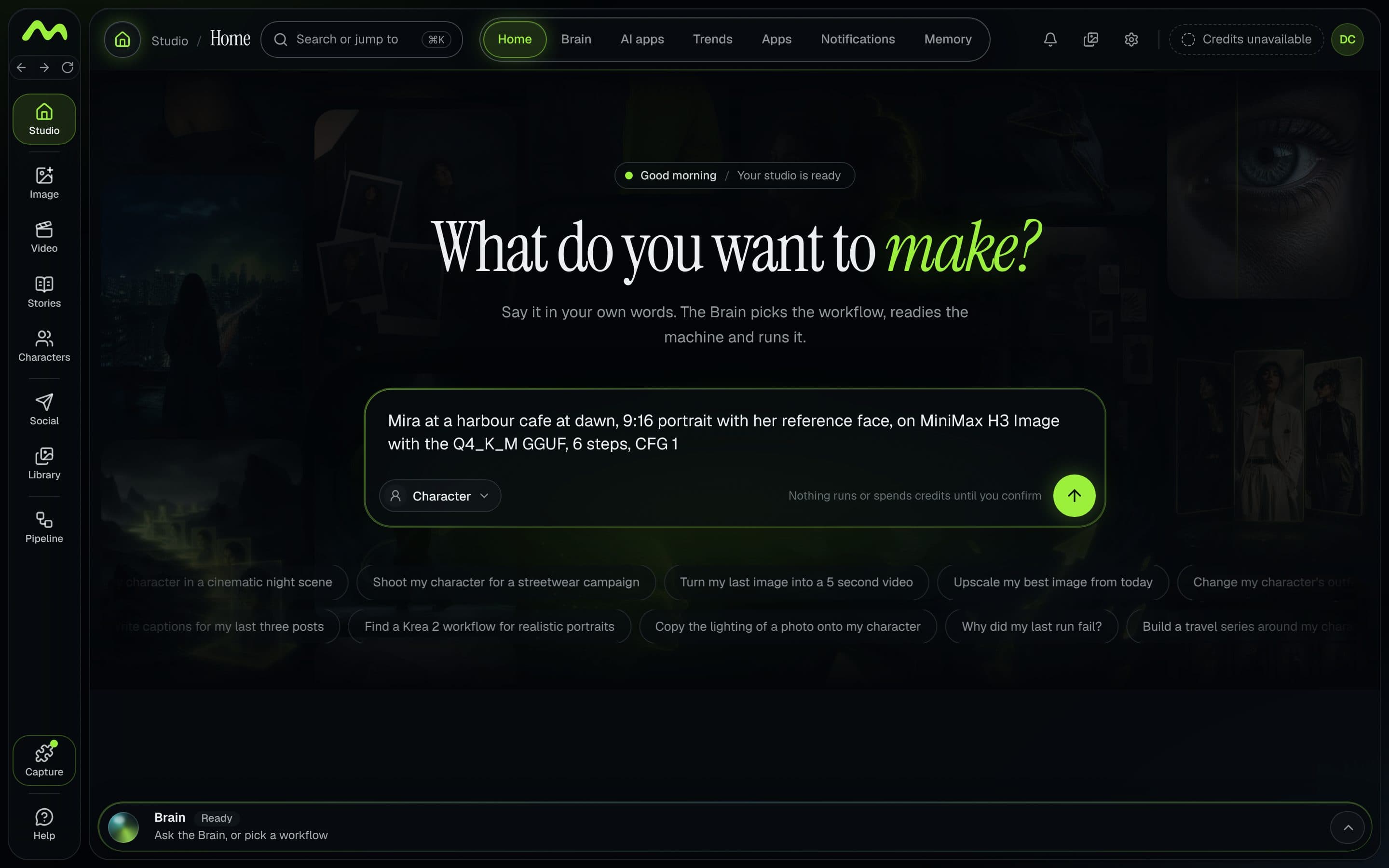
- 6 steps, CFG 1, euler, simple. The quant does not change them.
Our opinion, for a character feed: 4 bits is the floor. Below it, more than half the distance to a new seed is gone in AtomicChat's test (53% at AD-Q3_K, 60% at AD-Q2_K), and identity lives in exactly the small details that move first. If only a 3-bit file fits, generate, then judge the face against your reference at full size before you batch a week of posts. If negative prompts seem dead at these settings, CFG 1 is why.
Limits of this study
- File sizes are ours and exact for 16 November 2026. Repos change; two of the five were updated within days of their first upload.
- LPIPS, peak VRAM and timings are the publishers' numbers, measured on their own files with their own tools. AtomicChat and unsloth each rank their own files first, so weigh that, though both publish method and intervals.
- LPIPS measures distance from the BF16 picture, not beauty or likeness. Nobody has published a face-identity score for these quants.
- No test covers 16 MP, the size the model card recommends. Memory for activations grows with resolution; the 2.2 GiB gap is a 1 MP figure.
- Every file inherits the MiniMax H3 Image Community License, which excludes four territories. See the license section of our comparison before a monetized account uses any of them.
Related reading: why repacks out-download official repos, this fortnight's download board, the six H3 error messages and their fixes, and how Musetta sits next to plain ComfyUI in our comparison. Musetta runs on your own ComfyUI and installs the files a workflow is missing; it does not pick the quant for you, so the table above still applies.
Questions
- Which MiniMax H3 Image GGUF should I use on 12 GB of VRAM?
- A Q3-class file of 8.7 to 8.9 GB fits whole at 1 MP. A Q4 file near 11.5 GB peaks about 1 GiB over the card by unsloth's measurements, so ComfyUI offloads a little, but it scored 0.254 LPIPS against 0.334 for the 3-bit file in AtomicChat's test. For a recurring face we would take Q4.
- Can MiniMax H3 Image run on 8 GB of VRAM?
- It can run with offloading, not fit. The smallest file unsloth measured (Q2_K, 7.75 GB) peaks at 9.4 GiB at 1024x1024. Plain Q2_K also scored worst in both public tests, so a 3-bit-class file near 8.7 GB with part of it streamed from RAM is the better choice.
- Is Q4_K_M the same file in every repository?
- No. On 16 November 2026 it was 11.43 GB at Hearthscale, 11.57 GB at Abiray and realrebelai, and 12.72 GB at unsloth. The label names the main block type; converters keep different layers at higher precision.
- Do I still need the big text encoder with a GGUF?
- Yes. The GGUF replaces only the image transformer. You also need the Qwen3-VL-32B text encoder (12.00 to 27.14 GB depending on the file) and the 1.17 GB image VAE. The 7.34 GB Qwen 9B file in Comfy-Org's repo is the prompt enhancer, not the encoder.
- Do GGUF files change the license?
- No. The repos we read carry the MiniMax H3 Image Community License Agreement or point to it. A quantized file is a derivative of the model and follows the same terms.
Sources
- 01unsloth/MiniMax-H3-Image-GGUF model card (LPIPS, PSNR, peak VRAM, timings) · Unsloth, 2026-11-12
- 02AtomicChat/MiniMax-H3-Image-GGUF model card (40-caption comparison, load test) · Atomic Chat, 2026-11-11
- 03Hearthscale/MiniMax-H3-Image-GGUF model card (RTX 3080 timings) · Hearthscale, 2026-11-10
- 04Abiray/MiniMax-H3-Image-GGUF model card · Abiray, 2026-11-10
- 05realrebelai/Minimax-H3-Image_GGUFs model card · Rebel AI, 2026-11-11
- 06Comfy-Org/MiniMax-H3-Image (repackaged files for ComfyUI) · Comfy-Org, 2026-11-08
- 07MiniMaxAI/MiniMax-H3-Image model card · MiniMax
- 08MiniMax-H3-Image Community License Agreement · MiniMax, 2026-11-10
- 09unsloth/MiniMax-H3-GGUF (text encoder GGUF files) · Unsloth
- 10Which MiniMax-H3-Image GGUF fits your card (discussion) · Hugging Face discussions, 2026-11-14
- 1112 GB card numbers: int8 DiT + full 32B text encoder (discussion) · Hugging Face discussions, 2026-11-11
- 12ComfyUI-GGUF · city96
- 13MiniMax H3 Image in ComfyUI (tutorial) · ComfyUI docs
Researched and written by the Musetta editorial desk with AI assistance, from the sources above. Numbers come from those sources; nothing is benchmarked by us unless the article says so. Spotted an error? Tell us on Discord and we fix it.