In short
Kromoss and MOSS-Image-SFT are both 5B and Apache-2.0, with the same 10.16 GB bf16 file size. A 300-prompt community test grades SFT 4.18 and Kromoss 4.11, while Kromoss with its 8-step LoRA renders in 11.4 s against about 60 s. Kromoss's checkpoint has changed since launch, and neither model takes reference images, so a face still needs a LoRA.
Kromoss, a community full fine-tune of MOSS-Image-Base, is nine days old and the first thing people ask is whether it replaces MOSS-Image-SFT in a ComfyUI graph. The one public side-by-side we found, 300 prompts with identical seeds, grades SFT slightly ahead overall, 4.18 against 4.11 out of 5 (eval repo). The reason to look at Kromoss anyway is the 8-step LoRA: the same test measured a median render of 11.4 seconds against about 60 for SFT.
Both are 5B, both Apache-2.0, and neither takes reference images, so a recurring face still comes from a character LoRA. If you came from our MOSS-Image review or the three-way comparison, this is the review of the file you actually load.
The verdict first
- Keep SFT for people, groups and text if quality per image matters more than speed. It led the 300-prompt test on people (4.00 against 3.90), groups (4.10 against 3.94) and text (4.52 against 4.36).
- Switch to Kromoss with its 8-step LoRA for daily batches and drafts. In the same test it cost 0.13 of a grade point (4.05 against 4.18) and cut the median render from 60.7 s to 11.4 s on one RTX 5080.
- Do not trust a blur or sharpness claim yet. The model card measures Kromoss against Base, not SFT, and the checkpoint has been replaced several times since release.
- Nobody has measured face similarity for either file. Anything that says one holds a character better is a guess until you test it on your own references.
Side by side
| Spec | MOSS-Image-SFT | Kromoss |
|---|---|---|
| Origin | OpenMOSS-Team, official release | lodestones, full fine-tune of MOSS-Image-Base at 1024 px |
| Size and license | 5B parameters, Apache-2.0 | 5B parameters, Apache-2.0 |
| Text encoder and VAE | Qwen3.5-9B, FLUX.2 small decoder | Same, per the card |
| Main file in ComfyUI (bf16 / int8) | 10.16 GB / 5.41 GB | 10.16 GB / 5.41 GB |
| Card settings | 50 steps, CFG 3, shift 5, Euler | 50 steps, CFG 3, shift 5, Euler |
| With the 8-step LoRA | Not shipped with SFT; the Kromoss repo says its LoRAs were distilled from Base and transfer to Kromoss | 8 steps, CFG 1, no negative branch; two LoRAs of 1.19 GB each |
| Training data stated | Not stated on the card | 704k images, update 11000 (EMA weights) |
| Reference images | Not supported | Not supported |
| Created on Hugging Face | October 11, 2026 | October 19, 2026 |
Kromoss cheat sheet
- Base
- Full fine-tune of MOSS-Image-Base at 1024 px, 5B parameters
- License
- Apache-2.0 for the weights and bundled inference code (model card)
- Files
- kromoss_bf16 10.16 GB, kromoss_int8_convrot 5.41 GB, two 8-step LoRAs of 1.19 GB each
- Full quality
- 50 steps, CFG 3, shift 5, Euler, negative branch skips layer 22
- Fast
- 8 steps, CFG 1, one LoRA at strength 1, no negative branch
- ComfyUI
- Current master; Load CLIP type moss_image; no custom node required
- Do not
- Merge the LoRA into bf16 weights, or stack both LoRAs
The fast path, from the card's ComfyUI notes. Drop the LoRA node and raise steps to 50 and CFG to 3 for full quality.
What 300 prompts show, and what they do not
The only side-by-side we found is an eval by a community tester: 300 prompts in six sets, identical seeds, graded by a Claude vision agent (one grader per set and model, not a human panel) against a checklist of four to eight items per prompt. Runs used 25 steps with SFT and with Kromoss, and 8 steps for Kromoss with its DMD LoRA. Kromoss scored higher than SFT on 58 prompts, lower on 72 and the same on 170. The author calls the gaps small and advises caution with differences of a tenth of a point.
Source: jo-nike/moss-kromoss-eval
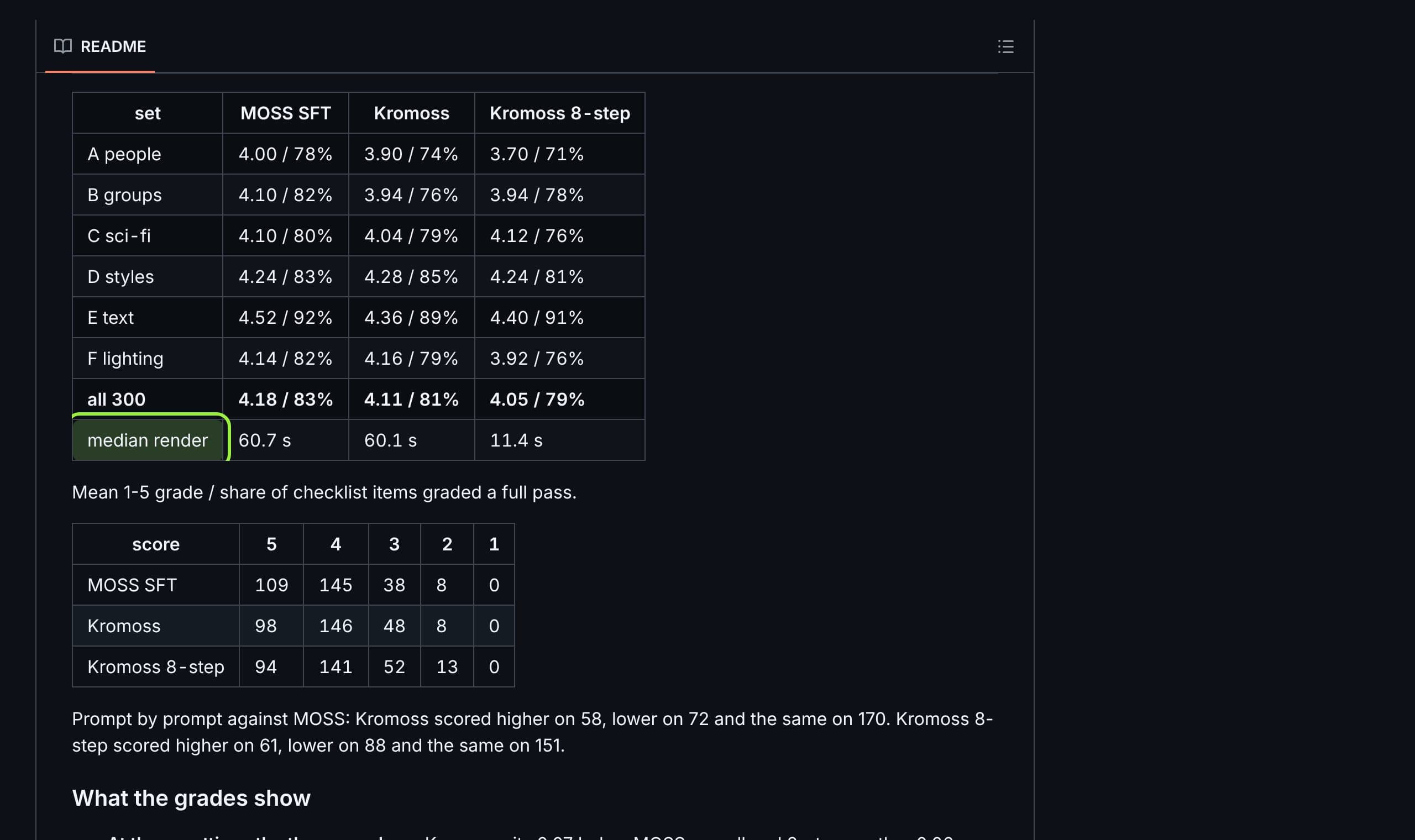
Two caveats from the author matter for you. Kromoss was run at about 2 megapixels and 25 steps to match SFT, not at its card's 50 steps and CFG 3, so "a run at the card's settings could rank differently." And the renders are dated October 18 for MOSS and October 19 for Kromoss, the day the repository went up; it has been updated since. The author's own summary: at these settings the three are close.
The checkpoint moved under the benchmarks
At launch, community coverage of the repo (ComfyUI Wiki) cited update 2000 for the CLIP numbers and update 9000 for the weights, with Kromoss at 26.88 on 100 PartiPrompts, below Base at 27.19. The model card today says update 11000 and lists Kromoss at 27.90 at 50 steps and 28.13 with the DMD2 LoRA at 8 steps. The repo was last modified on October 24.
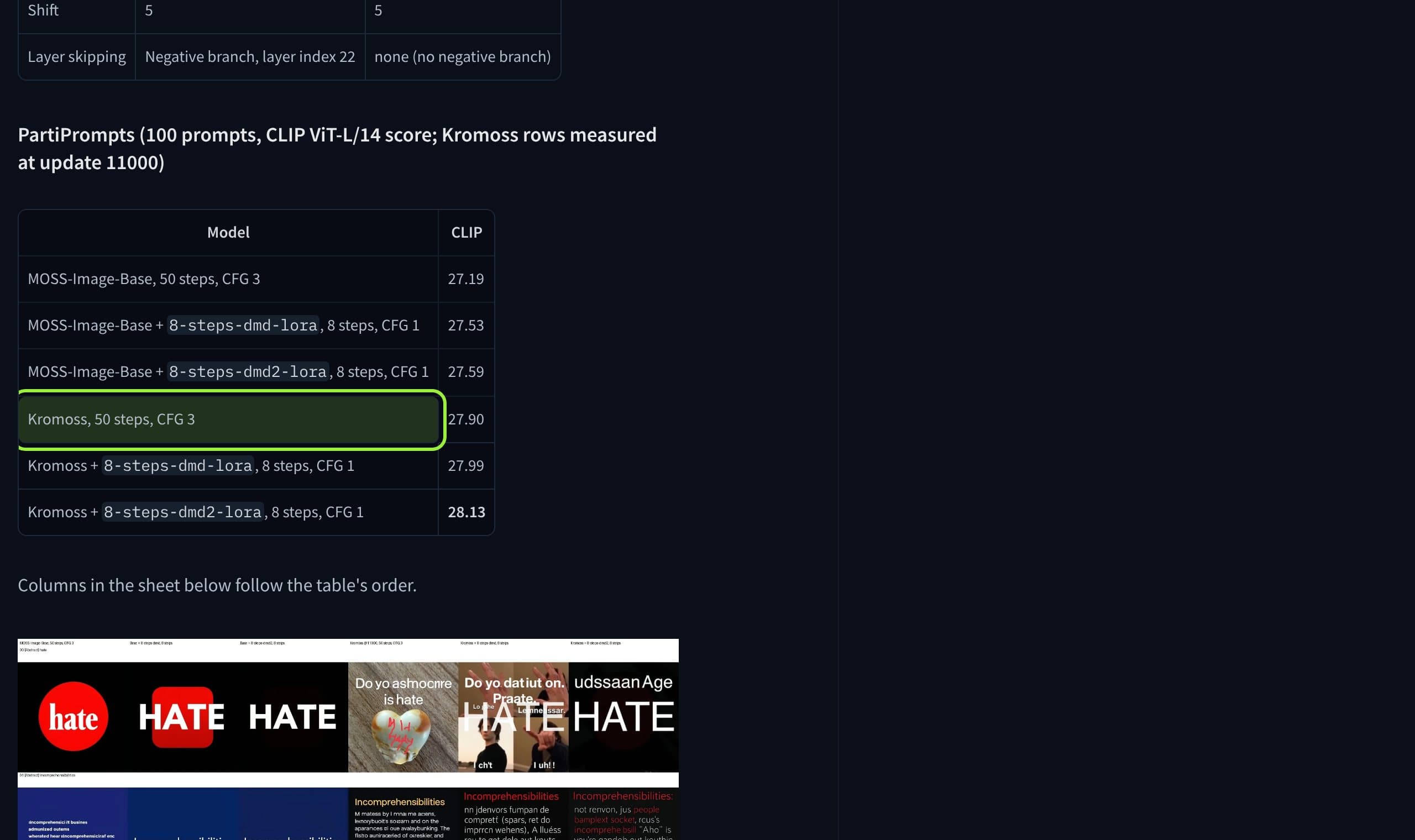
That is a bigger move than any gap in the table above, so treat every Kromoss number, including the eval's, as a snapshot of whichever checkpoint was live when it was taken. CLIP score measures how well an image matches its prompt text, not how sharp it is, and the card compares Kromoss with Base, not with SFT. Before you pull the file, check the update number on the card against the one you used last week.
The speed case: the LoRA is the product
Kromoss ships two LoRAs distilled from Base: 8-steps-dmd-lora (data-space DMD, 12,000 updates) and 8-steps-dmd2-lora (the same run continued for 3,000 updates with a GAN stage, which the card says has slightly more contrast and detail). Both are 1.19 GB, rank 128, and run at 8 steps and CFG 1 with no negative branch, so each step does one transformer pass instead of two. The card says to use one LoRA at a time and not to merge it into the bf16 weights, because the LoRA's changes are close to bf16's rounding step.
In the eval the DMD LoRA gave a 5.3 times faster median render for a drop of 0.06 grade points against plain Kromoss, with the weakest results on people (3.70) and lighting (3.92). For a character feed that is a trade to make deliberately: draft at 8 steps, then render the keepers at 50 steps and CFG 3. The same logic is in our note on distilled against base checkpoints.
Running Kromoss in ComfyUI
- 1
Update ComfyUI
The card says it needs current ComfyUI master; MOSS-Image support is in core, so no custom node is required.
- 2
Put the files in place
kromoss_bf16.safetensorsorkromoss_int8_convrot.safetensorsinmodels/diffusion_models,qwen3.5_9b_bf16.safetensorsinmodels/text_encoders,flux2-vae_small.safetensorsinmodels/vae, and the LoRA inmodels/loras. - 3
Swap, do not rebuild
kromoss_bf16replaces the SFT file in the Comfy-Org MOSS workflows, per the card. Load CLIP uses typemoss_image. - 4
Choose the speed
Full quality: 50 steps, CFG 3, shift 5. Fast: add the LoRA through LoraLoaderModelOnly at strength 1, euler with simple, 8 steps, CFG 1.
What creators are saying
One early user found the default output heavily blurred in every background and asked whether it was intended; the author replied that the checkpoint was still training and pointed to a newer upload.
A user already running the official fine-tune asked what Kromoss changes; a reply said anatomy, especially hands, is still a mess and the adult-content knowledge does not reach Chroma levels.
Someone asked for a Q4 GGUF for low-VRAM cards; replies said to use the int8 file with the w4a8 text encoder instead, and that ComfyUI handles the memory swapping.
A user reported an error on the int8 file and later traced it to the MOSS diffusion loader node, saying the default ComfyUI node worked for them.
Which one to run
- 1
MOSS-Image-SFT
The official, steady default: slightly ahead in the one 300-prompt grade, and its card has not changed under you.
Best for: Final renders of people, groups and text
- Led people, groups and text in the 300-prompt eval
- Official release with the same Apache-2.0 license
- Same 10.16 GB bf16 file as Kromoss
- About 60 s a render on the eval's RTX 5080
- No official 8-step LoRA; the Kromoss LoRAs were distilled from Base
- 2
Kromoss at 50 steps
A sibling that wins styles and lighting by a few hundredths and loses elsewhere; worth a test on your own prompts, not a switch on faith.
Best for: Style-led images and testing the sharpness claim yourself
- Top of the card's CLIP table at 50 steps, 27.90
- Drop-in for the SFT file in Comfy-Org workflows
- Checkpoint still being updated
- 0.07 below SFT overall in the eval
- 3
Kromoss with the 8-step LoRA
The practical pick for volume: five times faster for a small, measured loss.
Best for: Daily batches and drafts before a 50-step final
- 11.4 s median render in the eval
- 28.13 on the card's CLIP table with the DMD2 LoRA
- Weakest on people (3.70) and lighting (3.92) in the eval
- One LoRA at a time, never merged into bf16
Where Musetta fits
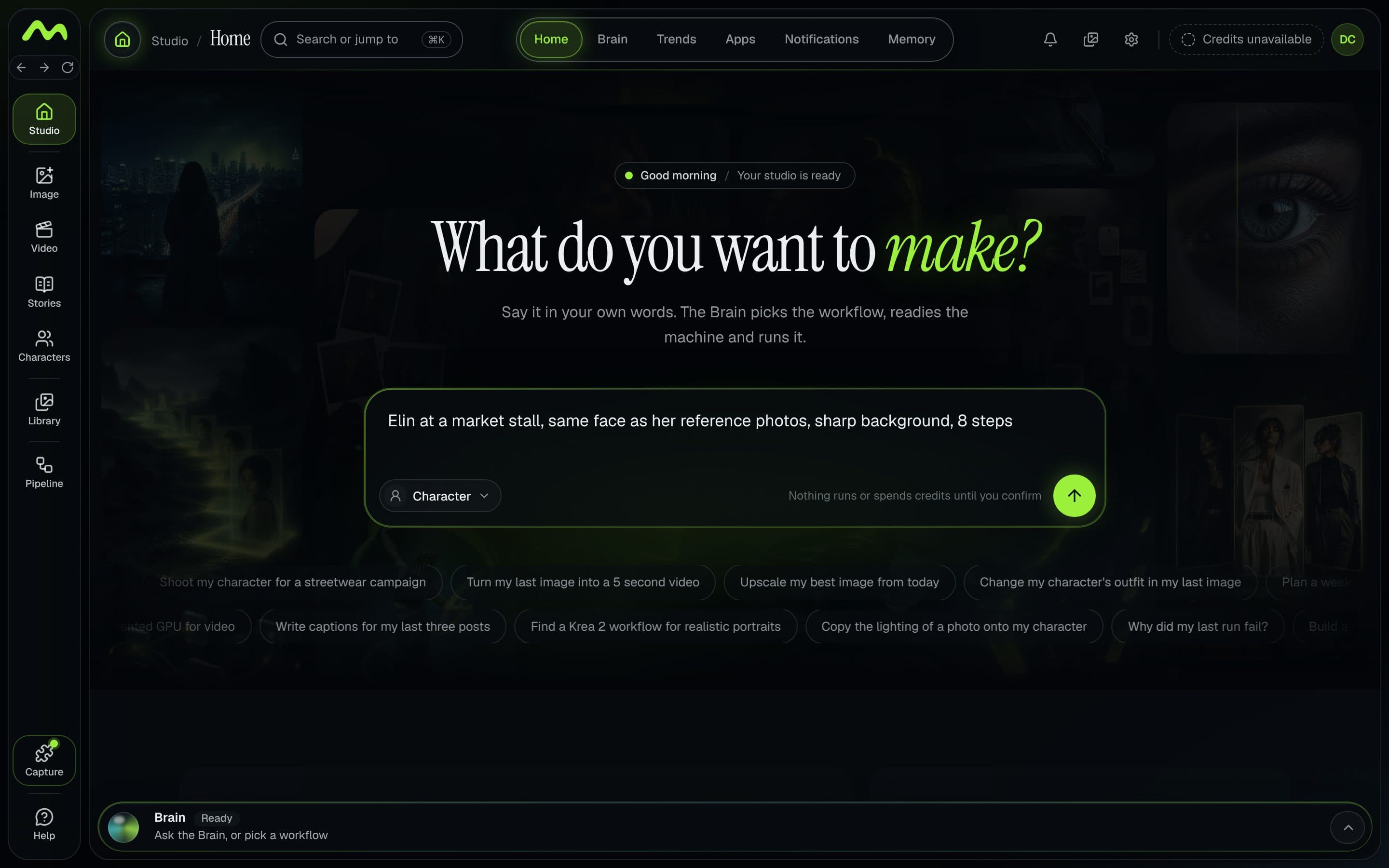
Musetta runs on your own ComfyUI, installs the nodes and models a workflow is missing, and keeps each character's reference photos, so trying Kromoss next to SFT is a test, not a rebuild. It does not make either model hold a face; for that, train a character LoRA and read our consistent character guide.
Questions
- Is Kromoss better than MOSS-Image-SFT?
- Not clearly. In a 300-prompt community eval with identical seeds, SFT scored 4.18 and Kromoss 4.11 out of 5, with Kromoss ahead on styles and lighting and behind on people, groups and text. The checkpoint has been updated since.
- Is Kromoss free for commercial use?
- Its Hugging Face card says the weights and bundled inference code are released under the Apache License 2.0, the same license as MOSS-Image-SFT. Read the LICENSE file in the repository before you rely on it.
- Can I use the Kromoss 8-step LoRA with MOSS-Image-SFT?
- The Kromoss card says both LoRAs were distilled from MOSS-Image-Base and transfer to Kromoss. It does not say whether they transfer to SFT, so test it before you rely on it.
- Does Kromoss keep the same face across images?
- Neither Kromoss nor SFT takes reference images, and we found no published face-similarity test. Train a character LoRA and test it against your own references.
Sources
- 01lodestones/Kromoss model card · lodestones, Hugging Face
- 02OpenMOSS-Team/MOSS-Image-SFT model card · OpenMOSS-Team, Hugging Face
- 03Comfy-Org/MOSS-Image repack · Comfy-Org, Hugging Face
- 04moss-kromoss-eval: SFT vs Kromoss, 300 prompts · jo-nike, GitHub
- 05Kromoss: a MOSS-Image full finetune shipped for ComfyUI · ComfyUI Wiki, 2026-10-19
- 06Kromoss discussions · Hugging Face
Researched and written by the Musetta editorial desk with AI assistance, from the sources above. Numbers come from those sources; nothing is benchmarked by us unless the article says so. Spotted an error? Tell us on Discord and we fix it.