In short
FLUX 3 Image Klein runs in ComfyUI with 16 steps at CFG 1 on the distilled checkpoint or 50 steps at CFG 3.5 on Base. The part most guides skip is the 9B prompt upsampler: Black Forest Labs says to always run it, and the launch-day complaints about mangled faces came largely from templates that did not. The full INT8 stack is 20.8 GB. Commercial use is free below USD 5 million of annual revenue.
Black Forest Labs released FLUX 3 Image Klein on October 15, 2026, and ComfyUI support merged the same day. If you run a character feed, the question is not whether it loads. It is which of two checkpoints to pick, which two numbers to set, and why a model that its maker ranks first among open weights produced mangled faces for many people in its first week. The short answer is a 9B helper model most templates hid.
How we read it: the official ComfyUI template files sit in a gated Hugging Face repository we could not open, so we did not read their JSON. Instead we read what is public: the vendor's documentation, the pull request that added the model to ComfyUI, the node source on the ComfyUI master branch, the repository's file listing, and the discussion threads where people reported what happened. We did not run the model on a GPU, so there are no timings or face scores of ours here. For the same exercise on a rival, see our Krea 2 Turbo workflow breakdown, and for the week it launched, our creator news round-up.
The verdict first
- Generate on the distilled checkpoint, train on Base. Distilled is 16 steps at CFG 1. Base is 50 steps at CFG 3.5 and is the one meant for fine-tuning. This is the same split we explain in distilled vs base checkpoints.
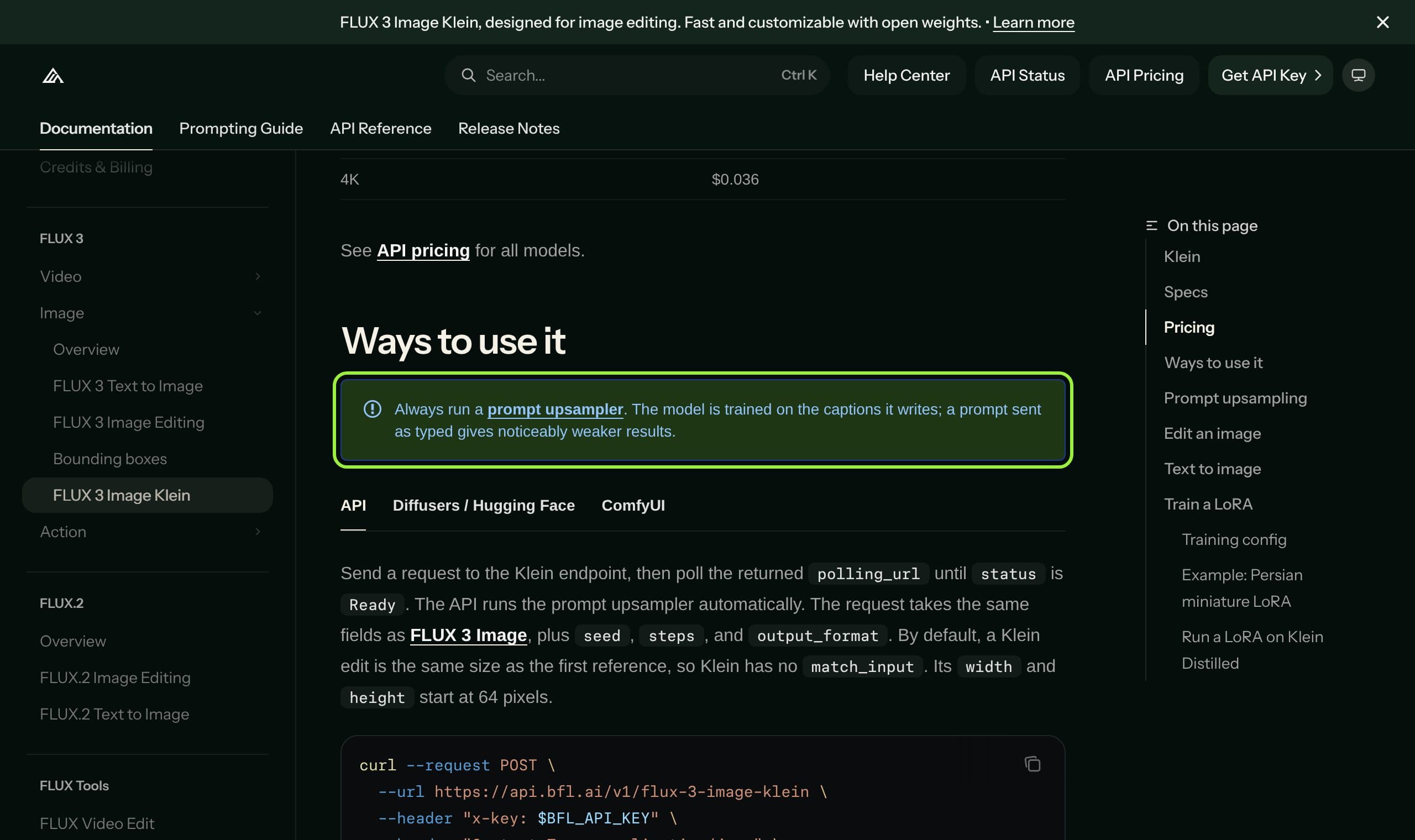
- Keep the prompt upsampler on. The vendor's own docs say the model is trained on the captions the upsampler writes, and that a prompt sent as typed gives noticeably weaker results. Budget the memory for it.
- Check the filename before you blame the model. Several people got poor images because they ran the Base file at CFG 1. The distilled files have no
basein the name. - Do not pick Klein for a face on the strength of the launch. Creators in the Hugging Face threads still reported weak faces and anatomy after the fixes. Test your character before you commit a feed to it.
- Mind the license. Commercial use is free only below USD 5 million of annual revenue; above that you need BFL's self-hosting terms or its API.
What you download, and what it weighs
The ComfyUI pack on Hugging Face lists three folders of files. Sizes below come from its file listing, read on November 10, 2026. The default path is a transformer, a Qwen3-VL 4B text encoder, the FLUX.2 VAE and, if you follow the vendor, the prompt upsampler. Added up, the INT8 stack with the INT8 upsampler is 20.8 GB, and the upsampler alone is 47 percent of that. The pattern matches our download size study: the language models cost more disk than the image model.
| File | Folder | Size | Role |
|---|---|---|---|
| flux3-image-klein-int8-convrot.safetensors | models/diffusion_models | 5.83 GB | Distilled transformer, INT8 (16 steps, CFG 1) |
| flux3-image-klein-base-int8-convrot.safetensors | models/diffusion_models | 5.81 GB | Base transformer, INT8 (50 steps, CFG 3.5), for training |
| qwen3vl_4b_int8_convrot.safetensors | models/text_encoders | 4.86 GB | Reads the prompt |
| qwen3.5_9b_flux3_prompt_upsampler_int8_convrot.safetensors | models/text_encoders | 9.75 GB | Rewrites your prompt into a full scene caption |
| qwen3.5_9b_flux3_prompt_upsampler_w4a8.safetensors | models/text_encoders | 6.72 GB | Smaller upsampler for tight memory |
| flux2-vae.safetensors | models/vae | 0.34 GB | Decodes the latent to pixels |
| flux3-image-klein-bf16.safetensors | models/diffusion_models | 11.10 GB | Distilled transformer at full precision |
| flux3-image-klein-nvfp4.safetensors | models/diffusion_models | 5.28 GB | Distilled, for RTX 50 cards; we did not test it |
FLUX 3 Image Klein at a glance
- Released
- October 15, 2026 (BFL announcement; ComfyUI pull request merged the same day)
- Size
- 5.6 billion parameters, generator only
- Distilled
- 16 steps, CFG 1, euler in the ComfyUI pull request; up to 4K
- Base
- 50 steps, CFG 3.5; for fine-tuning and LoRA training
- References
- Up to 10 reference images for editing and multi-reference generation
- Memory claim
- INT8 build on GPUs with as little as 8 GB of VRAM, per BFL (the Decoder and VentureBeat note it is not tied to an output size or speed)
- License
- FLUX Kommunity License, gated download with automatic approval
The graph in one picture
A reading of ComfyUI's node source and the vendor's docs, not of the template file. Optional nodes, such as the layout prompt and the reference-image method, are described below.
Node by node
- 1
Load the checkpoint, and read the filename
Pick the distilled file to generate and the
basefile to train on. The vendor's docs give the settings for each: distilled 16 steps at CFG 1, Base 50 steps at CFG 3.5. Mixing them up is the most reported mistake. One thread user got dramatically better pictures at more steps and CFG 3, and other users in the thread concluded that CFG 1 is wrong for Base. - 2
CLIPLoader with type flux3
The ComfyUI pull request added a
flux3option to the CLIP loader and wires the stock Qwen3-VL 4B encoder. Per the pull request, it concatenates hidden states of layers 4 to 32 into 20,480 channels and pads prompts to a multiple of 80 tokens. Ifflux3is missing from the list, your ComfyUI predates the release. Update it first, as in our missing nodes guide. - 3
The prompt upsampler
The 9B upsampler, published as
flux-3-image-klein-pup, rewrites a short request into a full scene caption. The docs say to always run it. The API runs it automatically, Diffusers runs it on every request, and the reference code runs it unless you pass--no-pup. The ComfyUI tab of the vendor's docs does not mention it, which is exactly the gap people fell into. - 4
Empty Flux 2 Latent
ComfyUI's node source builds the latent with 128 channels at one sixteenth of the width and height, in steps of 16 pixels, default 1024 by 1024. Use sizes that are multiples of 16, and read our 9:16 size guide for vertical reels.
- 5
Flux2Scheduler and the sampler
The scheduler takes steps, width and height and computes its sigma shift from the number of image tokens, which is width times height divided by 256. That is why the resolution you type into the scheduler must match the latent. The pull request names euler for the distilled path.
- 6
Reference images and the layout prompt
Editing takes up to 10 references. ComfyUI also has an experimental Flux KV Cache node for reference images and an Edit Model Reference Method node. A FLUX 3 Layout Prompt node, also experimental, appends bounding boxes to the prompt as a layout table, where you cite box N as
obj_N.
What went wrong at launch
Oct 15, 2026
Klein released; ComfyUI pull request 17064 merged the same day. The reviewer who merged it dismissed a change request with a note that the model had to ship.
Oct 15 to 16, 2026
A discussion on the ComfyUI pack asks whether the wrong weights were uploaded. A BFL staff member replies that the Comfy workflow has an error and that upsampling should be used all the time.
Later in the thread
The same thread gets a note from BFL that ComfyUI v0.41.2 ships much better templates, with the upsampler's impact stressed again.
Oct 18, 2026
A separate thread, titled around faces, collects reports of mangled eyes and faces.
The pattern is familiar from earlier releases: a template defaulted to a setting the model was not built for, and the first impression stuck. What is different here is that the vendor says in public that the upsampler is part of the model's quality, not an add-on. That also means a plain CLIPTextEncode with your hand-written prompt is not the intended path, which matters if you already write careful prompts.
That has a cost for a recurring character. The upsampler is a language model rewriting your words, the same worry we raised for Krea 2's rewriter. A face and outfit you described precisely can come back reworded. One user in the threads called the enhancer a joke for anyone who structures prompts well. We have not measured how often it changes a described face, so treat this as a risk to test, not a finding.
What creators are saying
Running the shipped text-to-image template at 16 steps and CFG 1, one tester got anatomy they called nonsense even with the prompt refiner on, and asked whether the wrong weights had been uploaded.
Another user on INT8 weights said the results were leaps above FLUX.2 Klein 9B and put the bad reports down to user error.
One user improved results with 8 steps and CFG 5, then learned they had loaded the Base checkpoint rather than the distilled one, which explains why a lower CFG had looked so bad.
Results get better at larger sizes, but the poster still found anatomy and small figures weak, and said the prompt enhancer ruins more prompts than it helps for people who already structure them.
A thread on faces collected reports of mangled eyes. Some posters guessed at a safety layer; nobody posted evidence for that, so we treat it as speculation.
Settings for a recurring character
For a face that has to stay the same across a feed, Klein offers two routes and the vendor documents both. Neither has been verified by us on a face.
BFL's LoRA recipe, from its docs
- Checkpoint to train
- Base
- Dataset
- 20 images, captions end with the trigger word
- Resolution
- About 1 MP, native aspect ratio
- Rank and alpha
- 32 and 32
- Optimizer
- AdamW, betas 0.9 and 0.95, learning rate 1e-4, 200 warmup steps, then constant
- Steps
- 4,000, checkpoint every 250; about 4.5 hours on one GPU
- Run it on distilled
- 16 steps, CFG 1, LoRA scale 0.75 (0.5 to 1.0 works)
The second route is references: up to 10 images in an edit, which suits a quick one-off but does not bake the face in. For a long feed, train the LoRA, as in our character LoRA guide, and read how to keep a consistent character before you decide. Our rule: test the face first on ten prompts with the upsampler on and off, and only then commit.
Who may use it for money
Klein ships under the FLUX Kommunity License. Per BFL and VentureBeat, individuals and companies with annual revenue under USD 5 million can use it commercially without a licensing payment; larger organizations need a separate arrangement for self-hosting, or BFL's API. VentureBeat adds that Klein's own download terms control for this release. The weights are gated on Hugging Face with automatic approval, so you accept terms before downloading. We are not lawyers and did not read the full license text, which sits behind that gate. Read it before you monetize an account.
The API is the cheap check. BFL lists USD 0.009 for a 1K image and 0.036 for 4K, with generation and editing costing the same, per VentureBeat. That is a way to test a face without a download.
How to run it with your own character
Musetta runs on your own ComfyUI, installs the nodes and models a workflow is missing, and keeps each character's reference photos next to the job. That is the part of this article it covers: getting the loaders and the files in place. Whether Klein suits your face is still a test you run.
Questions
- What settings does FLUX 3 Klein use in ComfyUI?
- The distilled checkpoint uses 16 steps at CFG 1 with euler, per the ComfyUI pull request. The Base checkpoint uses 50 steps at CFG 3.5, per BFL's documentation and the same pull request.
- Do I need the prompt upsampler for FLUX 3 Klein?
- BFL's docs say to always run it, because the model is trained on the captions the upsampler writes. It is a 9B model that adds 9.75 GB in INT8 or 6.72 GB in w4a8.
- Will FLUX 3 Klein run on 8 GB of VRAM?
- BFL says the INT8 build runs on GPUs with as little as 8 GB through ComfyUI or Diffusers. The claim is not tied to an image size or speed, and the upsampler has to be offloaded or shrunk.
- Which file is the distilled model?
- In the ComfyUI pack, the files with base in the name are the Base checkpoint. flux3-image-klein-int8-convrot is the distilled one, 5.83 GB. Base at CFG 1 gives poor results.
- Can I use FLUX 3 Klein commercially?
- Yes, free for individuals and companies with annual revenue under USD 5 million under the FLUX Kommunity License. Larger organizations need self-hosting terms or the API.
Sources
- 01FLUX 3 Image Klein: open weights, 5.6B parameters · Black Forest Labs, 2026-10-15
- 02FLUX 3 Image Klein documentation · Black Forest Labs
- 03flux-3-image-klein-comfy file listing · Black Forest Labs, Hugging Face
- 04Add FLUX.3 Image model support (pull request 17064) · ComfyUI, GitHub, 2026-10-15
- 05comfy_extras/nodes_flux.py · ComfyUI, GitHub
- 06Black Forest Labs opens FLUX 3 Image Klein weights, with free commercial use limited to smaller businesses · VentureBeat, 2026-10-15
- 07Did you upload the wrong weights? (discussion 7) · Hugging Face discussions
- 08Works way better with higher resolutions (discussion 22) · Hugging Face discussions
- 09Faces discussion 37 · Hugging Face discussions
Researched and written by the Musetta editorial desk with AI assistance, from the sources above. Numbers come from those sources; nothing is benchmarked by us unless the article says so. Spotted an error? Tell us on Discord and we fix it.